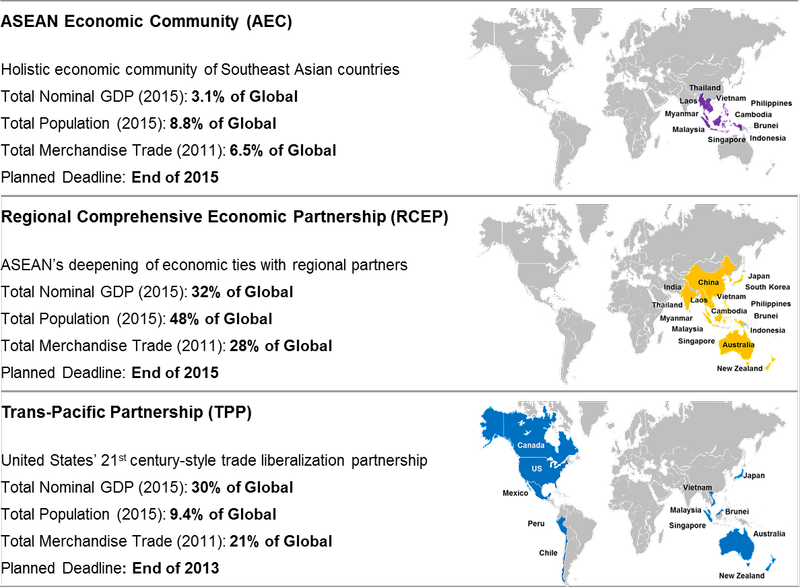
Free Trade Agreements have become the flavor du jour and Southeast Asia is not being left behind on that trend. The ASEAN countries are now involved in negotiations for two very different trade agreements: the Trans-Pacific Partnership (TPP) and the Regional Comprehensive Economic Partnership (RCEP) while continuing to pursue their own trade liberalization attempts through the ASEAN Economic Community (AEC). Below is an outline of the key components of the Free Trade Agreements and what MNCs can expect in 2014:
Key Insights for MNCs: Understanding the AEC vs. RCEP vs. TPP
ASEAN Economic Community (AEC)
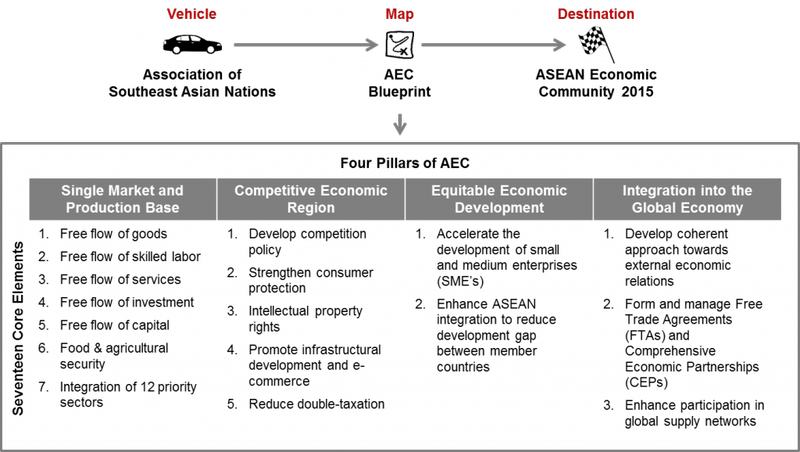
- AEC is not just about lowering tariffs; infrastructure improvements, better intellectual property rights protection, harmonized investment laws, and easier movement of capital and skilled labor are part of the agenda
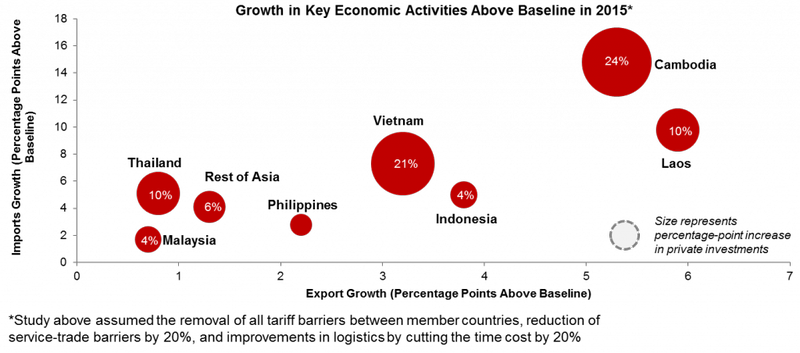
- All member states will gain economically from the AEC, and real income is expected to increase significantly. Overall, exports will outpace imports in the manufacturing sector, easing integration into global supply chains
- Growth is likely to be inequitable among member countries; companies should conduct in-depth studies to understand individual market dynamics
Regional Comprehensive Economic Partnership (RCEP)
- RCEP can be thought of as an extension of the AEC; it will deepen ASEAN’s relationship with its six FTA partners
- RCEP involves a lot of consolidation; it will build upon guidelines that already exist while working toward fixing the inconsistencies in regulations that exist, both with FTA partners and within the individual ASEAN countries
- RCEP is dealing with several trade harmonization issues and is therefore concentrating more on “border-based” matters
Trans-Pacific Partnership (TPP)
- While similar to the RCEP in pursuing trade harmonization, the TPP’s major difference is in its attempt to address issues that companies have to deal with once they want to set up an entity in a country. The TPP goes far beyond the “border-based” matters
- Proposed regulations in the TPP have a very high standard, but that is necessary, because it still has to go through several rounds of negotiations. Starting with lower standards might leave the final product at a subpar point
- Certain ASEAN countries might find the TPP appealing, because it would force them pass locally unpopular regulations that can benefit the country in the long run. Vietnam would have to reduce preferential treatment of its state-run-enterprises (SOEs). Participating in the TPP will be lot more complex than joining the RCEP. The TPP is not a group effort, but one where individual countries must decide if they have the political will to undertake the comprehensive domestic overhauls required for membership
What Should Multinationals Expect During 2014?
ASEAN Economic Community (AEC)
- The ugly truth is that the AEC 2015 is just the beginning, not an end; expecting all policy targets to have been met and support systems to be smoothly functioning by 2015 would be an unrealistic hope. Negotiations are likely to continue way beyond 2015 as the ASEAN area attempts to meet its original agenda of creating a political-security and socio-cultural community
Regional Comprehensive Economic Partnership (RCEP)
- RCEP has been designed to deepen the relationship between the ASEAN countries and its six regional partners. Subsidiaries of Western MNCs based within the ASEAN region are likely to benefit more directly. MNCs supplying to other MNCs or to Chinese, Japanese, and Korean companies would benefit from the lower trade barriers and improved logistics within the region
Trans-Pacific Partnership (TPP)
- While the TPP was planned for completion at the end of 2013, as a result of the US government shutdown and complexity of negotiations when Japan joined the group, the likelihood of completion might stretch beyond the end of 2014, closer to the next US presidential elections in 2016. US President Barack Obama will be working hard in 2014 to be given “Trade Promotion Authority” (TPA). Under TPA, Congress provides authorization to the president to negotiate trade agreements such as the TPP. The president can negotiate and conclude an agreement, but without TPA, Congress is free to amend the agreements during the approval and implementation process. Parties would be very reluctant to conclude a TPP deal if they thought the US Congress would be able to amend it