Venezuela: A Tale of Potential and Peril


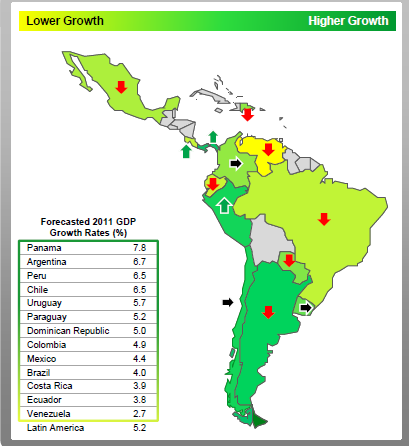
Venezuela presents a major challenge for MNCs who recognize the country’s market potential and high profit margins, but are troubled by the risks associated with any significant presence in the country. The upcoming elections in 2012 and recent concerns over Chavez’s health has renewed speculation over medium-term political and economic scenarios for Venezuela.

Advantages of Venezuela

Attractive demographics offer long-term prospects

  • 90% of Venezuelans live in cities and half of Venezuela’s 30 million people are under 25
  • GDP per capita is fifth highest in the region

Oil profits allow government to encourage domestic demand

  • Government maintains lending rate below inflation to encourage consumption

Business tax system is competitive with the region

  • Corporate and ordinary income tax rats are 34%
  • Attractive incentives such as non-taxable dividends for distribution of earnings and profit

Major Challenges

The operating environment is opaque and unpredictable

  • Little separation between executive, legislative, and judicial branches
  • Currency devaluation and expropriation are constant risks

Consumers behave differently than those in free market economies

  • Consumer spending is volatile as it is dictated by government spending policies
  • Price controls, inflation, and shortages alter consumer purchasing habits

Major structural challenges hinder growth prospects

  • Drought has led to shortages and rationing of electricity
  • Crime remains rampant, and a source of disillusionment with the Chavez regime
  • Oil production is rapidly declining

5 Risks to India’s Growth in Q4 2011


While the impact of Western volatility on Asian markets is cause for concern, this is just one force buffeting the Indian economy. Other risks to watch in Q4 and first half of 2012 are currency volatility, inflation, policy paralysis and farm output:

1) Western Recession

  • While India’s exports have withstood the global gloom so far, prolonged insecurity in Western markets could have a large impact on exports

2) Currency Volatility

  • The weak rupee may provide a short-term boost to exporters, but uncertainty around currency volatility will negate the benefits

3) Inflation

  • Inflation remains a consistent threat to business input costs, wage levels, and household consumption, as FSG observed in Q3

4) Policy Paralysis

  • This summer’s scandals halted business as usual in Parliament, and may continue to stall crucial policymaking on social and business issues

5) Poor Farm Output

  • Agriculture accounts for 17% of GDP and employs over 50% of the populace. A weak monsoon will hurt rural markets and heighten inflation

Russian ruble taps two-year low on Kremlin shift


From MarketWatch

The Russian ruble fell to a more than two-year low versus the U.S. dollar Monday, under pressure after the nation’s Finance Minister Alexei Kudrin resigned over a policy dispute with President Dmitry Medvedev.

Kudrin resigned Monday as Russia’s finance minister and deputy prime minister, citing differences with the president on economic policies, the state-run RIA-Novosti reported.

Putin to return as Russian president

WSJ’s Richard Boudreax looks a how Vladimir Putin’s return as Russian president could hamper U.S. efforts to advance arms-control and trade agreements.

Some investors had seen Kudrin as a guarantor of the country’s financial stability, the news agency said.

“It is difficult to see how Mr. Kudrin’s resignation can be anything but market-negative,” said Neil Shearing, chief emerging market economist at Capital Economics, in a note to clients.

The ruble weakened following the news, with one U.S. dollar (ICAPC:USDRUB) buying 32.48 rubles, up 1.5% from Friday. It traded as high as 32.55 rubles earlier, a more than two-year high for the dollar, according to data on FactSet Research, which tracks closing levels.

Medvedev on Saturday endorsed Vladimir Putin’s return as president. Kudrin has reportedly refused to join Medvedev’s government should Putin become the new president after elections in March and appoint Medvedev as prime minister.

“For all Mr. Medvedev’s warm words on the need to progress market reforms, Mr. Kudrin has arguably been more influential in rebuilding Russia’s balance sheet from the ashes of the 1998 ruble crisis,” said Shearing.

And “with oil prices starting to slide and financial markets still jittery, now is not a good time for the government to lose its arch-fiscal hawk and one of its most influential liberal voices,” he said. “It is unlikely that Mr. Kudrin’s replacement will share his predecessor’s credentials and clout.”

Ruble, equities risks

For now, the Russian markets will likely take their cue from events in the global economy and the outlook for commodity prices in particular, Shearing said.

And the risks to the ruble and Russian equities “lie firmly on the downside,” given Capital Economics’s view that the euro-zone crisis is likely to deepen, Group of Seven growth will grind to a halt in 2012 and oil prices will fall further, he said. Crude-oil futures prices (NMN:CL1X) have fallen by around 15% year to date.

Matt Lasov, director of global research at Frontier Strategy Group, said the negative impact on Russia’s market from Kudrin’s resignation won’t be enough to change market fundamentals.

But “Russia will still struggle with an over-reliance on oil in an environment where European demand is set to drop, impacting Russia’s revenues and growth trajectory,” he said.

It wasn’t clear if news of Kudrin’s resignation came before or after the stock market’s trading session ended. The ruble-denominated Micex stock index closed 1.5% higher on Monday at 1,346.86 points, according to the Micex Group’s Web site. Year to date, the index is down 20%.

At Moscow’s other stock exchange, the dollar-denominated RTS stock index (RTG:RU:RTS) fell 0.1% to finish at 1,315.25 points. Competition authorities earlier this month approved merger plans for RTS and the Micex Group.


Indonesia’s Workers Demand Higher Wages


Indonesia’s increased demand for workers calls for creative solutions and higher salaries. There is a limited pool of skilled workers in Indonesia, especially for positions that require English language proficiency or technological skill. Liberalizing investment policies and increasing FDI will continue to put pressure on the pools of both skilled and unskilled workers. MNCs are struggling to retain the talent that will be key to long-term growth in Indonesia.

In Frontier Strategy Group’s view:

  • MNCs need to launch rigorous training programs for both skilled and unskilled employees. Partnerships with local universities, trade schools, and government institutions should be set up to build a pipeline of qualified new hires.
  • Creative incentive packages are the key drivers of talent retention. Selected examples FSG has observed include co-signing of car loans or mortgages and provision of scholarships for children study at foreign universities.
  • MNCs fearful of wage increases in China who are looking to relocate operations to South East Asia need to consider the long-term implications of high demand for skilled and unskilled workers in Indonesia.


What drives private consumption in Russia?


The World Bank’s latest report on the Russian economy made headlines because of the Bank’s revision of its 2011 GDP growth forecast for Russia to 4%, down from 4.4%. However, a less conspicuous piece of analysis in the World Bank’s report carries particular importance for MNCs operating in Russia.

World Bank economists ran an analysis of the drivers behind consumer spending in Russia. The three most important factors were, not surprisingly, the level of economic activity, the external environment (price of oil, etc.) and labor market conditions.

The interesting discovery was in the effect of labor market conditions on consumption in Russia. The Bank’s estimates show that the level of unemployment has a strong negative impact on consumption, while short-term fluctuations in incomes do not translate into significant changes in consumption. For every 1% rise in the unemployment rate in Russia, private consumption falls by 2%, according to the Bank’s model.

The real-life logic behind this is that Russian businesses adjust to negative shocks mostly by lowering salaries, rather than firing employees. As a result, Russians have adjusted their consumption patterns to reflect more volatile wages, mostly seen as a temporary condition. Unemployment, on the other hand, is perceived as a much more permanent state, and directly affects Russian consumers’ choices.

The good news here is that the unemployment rate in Russia has been on a largely downward trajectory and was relatively low at 6.5% in July, a slight increase from June’s 6.1%. Coupled with a strong ruble, and a rise in consumer credit, MNCs can expect this trend to support a strong performance in Russia through the rest of 2011.


Middle Management’s Role in Strategic Planning


In recent posts, we’ve taken a look at two critical questions senior executives need to be asking themselves as they undertake the strategic planning process in emerging markets. First, we questioned whether the planning process may be too reliant on faulty assumptions or incomplete data. Second, we challenged the traditional industry-specific and insular planning processes that fail to take into account the rapidly changing external market and macro environment. Today, we wrap up this series of posts by posing a third critical question: Are mid- and lower-level managers placing enough priority on strategic planning, and am I doing enough to improve their planning capabilities?

Senior emerging markets executives are likely managing a very different team than just a few years ago. Companies have sharply reduced the percentage of expatriate managers in their emerging markets organizations and shifted more decision-making to local teams. A recent survey of Frontier Strategy Group’s clients indicated that more than one in ten of their mid-level managers were expats two years ago. Two years from now, our clients expect this number to be reduced by one third. The same survey data has also shown us that decentralizing decision-making around setting prices, developing marketing strategies, and managing human resources is highly correlated with more rapid growth. However, decentralization and local empowerment can come at the cost of so-called “corporate DNA” and can loosen ties between front-line management and corporate or regional headquarters.

For senior emerging markets executives, the strategic planning process presents an opportunity to leverage the front-line teams’ local knowledge for strategic advantage in the market, but it also requires executives to spend more time and energy ensuring that local teams are bought into and aligned with the strategy. The challenge, of course, is that time and resources are precious commodities, and asking the team to spend more time on planning could be interpreted as asking them to spend less time on execution.

Many companies have therefore looked to external consultants as a way to lighten the load. Unfortunately, FSG’s clients report mixed results at best after spending hundreds of thousands of dollars to outsource strategic planning to well-respected consultancies. At the conclusion of these engagements, executives inevitably recognize that they cannot outsource areas of their own teams’ core competencies, such as deep knowledge of customers, products, and markets. These executives have told FSG that external consultants add the most value when they provide the methodology and rigor necessary to ensure that the team is spending its time in the most efficient and effective way possible to bring these competencies to bear.

Consultants can also play an instrumental role in ensuring that individuals and planning committees are being held accountable for hitting key delivery milestones. One company that FSG works with in the consumer healthcare space used an external consultant to help define the framework for the strategic planning process, but then to ensure that its internal teams were following through on execution, the company built milestone-based KPIs into the incentive structure for managers, thus ensuring that managers felt personally accountability for executing on the plan. One aspect of the planning framework is an 18-month rolling planning cycle. Compensation is tied to setting and achieving milestones in the 12-month time horizon, and the remaining 6-months of the 18-month time horizon are intended to allow for a more strategic and forward looking perspective.

In summary, strategy and execution are not mutually exclusive.

A common view among executives is that time spent on planning is time taken away from execution. What we have seen among the most successful companies stands in stark contrast to this view: leading companies have demonstrated that prioritizing strategic planning results in superior execution in emerging markets. Leveraging the perspective of front-line teams, overcoming the scarcity of hard data, securing buy-in and alignment from organizational stakeholders, and holding individuals accountable for delivery are hallmarks of a successful strategic planning process and directly translate into improved results.


Impact of potential slowdown in Latin America less than 2008


Fear over a stalling global economy stalks the region as volatility returns to the local bolsas. Frontier Strategy Group expects the overall impact of a slowdown to be smaller than in 2008 as Latin America has grown less reliant on global trade flows than other regions. Mexico has the most to fear, given its dependence on the US economy, while Brazil and Colombia could actually benefit from a currency depreciating financial flight to quality.

Brazil’s Next Frontier - What Keeps LATAM Executives Awake at Night?


Brazil’s shock interest rate cut may have raised concerns about impending inflation; however, senior executives continue to view Brazil as a tremendous opportunity for their businesses.

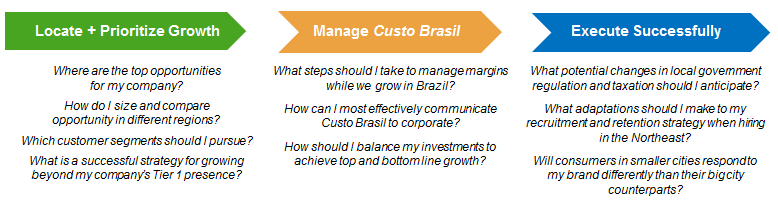
The opaque operating environment leaves executives asking the questions such as:

Senior executives are executing on aggressive growth targets

60% of our clients face growth targets in Brazil above 20% for 2011

…With more hurdles to success on the ground…

Brazil’s ranking in the 2011 Ease of Doing Business Index is 127, indicative of “Custo Brasil”, or the high cost of operating in the country

… And limited insight on where they should invest

There are 27 states in Brazil, and yet most MNCs have yet to expand beyond São Paulo and Rio de Janeiro

Executives are under pressure to justify and mitigate thin margins and long payback periods to impatient corporate centers. Brazil’s business environment is high cost compared to regional standards, due to cost of labor, regulation, taxation, and infrastructure.

Executives struggle to understand their true market opportunity and create a strategic plan for expansion because Brazil’s growth is increasingly found in regions that are largely unknown by multinationals and in customer and industries segments with few reliable data sources.

To fill this void, Frontier Strategy Group is launching Fronteiras Brasileiras, a comprehensive solution designed to support senior executives at Western MNCs to prioritize, manage and execute on growth opportunities in Brazil.

Monitoring the Global Economic Recovery


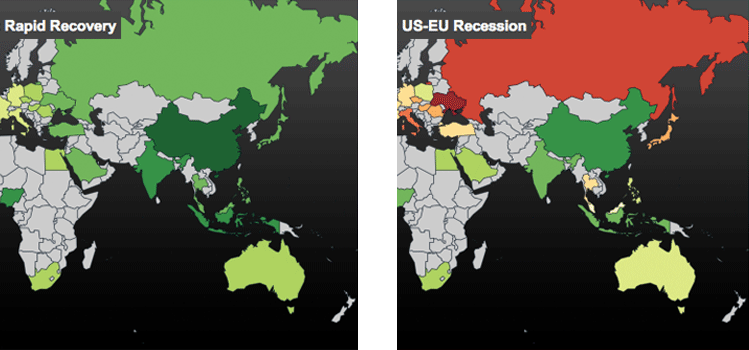
In a stable year, Q3 is a time MNCs use to adjust strategic plans and finalize budgets for 2012. However, 2011 is not a stable year. Volatility in the global economy has generated significant uncertainty in all planning processes. GDP growth projections for 2012 in Argentina range from 1.2% to 6.5%. For Russia, executives are making decisions based on GDP forecasts that range from -8% to 5.4%. These figures are critical to budget allocation, target setting, and strategic planning for 2012, and will continue to fluctuate in the coming weeks and months.

It will be increasingly difficult for MNCs such as Apple (Nasdaq: APPL) and General Electric (NYSE: GE) that have large exposures to volatile markets to manage through various scenarios. Through working with over 200 of the world’s most progressive multinational firms, Frontier Strategy Group understands what matters most to executives operating in emerging markets. In response to the economic slowdown Frontier Strategy Group launched FSG Monitor, and online resource for senior executives around the world to track the impact of the economic slowdown on their business performance in real-time.

For a limited time, FSG Monitor is available to the public, for anyone to access and view our proprietary intelligence platform.

Click on this link to view FSG Monitor yourself, or contact us for additional information.

Scenario Planning for Emerging Markets


In my previous post on the topic of strategic planning, we took a closer look at the personal and professional risks that executives face through the strategic planning process. In this post, we will focus on another thorny question: Is my strategic planning process putting the business at risk of being blindsided by unforeseen external events and volatility?

The 2008 economic crisis demonstrated that today’s seemingly safe bets can take a sudden turn for the worse tomorrow. Today, the headlines are again dominated by dark clouds. Monetary crises, commodity bubbles, political instability, labor unrest, and even armed conflict dominate today’s headlines. Furthermore, many executives have learned the hard way that crises hundreds or thousands of miles away can have a very real impact in their markets.

Until crystal ball technology improves, you have no choice but to plan for the worst and hope for the best in the markets that you oversee. Executives at many companies are blindsided by macro shocks when they become overly focused on internal data and industry/competitor analysis. Your strategic plan needs to lay out the foreseeable scenarios, key signposts, and leading indicators to monitor, and develop contingency plans accordingly.

One of FSG’s clients in the beverage industry has tried to shake its management of myopia by requesting rigorous analysis of the external variables that could impact the company’s market. The findings of the resulting analytical exercise are used to develop a white paper that is presented to the business unit presidents every March, before the strategic plans for the following year are developed.

Such an exercise requires an investment of time and resources, but the benefits are twofold. First, the strategic plan will more accurately reflect the reality of the markets. Second, even if the scenarios developed in the white paper never unfold or if unforeseen events override contingency planning, the exercise forces managers to think more strategically, to get involved in the planning process, and thereby become personally and financially invested in the final plan.

In my next post, we’ll look at one more critical question every senior executive needs to be asking as they undertake strategic planning for 2012: Are mid- and lower-level managers placing enough priority on strategic planning, and am I doing enough to improve their planning capabilities?

« Previous PageNext Page »