Overcoming The Data Challenge in Strategic Planning For Emerging Markets

To pick a timely analogy, let’s use the Olympic Games as a backdrop for understanding how difficult strategic planning tends to be for emerging market executives. Competing in a hypothetical Olympic archery duel is one executive from a developed market, and one executive from an emerging market. The goal of the contest (as usual) is to precisely and accurately hit the target. Rather than laminated plastic foam, their target is business growth.

Armed with years of practice and experience (historical performance data), and the best equipment money can buy (robust and high quality market data), the developed market executive is able to hit his target a majority of the time. Repetition and knowledge of his sport has made him a master at predicting his performance.

On the other hand, you have the emerging market executive. Given almost no time to prepare (little to zero historical data), a bow and arrow fashioned from a dying oak tree (poor market data), and essentially spun around while blindfolded and told to shoot…how do you think you would do? This is the situation many emerging markets executives face while attempting to harness data in their strategic planning process.

When data is unavailable, strategic planners have to rely considerably on estimates and assumptions.

Emerging markets often have limited granular market data sources, making analysis for potential market share, growth, and opportunity extremely problematic. Even data that is available may be outdated or inaccurate, increasing uncertainty.

In response to this problem, FSG has recently compiled a set of core principles and best-practice strategies executives can use to mitigate the challenge of data availability and quality, based on the key abilities of being able to effectively quantify and compare opportunities in the planning stage, and efficiently check assumptions on a periodic basis during plan implementation. One of the core insights is that while desired data may not be readily available, there are ways to equip your team to collect proxy data which is directionally helpful and far better than shooting blind. With these tactics at their disposal, we anticipate our clients will feel they are able to take off their blindfolds and improve the accuracy and precision of their strategic planning process, despite the persistent challenge of playing what is essentially a different game than planning in developed markets.

Argentina Consumer Crisis Redux: Lessons from History to Inform Investment Today

Argentina Consumer

While Argentina may be doomed to ignore the lessons of history and again plunge into recession or even economic free fall, investors are not obliged to follow blindly. For investors focused on the consumer products segment, previous crises offer ample clues to how consumers may behave in future crisis. Understanding these clues will be critical to crafting an effective strategy for mitigating risk and capturing opportunity in the consumer space should Argentina again march over the precipice.

Frontier Strategy Group works primarily with large multinationals operating and expanding in emerging markets. In an effort to inform strategy for clients with exposure to the consumer segment in Argentina, Frontier Strategy Group shared insights gleaned from experts and leading executives who weathered the past two crises in the country, namely the hyperinflation of the 1980s and the 2001 debt default and ensuing chaos. While the macroeconomic imbalances that precipitated those crises are different than those driving the country towards recession now, the conditions they produced for the average Argentine consumer could be similar: loss of purchasing power, evaporation of savings, inflation, shortages of goods, and unemployment.

Faced with these conditions in past crises, Argentine consumers responded with dramatic purchasing changes, as well as lifestyle alterations, and increased reliance on community. Practically speaking, this meant consumers reduced consumption of food and non-food consumer staples, substituted regular brands for cheaper alternatives, switched to cheaper transportation options, and were forced to prioritize between food and non-food consumer staples and other essentials such as medicines. Some significant lifestyle observed were consumers moving back from big cities to rural areas, home production of food, selling belongings, living off savings, and sharing housing and resources with many more members of family and community.

To continuing reading the full version, click here

Nigeria: Higher Electricity and Fuel Prices Increase Operational Costs

Nigeria

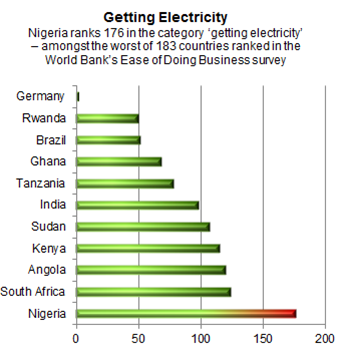
Getting electricity in Nigeria can be very difficult. The World Bank ranks the country 176 out of 183 as one of the worst places in the world to get electricity. Electricity supply is unreliable and power outages are frequent numbering more than 320 days per year.

As a result, businesses largely generate their own power from diesel generators which run on fuel. Both the outages and the generators increase operational costs as blackouts harm machinery while the cost of generators, including maintenance, fuel, and its transport, is high.

Already in January, with the reduction of fuel subsidies, the cost of fuel increased 50%. But now, businesses will again be hit by higher operational costs as the government increased electricity tariffs on June 1. Large businesses will see their electricity bills increase up to 50%, depending on geographic location.

Consumers are also impacted by the new tariffs as they will face higher prices as increased production costs are passed down. Coupled with the reduction of the fuel subsidy in January, this will cause consumer purchasing power to decline further, forcing consumers to be more cautious with discretionary purchases.

Electricity prices will continue to rise, with new price increases planned for early 2013. The prices of both, electricity and fuel, are distorted by government subsidies. The subsidies are likely to be further reduced in the short-term and removed altogether in the medium-to-long term.

The reductions of subsidies are part of the government’s plans to attract private investors to the power sector. If successful, this could benefit businesses operating in Nigeria as market-rate prices will allow private competition to enter, ultimately increasing the consistency of energy supply and bringing down prices as the market matures.

Regional Insecurity in Northern and Central Nigeria Impacts Local Operations

Africa

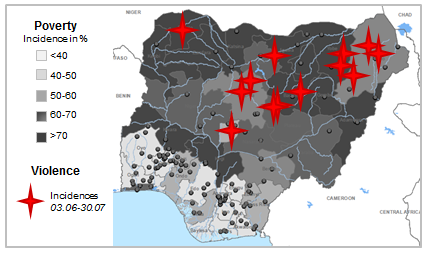
While Nigeria remains one of the most attractive long-term investment destinations in Sub-Saharan Africa, companies operating in the northern and central regions are facing operational risks resulting from increasing insecurity and revenue losses as consumers are staying at home.

Contrary to mainstream media coverage; the frequent attacks in northern and central Nigeria cannot only be linked to Islamist Group Boko Haram. The escalation of violence is born out of socio-economic grievances and longstanding tribal, ethnic, and religious animosities.

While the south is experiencing an economic boom, the northern and central areas are not. Instead they are struggling with staggering poverty levels of 60-70+%. Attacks have so far mainly targeted government officials and churches – both representatives of the wealthy south.

As violence increases, businesses divert investments southwards contributing to economic decline in northern and central Nigeria. However, companies that maintain a presence in affected regions can increase customer loyalty and gain market share by highlighting their commitment through tough times. Having a contingency plan allows companies operating in the area to manage risks and seize any opportunities as they materialize.

Some companies already see investment opportunities in affected areas. Considering the risk level relatively low compared to other dangerous areas such as the Niger Delta, Dufil Prima Foods, part of the Singapore-based Tolaram Group, recently opened a manufacturing site in the northern city of Kanu to save on transportation and distribution costs. South African telecoms provider MTN is also making major investments in radio and transmission to increase its capacity and offer improved services to customers.

Rising Trends for Q3 in Mexico

Mexico stepped into the spotlight in Q3 of 2012 as multinational executives began to shift their operations and increase their investments into Mexico. Reignited interest into Mexico has been largely driven by higher labor costs in China and expectations that the presidential-elect and business friendly Enrique Peña Nieto will implement structural reforms aimed at boosting long-term economic growth. A common trend in Q3 was the growing interest for companies pursuing SME customers as larger client markets became increasingly saturated. However, limited financing opportunities for SMEs is preventing multinationals from achieving additional growth. SME lending is mainly restricted by three main inhibitors: weak regulatory systems, poorly trained state development funds unable to assess credit risk, and overwhelming control of the banking sector by large foreign commercial banks in Mexico.

Multinationals may consider applying a best practices approach to SME financing. Sun Microsystems applies a credit assessment technique in another emerging market by using a quantitative and qualitative approach in order to determine credit worthiness for a potential SME client. In an attempt to assuage the multinational and lender concerns for SME financing, the Mexican government is considering an institutional reform creating a centralized development bank that will function as a main source of financing for underserved markets in Mexico. Public-private partnerships have served as an approach by commercial lenders to expand their portfolios to include SMEs as lenders provide credit lines to SMEs by partnering with a government agency that provides loan guarantees.

Antonio Martinez and Erick Soto contributed to this piece


Exporters Beware – Potential Impact of a Double-Dip Recession

Crisis GDP

As the Eurozone teeters on the precipice of financial disaster, the global economy lies in wait. Emerging markets countries in particular are acutely aware that the implications of a further slowdown in Europe could have paralyzing macroeconomic effects. The most recent crisis in 2008 put a spotlight on export-dependent countries as the reduction in global trade led to drastic levels of economic contraction.

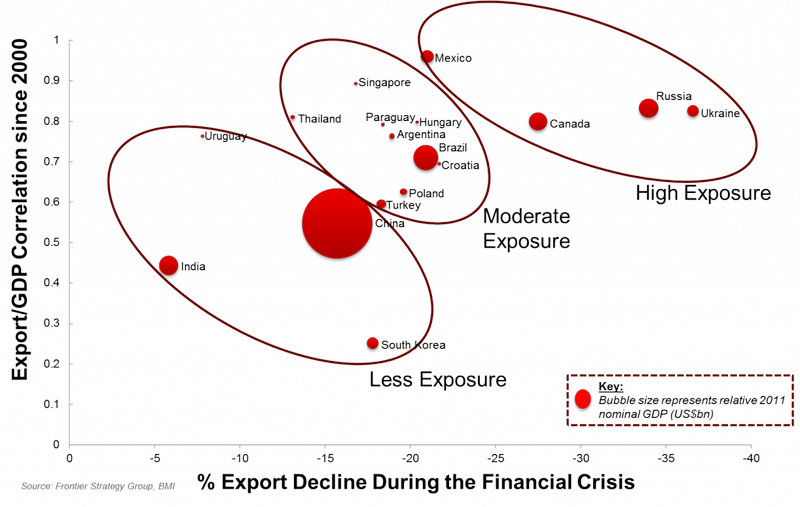
In preparing for a potential double-dip recession, it is important to recognize which countries are most susceptible to another wave of declining global consumption. By analyzing the overall correlation between countries’ GDP and export growth since 2000, as well as the % decline in exports during the 2008 recession, we were able to create a framework for gauging country risk exposure. What we found is that countries generally fall into one of three buckets in terms of exposure, depending on the overall historical relation of export growth to GDP growth and quantity of export decline in 2008.

Some of the results may be intuitive, as geographic proximity would dictate increased levels of trade and reliance on the general economic health of the Eurozone (e.g. Russia, Ukraine).

However, some results may not be as obvious. Even though Latin America is generally viewed as well insulated and a relative safe haven for growth-seekers, Mexico’s extreme GDP and export contraction during the last financial crisis should be a cause for concern. While Mexico is now much more prepared to pursue counter-cyclical policies and in an improved competitive position on the global scale, a sharp decline in global demand could leave the economy reeling.

FSG uses this framework as one of many lenses for understanding the potential consequences of a double-dip recession. Nonetheless, it is vital to incorporate the socio-political and macroeconomic developments to more accurately depict the possible results of another crisis. Nobody has the perfect crystal ball for predicting the future, but with the right analysis, it is possible to make the crystal less opaque.

Multinationals Reevaluating Growth Targets in Latin America

Weaker regional growth in the first half of the year has driven multinationals to reevaluate their growth targets for 2012 as Argentina’s business landscape grows increasingly unnerving, Brazil’s economy slows, and devaluation risks in Venezuela swell as President Chavez drives up fiscal spending as part of his reelection campaign. However, many regional executives are looking towards new opportunities in Mexico as higher labor costs in China and election of business friendly Enrique Peña Nieto leads executives to believe the new administration will be able to implement structural reforms aimed at boosting higher and sustainable long-term economic growth. Meanwhile, many multinationals are undeterred by the weaker first half growth as they continue to invest in Brazil, hoping that government stimulus measures to revive consumer spending and industrial production in Brazil in the second half of 2012.

Argentina: Multinationals are dealing with an increasingly dire business environment by decreasing investments and lowering growth expectations

Brazil: Foreign investors shake off short-term woes as some multinationals position themselves for the long-term rewards that Brazil offers

Chile: The forecast is upbeat as production, consumption, and high consumer sentiment all point to a favorable economic outlook for 2012

Colombia: Colombia’s economy will continue to be a growth leader in 2012, but sluggish retail and falling industrial production dim its prospects

Mexico: Multinationals remain bullish on Mexico’s growth prospects as a new administration offers hope for necessary structural reforms

Venezuela: Multinationals remain cautious as ballooning fiscal spending contributes to rising currency devaluation risks for the beginning of 2013

Antonio Martinez and Erick Soto contributed to this piece.

Distribution Best Practices for Penetrating the Indian Rural Market

Infrastructure is the top barrier for multinationals in rural India

  • The slow rate of reform and the country’s vastness means that companies wanting a share of this high-growth market need to employ cost-effective and innovative supply chain techniques
  • A recent survey revealed that ‘inadequate infrastructure’ is the number one barrier for multinationals in terms of expanding into India’s growing rural market
  • Moreover, it was also found that respondents believe that ‘supply chain and distribution efficiency’ are the key imperatives for profitable and sustainable growth in Indian rural markets
  • Road construction and electrification are rapidly increasing in rural India, but these projects are often slowed due to high amounts of corruption and bureaucracy

FSG View: Multi-Layered Distribution Channel Network Ideal for Penetrating the Indian Rural Market

  • Multinationals need to create a network of trusted distributors in order to reach the nooks and corners of a highly scattered rural setting
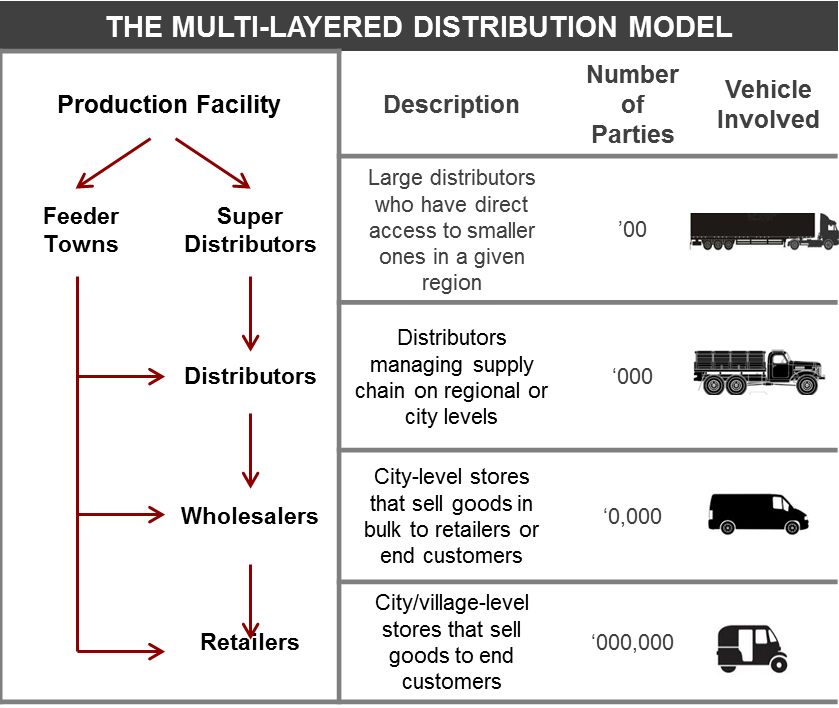
  • Companies cannot use the conventional distribution model used in urban settings, by which products go from the factory to retailers or wholesalers. The model is obsolete due to the vastness of the country and the 638,000 villages scattered across it
  • In order to reach the smaller villages while keeping costs low, companies need to use a series of large local distributors who in turn have access to the smaller distributors and wholesalers (see graphic for explanation)
  • They should expect to monitor a complex system that involves multiple transactions and a large number of stakeholders

India Distribution