Emerging Market View: What Our Analysts Are Reading – 3/29/2013

FSG’s research talent keeps a close eye on not only worldwide headlines, but also region-specific news for more locally-driven insight. Here are a few articles highlighted by our research team:

Is Africa much richer than we think? No one knows - CNN

“This article is very timely as Nigeria is about to rebase its GDP this year which is likely to make the country into the biggest economy in Sub-Saharan Africa, surpassing South Africa. Many countries are expected to follow suit. This means that the continent could in fact be much richer than we think. MNCs should invest now to get ahead of the curve.”
- Anna Rosenberg, Senior Analyst for Sub-Saharan Africa Research


House deal see Agus named BI govenor - The Jakarta Post

“While Agus’ approval as the BI’s new governor may prove positive for Indonesia’s monetary policy, it is not a good sign for the country’s fiscal policy. This is the second time that a reform-minded finance minister has been pushed out in less than three years. If Agus’ replacement does not have his predecessors’ penchant for reform, it will bode ill for the future of Indonesia’s economy.”
- Adam Jarczyk, Associate Practice Leader for Asia Pacific Research


Argentina extends price controls for 60 days (Reuters, article in Spanish)

“As FSG predicted, price controls on a wide range of consumer staples in supermarkets will be extended another two months. The Argentine government introduced the measures for 60 days in February in order to dampen inflation and preserve purchasing power for key electoral demographic groups in the run-up to the election. FSG expects the controls to be extended again until after the elections.”
- Clinton Carter, Director of Research for Latin America
Adapt to Nigeria’s Changing Business Environment

Nigeria is changing rapidly. The size of the economy may expand 40-60% overnight, new online sales channels are booming, and the security situation is deteriorating:

  • Rebased GDP figures, to be released later this year, are likely to make Nigeria the largest economy in Sub-Saharan Africa, surpassing South Africa. While the increased size of the economy makes the country more attractive on paper, performance targets may become harder to reach as growth rates slow because the economy is expanding from a larger base
  • Ecommerce is booming on the back of Nigeria’s large consumer base increasingly shopping online. MNCs should tap into this fast growing channel to reach consumers
  • A new militant Islamist group emerged in the North of Nigeria, changing the security situation for MNCs, as foreigners are now being targeted. Companies operating in the North have to implement strategies to mitigate risks. Companies operating in Lagos and the South are not in danger from this group

Trend #1: GDP Rebase to Impact MNCs Performance Targets

Nigeria will surpass South Africa as the continent’s largest economy when GDP is revised upwards between 40-60% in October 2013. If GDP increases by 40%, Nigeria’s economy would swell from US$275bn to US$385bn. South Africa’s economic output is US$378.9bn. New GDP figures will be calculated by using prices of goods and services from a 2008 base year. Currently, Nigeria’s GDP is calculated by using 1990 figures, which do not account for the rapid development of the services, telecoms, and entertainment industries. While the increased size of the economy makes the country more attractive on paper, performance targets may become harder to reach if they are calculated on a GDP multiplier basis. Executives must communicate changes in GDP forecasts to corporate to set expectations about performance in the Nigerian market. Companies should consider revising growth targets down to reflect revised GDP growth rates. Targets should be revised down using a new GDP growth multiplier, but not in real dollar terms.

Trend #2: Ecommerce Is Growing – Get Ahead of the Curve

Nigeria’s Ecommerce market is expanding rapidly: Online sales grew 25% in 2011 to N62.4bn, up an additional N12.5bn from N49.9bn in 2010. Total investment in the sector is estimated at N2.4bn, but this figure is expected to double by 2014 as Nigerian consumers shop more online. The trend is fueled by deepening internet penetration and an uptick in purchases made with mobile phones. In Mastercard’s 2012 online shopping behavior survey, the share of purchases made with mobile phones increased to 30.3% up from 8.0% in 2011.

Ecommerce allows companies to reach a wide consumer base, even without having a local presence in the market. It also makes buying global brands more accessible for consumers in tier 1 but also in lower tier cities.

MNCs can capitalize on growing online sales by partnering with local Ecommerce providers and by offering internet shoppers exclusive deals and differentiated products.

What you need to know when building an Ecommerce platform for Nigeria

  • Payment methods and cash-on-delivery: Despite attempts to reduce Nigeria’s reliance on cash, the economy is still very much cash-based as credit card penetration remains limited. Allow customers to pay cash on delivery alongside other payment methods
  • Human contact: Nigerians value human interaction when shopping. They like to touch, feel, and speak about the product. Have customer relations managers call customers after the item has been reserved online to make sure the customer really wants the product. Allow customers to touch and see the product on delivery
  • Online deals: Offer good online deals to highlight the appeal of online shopping and build recurring customers as Nigerians are very price sensitive and will compare prices
  • Trust: Nigerians are very suspicious of buying online considering high levels of cybercrime. Once trust is established through the steps outlined above, customers will shop online for your products with fewer reservations
  • Challenges: Nigeria’s Ecommerce industry faces various challenges including poor infrastructure, road congestions, power blackouts, the high cost of internet, and cybercrime

Trend #3: The Security Situation in the North Is a Threat to MNCs

A new militant Islamist group called Ansaru emerged in the North of Nigeria, changing the security situation for MNCs in the region for the worse. Companies operating in Nigeria’s commercial centers including Lagos and the South are not in danger from this group.

Ansaru, a more radical breakaway group of Boko Haram, came to the forefront in 2012. The movement is heavily influenced by Al-Qaeda in the Islamic Maghreb (AQIM) and motivated to fight French and Nigerian military intervention in Mali. Ansaru’s agenda is far more international than Boko Haram’s. It is being manifested for the first time with the systematic kidnapping of foreigners. Boko Haram’s grievances are primarily local and come down to skyrocketing unemployment and poverty in the North of the country (60-70+%). It primarily aims to weaken the government which it blames for the precarious economic situation. But as security forces vehemently cracked down on Boko Haram militants, weakening its leadership, the movement fractionalized, creating a more radical offshoot. Companies should monitor closely whether attacks against foreigners are increasing and prepare for insecurity in hot spot regions.


Syrian Civil War: Wait-and-See Approach Will Hurt MNCs in the Middle East

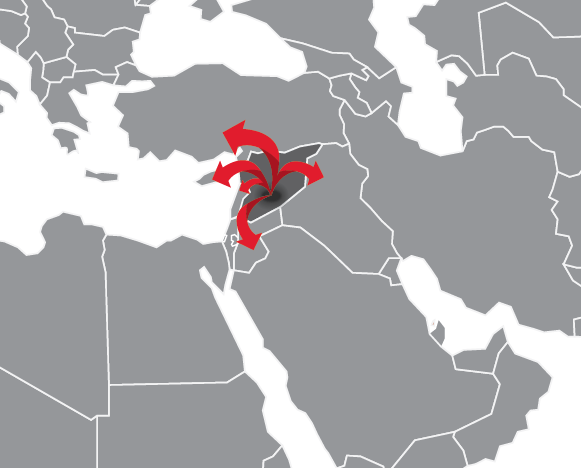
Syria

(This post is adapted from FSG’s report on how the Syrian Civil War impacts the MENA business climate. The report is part of FSG’s monthly series on managing volatility in the MENA region and is available for FSG clients here.)

Seasoned Middle East executives are confident in steady sales growth rates regardless of sensational news headlines from the region. Companies that overreact to the region’s latest developments risk falling behind aggressive competition, especially from the Gulf and Turkey. However, Western multinational companies should avoid following the lead of their governments that are taking a wait-and-see approach on Syria.

Companies must adjust business plans for the Levant region and surrounding markets as the Syrian Civil War will not end anytime soon. Fighting has already led to more than 70,000 deaths, one million refugees, and two million internally displaced in Syria. The conflict will increasingly spill over Syria’s borders and hurt economic and political stability in Iraq, Jordan, Lebanon, Israel, and Turkey.

Planning ahead allows companies to weather short-term instability, while still positioning for long-term growth in the Middle East. FSG suggests that businesses consider taking actions across core functions:

  • Human Resources: Mitigate risk for staff and local partners located in areas that are most vulnerable to spillover from Syrian fighting: Anbar province, Iraq; Jordanian-Syrian border areas; Tripoli, Lebanon; Bekaa Valley, Lebanon; southern Lebanon; northern Israel; and southeastern Turkey. Designate alternative locations for offices, outline emergency plans regarding whether employees should come to the office, and set up IT capabilities to allow people to work remotely.
  • Logistics: Reorient shipping routes through Lebanon’s Port of Beirut and Jordan’s Port of Aqaba until at least 2015. Syrian ports are not viable supply chain options for transiting goods to other parts of the Levant, Eastern Mediterranean, Iraq, and Europe. Regionally, prepare for increased insurance rates and longer transportation times for the duration of the Syrian Civil War, which could last years without any major change in the environment, such as an international intervention.
  • Sales: Reassess sales targets for your businesses in Iraq, Jordan, and Lebanon. The Syrian Civil War represents an immediate threat to economic stability in Jordan and Lebanon and political stability in Iraq. Emphasize a market share-driven strategy to position for long-term growth after political turbulence associated with the Syrian Civil War subsides. Your business can focus on a profitability-driven strategy in relatively stable and economically vibrant markets in the Gulf Cooperation Council like Saudi Arabia, Qatar, and the UAE.
  • Marketing: Utilize social media tools to establish customer loyalty, recruit local talent, and reach new customer segments in the region. Even if the corporate office wants expansion plans to be put on hold, this is an effective way to maintain and create new relationships without the cost of a strong physical presence on the ground.
  • Partners: Establish relationships with Syrian-run businesses that moved operations to nearby countries. These businesses will be positioned to reenter the market after the cessation of fighting. Egypt is an attractive destination for Syrian businesses looking to take advantage of low labor costs, reasonable cost of living, and the local textile industry infrastructure. Jordan is a natural destination for Syrian-run tourism companies that focus on the broader MENA region. Lebanon’s multi-communal society is attractive to Christian businessmen who fled Syrian cities like Aleppo, Damascus, and Homs.


The New Rules of the Game - Five Ways Cyprus Changed the Course of the Eurozone Crisis

1. Capital controls are back – Typically associated with emerging markets crises and Bretton Woods, the eurozone is developing its first set of capital controls. Capital controls will create a defacto new euro currency in Cyprus, where the local currency will not be able to buy the same goods and services as it would in the rest of the eurozone. Cyrpus imports everything, but money can’t leave to buy imports. When money can’t leave the country, it creates scarcity which drives inflation and an internal devaluation of the currency.

2. Insured deposits are no longer untouchable - Even if deposits are insured, the Troika, comprised of the ECB, EU and IMF, made it clear that deposit insurance, and national law, is subordinate its demands. The appropriation of Cypriot deposits will make depositors across the eurozone think carefully about pulling cash out of banks if there is an indication of further banking sector trouble.

3. National champion banks are in play - Spain, Italy, France and Greece have all protected their national champion banks regardless of the banks’ sustainability. In Cyprus, the Troika is breaking the two national champion banks into a good-bank/bad-bank structure that effectively kills off the second-largest bank and neuters the largest bank. Now that national champion banks are in play, creditors may pull back bank financing if the Troika indicates it is not satisfied with banks’ health.

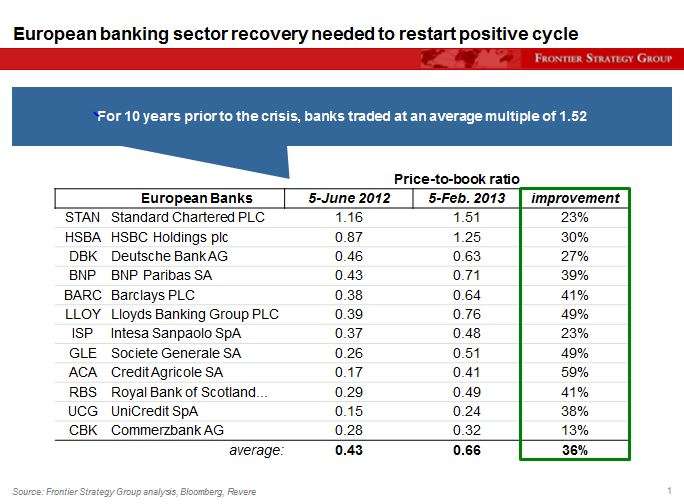
Price-to-book ratio

4. Senior bondholders suffer losses – While far less aggressive than the raid on deposits, punishing bondholders does impact the way banks capitalize themselves. If bondholders perceive risks to have increased across the eurozone after the Cypriot banks’ bondholders were wiped out, they may demand higher interest rates to refinance banks limiting the ability of banks to lend to customers.

5. Germany makes the rules now – Eurozone decision making is now clearly in the hands of Germany which has contentious elections coming up this fall. German demands about the structure of the bailout look good at home but undermine the ECB commitment to do “anything it takes” and the broader European vision of cooperation.


What this means for your business: Expect any eurozone recovery to be pushed out further into the horizon as banks will be cautious about recapitalization, and as a result, lending. If lending can’t restart, the economic cycle will remain stalled. Also expect interest rates to increase in the short term outside of Germany while the probability of a eurozone default increases. For a more detailed analysis of the crisis and what it means for emerging markets, FSG clients may download the EMEA Regional Overview released today.


PODCAST: FSG View on Saudi Arabia- Q1 2013

Saudi Arabia’s economic growth is expected to be slightly lower in 2013 than in the previous year, but there are still positive trends in the market despite current global and regional economic environments. Companies should continue to invest and identify new opportunities in Saudi Arabia for 2013; the Saudi Arabia government budget is nearly 20% higher than 2012′s plan, including a lot of non-oil sector opportunities.

Listen further as Matthew Spivack, FSG Practice Leader for the Middle East and Africa, explains how to better position your business for success by planning ahead of major developments, especially amid economic and political instability in other parts of the Middle East and North Africa.

To listen to or download the podcast, click on this link to access the iTunes store.

Emerging Market View: What Our Analysts Are Reading – 3/22/2013

Here’s a look at a few headlines that caught some of our research analysts’ attention this week:

Brazilian firms root for Chavez’s man in Venezuela vote - Reuters

“Despite difficulty obtaining currency, Brazilian firms have preferential market access in Venezuela. The scarcity of dollars in Venezuela means the government is playing favorites in who gets access to currency for imports. Importing your goods from Brazil rather than from the US has been a successful strategy for securing currency from the Central Bank for some FSG clients in the past.”
- Clinton Carter, Director of Research for Latin America

For Oil Markets, China Isn’t What it Used to Be - CNBC

“China is no longer moving the world energy market the way it used to be, as growth slows down and efficiency improves. We are seeing similar trends in other industries where companies are putting more emphasis on productivity and efficiency instead of growth. MNCs need to build new capabilities in their China organizations to adjust to the new reality.”
- Shijie Chen, Practice Leader of Asia Pacific Research

Presidential Dreaming - The Economist

“Excellent analysis of the most important political development in Turkey right now.”
- Martina Bozadzhieva, Associate Practice Leader for Central and Eastern Europe


Peru’s Growth Strong, but Difficult to Capture

Infrastructure bottle necks and the lack of a skilled workforce are hampering multinational growth prospects in Peru, where the currency is expected to appreciate and growth has slowed to a still-impressive 6.2%. In spite of these difficulties — and fears surrounding rising real estate prices — confidence remains high that the government can keep the economy growing.

South America’s fastest growing economy has slowed recently, exposing some of the difficulties multinationals are having in Peru. Rising consumer spending, a recent easing of political tensions, and an expected recovery in exports make Peru too attractive for many multinationals to pass up. However, labor and infrastructure difficulties are stifling some attempts to take advantage of the 6.2% growth. Problems faced by multinationals include:

  • Lack of a skilled workforce: More than 52% of employers in Peru are having difficulties finding skilled workers, according to a recent Manpower study. Some multinationals have even begun importing workers from abroad, in spite of Peru’s high unemployment rate. The government has responded by offering tax breaks to companies that provide training to workers.
  • Infrastructure bottlenecks: Many multinationals are finding it difficult to expand outside of Lima, due insufficient infrastructure. This makes scaling up operations difficult and concentrates short-term opportunities in the capital city. Throughout the country, housing prices have tripled since 2007, as rising real wages, a burgeoning middle class, and a strong Nuevo Sol are pushing up demand for real estate. This has led to some fears of a correction.

One of the largest questions in the short term is: How will the Peruvian government handle an expected appreciation of the Nuevo Sol? The country is taking a variety of steps to bring down appreciation, including pre-paying debts, and many multinationals have confidence in the government’s ability to deal with these problems. Close observers of the Peruvian economy will continue to monitor the government’s actions closely as they try to overcome bottlenecks while maintaining growth and stability.


The Eurozone Crisis Takes a New Twist

Just when it appeared that stability was returning, late on Friday, tiny Cyprus announced that its banks bailout will be paid for by depositors rather than the banks’ creditors or the pooled resources of the EU stability funds. Predictably, the announcement caused runs on the banks, which promptly shut down, as households attempted to remove cash before the government appropriates up to 10% of savings. The decision was made following talks with the EU and IMF and is subject to parliamentary approval on Monday.

The Cypriot bailout provides a new twist to the ongoing eurozone story. For the first time, depositors who may have had nothing to do with risky lending practices are asked to pay the bill to avoid default. Creditors including the ECB and German banks would be kept whole.

The bailout sets a dangerous precedent. Depositors in larger countries like Spain and Italy may see the situation in Cyprus as a catalyst for withdrawing savings before it’s too late. Until now, households in these markets have kept their savings in domestic banks though corporate depositors have not. If the decision to appropriate savings is approved, the thinking may change: since deposits can be appropriated in one EU country, why not in another?

A run on banks in a larger market would reverberate through the eurozone causing sharp economic contraction in that market and steep losses for creditor banks in neighboring northern European countries.

Implications for Your Strategic Planning:

  • Eurozone recovery pushed further into the horizon – Countries will be less likely to take immediate action to address insolvent banks because the new tradeoffs are so steep. As a result, bank lending will remain stalled and troubled economies will continue to contract.
  • Eurozone bank runs more likely – Even if depositors in weak eurozone markets do keep their cash in banks this week, the risk of bank runs will not dissipate. Because bailouts for markets like Greece and Portugal are ongoing, future negotiations may include demands to appropriate deposits from savers. There is no EU-wide deposit insurance and the deal with Cyprus superseded Cypriot deposit insurance law, wiping it out.
  • Creditor countries will make the rules – Harsh policy proposals coming from Germany and other creditor countries should be taken seriously as they are more likely to be enacted without support of countries in crisis. The precedent created around Cyprus protected Germany as the primarily German-funded ECB will not lose any money on its loans to Cyprus.
  • Increased probability of eurozone breakup – The new tradeoffs imposed by creditor countries makes staying in the eurozone less attractive. Governments will have to appropriate assets from savers, overturn national deposit insurance laws, and neuter domestic banks’ ability to recycle savings to restart economic growth. Popular support for anti-euro parties, like Beppe Grillo’s in Italy, will only increase.

Signposts to watch:

  • Cypriot parliamentary decision - Cyprus’ parliament will vote Monday to pass the bailout terms. A ‘no’ vote will make a eurozone exit more likely and a ‘yes’ vote will make bank runs more likely, both setting dangerous precedents.
  • Bond yields – While the value of bank deposits is a more important indicator, it is not published frequently. As a result, look at bond yields on Spanish and Italian banks. Rising yields indicate potential trouble, and flat yields indicate that contagion has not spread.
  • ECB response – Watch for an announcement about bank deposit insurance or cash injections into national banking systems. If there is a run on banks, these actions will be needed at the onset to stop them. Lack of an ECB response will confirm that the central bank does not “stand ready to act” as it publically stated.

Suggested Actions To Consider:

  • Remove any remaining corporate deposits from Portugal, Spain, Ireland, Greece and Italy.
  • Immediately communicate the significance of this seemingly minor event to corporate stakeholders who may believe the eurozone is entering a recovery.

Revisit and update your eurozone contingency plans or work with FSG to create them if they are not in place.


Is China Losing its Competitive Edge?

This blog entry is the first of a six-part series on China which will cover China’s productivity growth, portfolio management, geographical coverage models, talent management, post-merger integration and sales force effectiveness.

Is China Losing its Competitive Edge?

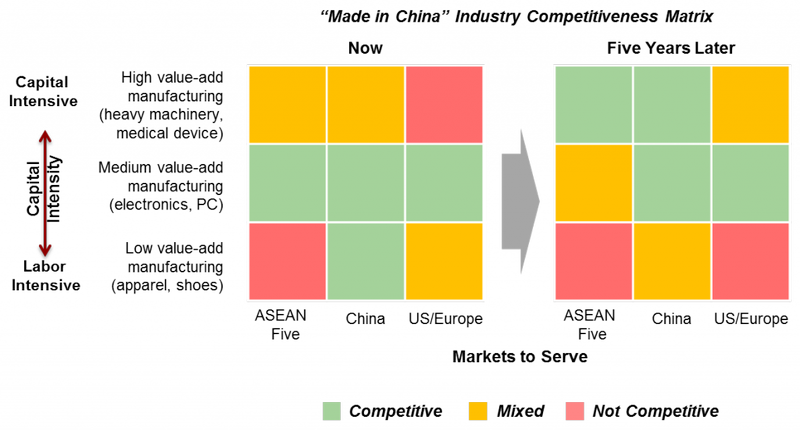
Many multinational companies are re-assessing China’s competitive advantage as a manufacturing base since labor arbitrage is becoming less compelling. Although China’s productivity gains (as measured by TFP growth) outpaced other major economies in the first decade of the 2000s, this rapid growth was interrupted by the financial crisis in 2008 and has been slowing ever since. This is largely due to overcapacity and a “crowding out effect” caused by the massive fiscal package that Beijing put in place to offset the effects of the global financial crisis.

"Made in China" Industry Competitiveness Matrix


We believe that China is gaining momentum in higher value-added industries such as heavy machinery, information technology, and medical devices, but losing competitiveness in low value-added manufacturing to other low-cost Asian countries, even when it comes to serving the domestic market. In a workshop that I have run recently, we discussed the possibility that “Made in Bangladesh” apparel will begin to flood the Chinese market in a few years.

As China continues climbing up the value chain, more and more of its companies are expanding abroad to other emerging markets. This leads to interesting dynamics on talent requirements, intellectual property, and portfolio management.


Emerging Market View: What Our Analysts Are Reading – 3/15/2013

In addition to keeping an eye on global headlines, our analysts also keep an eye on several other blogs that frequently have insightful, value-added commentary:

FSG Expert Advisor James Bosworth wrote an interesting blog entry on Chavez’s legacy - Bloggings by Boz - Foreign Policy, Latin America, etc.:

“Expert Advisor James Bosworth makes a persuasive case that President Chavez’s policies on crime and security, as much as his misguided economic policies, will be the lasting legacies of his rule.”
- Antonio Martinez, Senior Analyst for Latin America Research

The Financial Times’ Beyondbrics blog, centered on emerging market news posted about a new appointment in Russia - Nabiullina: Vladimir Putin’s new broom at Russia’s central bank:

Nabiullina’s nomination, likely to be confirmed, could result in interest rate cuts as the government seeks to boost economic growth and Nabiullina is unlikely to put up strong opposition to the Kremlin’s priorities.”
- Martina Bozadzhieva, Associate Practice Leader for Central and Eastern Europe

And lastly, from the The Jakarta Post - Expats to pay $100 monthly levy to Depok:

“If you are operating in or considering an investment in Depok, you should inquire about the draft legislation mentioned in this article, as it may have an impact on your cost base and staffing flexibility in the municipality.”
- Adam Jarczyk, Associate Practice Leader for Asia Pacific Research