Spain Teetering - FSG Analyst Insights

Spain Flag

Interview with Matt Lasov, Head of EMEA Research for Frontier Strategy Group

“The crisis in Spain is accelerating faster than expected. Again, it’s all down to the banks. While everyone’s attention is on Greece, Spain is quietly struggling to pull off the Bankia bailout. Spain planned to provide Bankia with $24bn government debt that Bankia could post at the ECB in return for loans. The ECB said they would not accept that as collateral. Now Spain is back to the drawing board because it’s unclear where $24bn cash will come from. They only have $12bn cash left in their bailout fund. They can issue debt to fund the gap, but who is going to lend to them at this point? The solution is probably to force a merger with a healthier bank. This will buy a bit of time, but will compound the problem. Can a bank like Santander really handle a large, toxic portfolio?”

What do you think? Leave a comment and join the conversation.

Brazil: Consumer Fever – and Some Headache

Brazil Flag

Full article in Latin Trade

‘Custo Brasil’ alive and kicking

Nevertheless, exploring the expanding Brazilian market still comes at a price, and the business environment has remained remarkably difficult, if not hostile.

Brazil has fared badly in the World Bank’s annual “Doing Business” survey, putting the country at a disadvantage against its main competitors worldwide. The latest survey ranks Brazil 126th among 183 countries, including a dismal 150th in the “paying tax” category.

CFOs in multinationals operating in Brazil usually express a lingering concern – if not frustration – regarding tax complexity and compliance issues in Brazil, which often is described as the most critical case in the region. Almir Barbassa, CFO of Petrobras, the oil company, notes that 900 people are employed in Petrobras’ tax department.

Jorge Gerdau, chairman of Gerdau, the steel group, has complained that companies in Brazil typically need 2,000 hours to comply with their tax obligations. He is now part of a presidential steering group to improve management and try to cut bureaucracy, but executives still complain about the lack of tax and labor reforms. President Dilma Rousseff has pledged to cut the tax burden, but structural reforms are not on the agenda.

Rogerio Menezes, CFO of Akzo Nobel Pulp & Paper, is very critical of what he calls “the tax monster”. He says there already have been more than 300,000 changes in the tax legislation, which results in high compliance costs. This is a drag on Brazil’s competitiveness as a whole. At present, each of Brasil’s 26 states and the Federal District of Brasilia has its own tax legislation and is able to tax the so-called ICMS (a sort of sales tax on goods and services) at different rates.

“The cost of doing business in Brazil continues to climb, as Brazil has failed to address the principal elements of the ‘custo Brasil,’ such as poor infrastructure, an onerous regulatory burden, heavy taxation and non-compensation labor costs,” says Clinton Carter, head of research for Latin America at Frontier Strategy Group (FSG), a U.S. business advisory firm. “Add to this a scarcity of skilled labor that is pushing salaries through the roof, and the result is a ‘custo Brasil’ that is climbing.”

The bottom line for foreign investors is that “Brazilian business units are less profitable than those in other Latin American countries,” says Ryan Brier, FSG’s Associate Practice Leader for Latin America.

According to an FSG survey , “net margins in Brazil are 5.1 percent narrower, on average, than in the rest of Latin America, largely due to taxes.” Whereas the average corporate tax paid amounted to 48 percent of profits in Latin America, the figure reached 69 percent in Brazil, FSG says. Fast-moving consumer-goods companies are much more heavily taxed than those operating in other sectors, it says.


Capture additional market share by improving organizational agility

To achieve higher company revenues, multinational executives recognize the importance of product localization efforts. Sixty-five percent of over 300 surveyed multinational executives believe that localizing products is “very important” in driving market growth. However, in a clear illustration of mismatched strategy and execution, the large majority of executives are not fundamentally altering their products when looking for market expansion.

From a multinational executive perspective, it is important to remember that local competitors are able to differentiate themselves and achieve success mainly because of two key factors:

1. Ability to customize products to local needs

2. Experience in devising innovative business models that overcome local challenges

These two factors are a testament to the priority that needs to be placed on product localization strategies. In order to compete with local competitors on their home turf, multinationals need to think about developing products to meet local needs and overcome local challenges. However, the global scale of multinationals that is often an advantage can work against multinational initiatives in combating local competitors. The image of a gigantic slow-moving ship readily comes to mind, as a huge global organization is much less adept at reacting to fast-moving local market dynamics compared with a locally-based company. Nonetheless, FSG has identified eight increasingly aggressive strategies that leading multinationals that have implemented to improve local agility and autonomy, thereby capturing additional local market opportunity.

A winning combination: transparency and extra capacity

Company Alpha International realized that becoming more agile to market conditions was absolutely critical for their emerging market strategy. However, they recognized that they still need to balance the local autonomy required for improving agility with centralized resources and support. So what they did was they created a Project Management Office that allows for simultaneous visibility from all levels and departments within the organization, creating more efficient usage of internal resources as well as incorporation of local insights.

The project management office has two key components. The first is the actual organizational component which consists of a team of FTEs, and the second component is the software component. This Project Management Software is opened to all departments and levels of the organization, allowing for a local sales manager to share information with a corporate finance manager or the international president. This fluid sharing of information has allowed Company Alpha to manage against situations of local teams running duplicative efforts across markets or deprioritizing important strategic objectives.

Organizational Structure Best Practices in Asia Pacific from Valmont

Valmont

In one of the most diverse and varied marketplaces, senior executives in the Asia Pacific region face complex challenges in developing an efficient organizational structure. Should companies group their business units geographically? By function? How decentralized should decision-making be? In order to gain insight into the unique strategies for confronting these questions, I sought out the expertise of Valmont’s Asia Pacific senior management team, who has successfully navigated a large acquisition to meet growth and profitability targets in Asia. In a recent interview, Vik Bansal, Group President of Asia Pacific, and John Fehon, VP – Finance, shared their best practices for successfully creating a matrix organizational structure in Asia Pacific.

The Valmont APAC executives are firm believers that business unit leaders need to be empowered to run their businesses. However, Valmont is able to maintain control over this decentralization by thinking of their matrix organizational structure uniquely. “Our business is a necklace with individual pearls, the threads that go through all of those pearls are the functions that should be common across each unit”. For Valmont, they selected three key common threads that link each disparate business unit together.

  1. Standardized financial systems – this is non-negotiable across business units.
  2. Applying the Valmont way – with a focus on continuous improvement, individual business units are able to apply this concept in the most relevant manner for their market.
  3. Talent identification and succession planning – In order to ensure a healthy pipeline of future managers, Valmont leadership spend significant time identifying leaders from compatibility and capability perspective.

Multinationals that have their strategic plans jointly owned by both regional executives as well as local teams have an opportunity to promote alignment throughout their organization. Valmont has been able to leverage their internal collaboration into a strong, autonomous, and agile workforce that is capable of succeeding in the diverse and fast-paced Asia Pacific business environment.

How prepared is your business for a recession in Russia?

Russia

How prepared is our business for recession in Russia?

This is the key question multinational companies should be asking themselves as they develop strategic plans for their business in Russia.

Multinational companies are increasingly relying on growth in Russia to compensate for dwindling demand as the eurozone recession deepens and much of Central and Eastern Europe slows. And while Russia has performed relatively better than most of CEE – it grew 4.2% in 2011 – this has been mostly on the back of high oil prices.

High oil prices have supported the ruble, funded high government spending, and benefited Russian consumers who in turn have helped boost GDP growth. However, high oil prices have also made Russia a much riskier market to operate in. Russia will balance its budget this year at US$117/barrel oil up from US$37 in 2007. The country’s rainy-day fund is less than half of what it was in 2008 when it helped the country stave off the worst effects of the global financial crisis. And Russia’s economy is as far as ever from true diversification away from energy.

What does this mean for the country’s economy? Standard & Poor’s estimates that if oil prices fall to US$80/barrel, Russia will be in recession; a decrease to US$60/barrel will lead to a 5% economic contraction. This will reverberate through the whole economy, impacting companies across industries. It will also lead to capital flight, currency depreciation, and, unlike in 2008, political instability.

Although Standard & Poor’s estimates the likelihood of these scenarios playing out in the next 2 years to 30%, there are valid reasons why multinational companies should invest resources in planning for this risk. Global oil prices are not supported by supply-demand fundamentals, and will experience significant declines if the eurozone plunges into deeper recession, China’s slowdown continues, and there is an easing of international tensions with Iran. All of these events are, to some extent, already under way.

This makes planning for a significant slowdown or even recession in Russia is not just an exercise in counterfactuals; it’s an essential piece of how MNCs should be thinking about protecting their business in Russia and preparing it to take advantage of the opportunities a recession will no doubt bring about.

A Tale of Two Regions: Southern Investment, Northern Insecurity in Nigeria

Nigeria

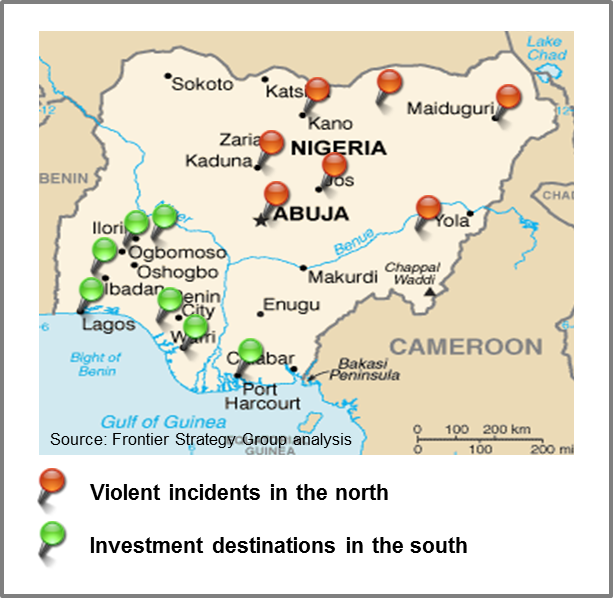
Nigeria is a tale of two regions as city-level opportunities in the south overshadow widespread insecurity in the north. Companies must overcome corporate HQ fears regarding operational risks to position for long-term success in Nigeria, which remains the most attractive long-term investment destination in Sub-Saharan Africa.

Last month ethnic conflict ravaged northern Nigeria, leaving 150 dead and 100 injured. This continues a troubling trend of violence in 2012. From an investment perspective, this has rattled foreign companies that are wondering if Nigeria is becoming too risky. However, halting or drastically scaling back investment plans would be a mistake for senior executives.

Much of the violence is isolated in the economically underdeveloped north. The total GDP of 7 attack locations between April 5 and May 4 is US$25 billion, which represents less than 10% of Nigeria’s economy. On the other hand, the total GDP of 7 top investment destinations in the south is US$80 billion. This represents more than 30% of Nigeria’s economy.

Nigeria’s five largest cities, all of which are located in the south, have a combined GDP exceeding US$75 billion. This is surpassed only by Angola and South Africa. City GDP in Nigeria’s south is set to expand significantly this quarter, even if only on paper, because the government is shifting the base year for real GDP to 2009 from 1990. The result will be an overnight gain of 40% that closes the overall economy size gap between Nigeria and South Africa to only 10%.

Southern cities represent great opportunities for companies targeting emerging consumer classes, public sector projects, and other private sector companies flocking to urban areas. Companies should establish good relationships with distributors that know the southern part of the country well. Much of your sales opportunities are likely to be concentrated in this region for the foreseeable future.

3 winning strategies to beat local competitors in Asia (Part II)

Wipro

For part I of 3 winning strategies to beat local competitors in Asia click here

2. Educate the right customer

Education is clearly important when selling at a higher price point vs local competitors. But who do you educate? The President of China at a leading company in the paint industry says: “Our paint can last 15 or 20 years on a new building. You can use a cheaper paint, but in 5 years you will have to repaint and it will cost more! The problem is: [real estate] developers don’t care, they won’t be there in 5 years!”. So the question is: who should you educate about your differentiators?

In some cases the answer is clear, especially if your differentiator is relevant to your direct buyer or, for B2C companies, to consumers. For example, food and beverage multinationals operating in China can capitalize on safety to capture demand. As a senior executive from a leading dairy company mentioned: “Consumers are willing to pay a premium for imported milk because they are still skeptical about safety of local milk. […] Food safety shouldn’t be a differentiator, but it is one in this market”.

However, the right customers to educate might be more distant, for example one step away in the value chain. A leading healthcare company in the diabetes space provided an interesting example. Traditionally, companies in medical devices (including diagnostics) partner with doctors to increase awareness and compliance. “That’s the right approach in most markets”, comments the President of Asia Pacific, “because people respect the advice of experts. However, in India we went directly to consumers, as we believed that it would be a most effective way to grow awareness and drive compliance.” The results? “Today we are the number one player, with a big distance from number two.” Educating the right customer might require some creativity and bold moves, but the payoff can be significant.

3. To remain cost-competitive, start from people and culture

“You can differentiate yourself as much as you want”, comments a senior executive with 25 years of experience in a global industrial conglomerate, “but if a large share of volumes comes from commoditized products, you have to relentlessly work on your cost base.” Most senior executives in Asia today recognize that building scale and minimizing the cost structure is vital to remain competitive. However, cost excellence is typically associated with supply chain optimization, sourcing strategy, lean organizations, etc. In our experience, the difference is made with the right people and culture.

“For some time, we couldn’t create products to compete with local players. We gave a budget and specs to the best engineers, and they said: ‘It’s impossible!’”, says the President of Asia Pacific at a chemical multinational. “Then we gave the same resources to the local engineering team. In 2 weeks we had a competitive product.” Minimizing costs requires a specific mindset and pervasive culture. As a senior executives in the medical diagnostics sector puts it: “We want to come up with affordable products to address the mid-tier market, but then we end up with the same frills, because that’s what we are so used to.”

Segmenting the organization internally based on the external market segmentation (e.g. separate engineering, sales, product management teams, etc) seems to be a fairly common approach. Here is an extreme case: “We have a trucks business and a wheel-loaders business”, explains the President China of a leading automotive multinational. “In trucks we play only in the high end market, but wheel-loaders is an entirely local industry; we acquired a wheel-loader manufacturer and we manage that business separately as a local company.”

While this strategy has its own limits and downsides (e.g. realization of synergies), it also has some side-benefits. For example, it helps to work around common post-merger integration challenges, such as harmonization of incentive structures. MNCs acquiring local companies are often faced with a very different system of values and incentives, challenging to integrate with their own. Our Director of Research, Shijie Chen, provides an explanation of such differences: “Many people think Chinese companies should have a more socialist leaning corporate and compensation structure. This is probably true for state-owned enterprises and civil services, but definitely not the case for private Chinese companies. The reality is that most privately owned Chinese companies are very market-oriented in a ruthless way, or Capitalism in its raw form. Creating a supportive working environment, building work life balance, providing training and development to employees (things MNCs would pay a lot of attention to) are much less important for private Chinese companies. So for example, it is common to see a “low base + high variable” compensation structure in this environment.”

3 winning strategies to beat local competitors in Asia (Part I)

Competition from local players is one of the biggest challenges for many multinationals in Asian emerging markets, especially in China. Over the last few months, Frontier Strategy Group conducted primary research with over thirty leading multinationals in Asia to gather the most innovative best practices to play against local competitors. While we found a number of common (and quite renowned) themes (e.g. R&D localization, Asia-for-Asia products, supply chain optimization), here are 3 winning strategies which separate leaders from laggards.

1. Invest on value-driving differentiators

Most multinationals operating in emerging markets have clear differentiators vs. their local competitors, brand equity being a common example. However, it is important to make a clear distinction between hygiene factors and real value-driving differentiators.

One common example of the former is sustainability (and its variations, such as CSR or environmental friendliness). As the President Asia Pacific of a global chemicals conglomerate puts it: “Sustainability is a key priority for us, but it doesn’t really give us any advantage in the marketplace. As a multinational, of course you have to be sustainable: it is your license to play in countries like China. But we haven’t been able to realize a premium from sustainable products”. Sustainability is becoming a hygiene factors in Asia; if you are betting on sustainability to gain market share from your competitors (local or multinational), you might be soon disappointed.

The good news is: value-driving differentiators might be right up your alley. Here is an example from a recent discussion with the Global BU head of a multinational in the chemicals space: “We resolved that Speed and Flexibility was going to be our motto. It dominates our internal culture and the way we do everything here. […] That is why our clients work with us: they want certain volumes, and they want it quickly. They might not pay a huge premium, but they give their business to us and not to anybody else.”

Especially in commoditized industries, a reputation for quality and consistency can work as a differentiator. Here is an extreme example; speaks a Board Member of a leading EU-based shipping company: “Fuel trading is a big business for us in Asia. Shipping companies simply pay a price per ton, and that’s the market-clearing price, with very small plus and minuses. So many companies dilute the fuel to make more money [..] but that spoils the engine of their clients’ ships in the long run. We win clients because we don’t do that, and they know it.”

In heavy industries, MNCs often manage to differentiate their solutions thanks to a lower TCO (Total Cost of Operation), longer lifecycle, or higher reliability. Speaks the President Asia Pacific of a leading supplier of gas-powered technology: “Our solutions are more CAPEX intensive, but much less OPEX intensive. Plus they are more reliable and last longer. No doubt our solutions are superior to those of local competitors, our main challenge is to educate our customers on that.”

And that leads us to the next point… Come back tomorrow for Part II.


Modest Business Climate Improvements with Iranian Nuclear Negotiations

Iran

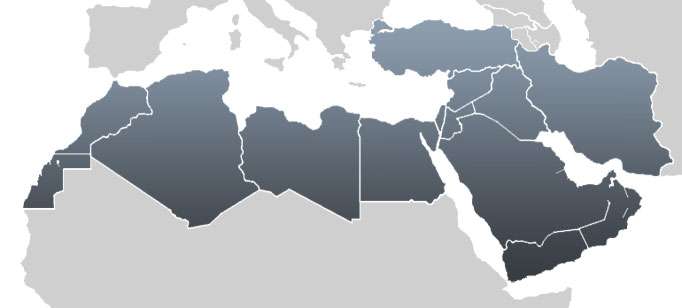
There is some optimism among Middle East analysts and US government officials regarding easing tensions with Iran. The renewal of direct nuclear negotiations and the Obama administration’s determination to avoid an oil price spike during an election year has supported these developments.

An averted regional conflict would mean a modest decline in the cost of doing business in MENA, but this hinges on a breakthrough in the next round of nuclear negotiations and shifts in internal political dynamics in Iran and Israel.

As a result of easing tensions, a modest decline in oil prices would be gradual and have global implications on the cost of doing business and consumer spending power, particularly in import-dependent markets.

In the Middle East and North Africa, an improved risk profile would lead to lower insurance premiums for transport and a lower cost of production. MNCs would have greater pricing flexibility without facing the choice of whether or not to pass on higher costs to customers. While an improved environment bodes well for making the case for investment, it is unlikely that the corporate center will shift its cautious approach to the region.

Companies should monitor key signposts to anticipate the trajectory of this developing story in MENA:

1) Nuclear negotiations on May 23 in Baghdad: A lot is riding on the emergence of concrete steps from this round of negotiations and failed talks could swing the atmosphere away from cautiously optimistic very quickly. The Iranians are already managing expectations by messaging that this will be part of a process rather than a breakthrough round.

2) Centralization vs. decentralization of Israeli decision-making: FSG has told clients for months that centralized decision-making with Prime Minister Netanyahu and Defense Minister Barak increases the likelihood of a conflict, while decentralized decision-making with institutions decreases it. Israel’s centralized approach to Iran is increasingly being opposed by the military and intelligence institutions.

3) Political messaging and domestic realities in Iran: Iranian messaging that the Istanbul talks were a victory is a significant development, because the government might be laying the groundwork for a negotiated settlement. Ongoing sanctions, and tightening of oil restrictions on July 1, may have changed how the Iranians are calculating negotiations due to a weakening currency and overall economic pressure.

Key Lessons from Walmart’s Corruption Probe in Mexico

Executives in high-risk markets should use Walmart’s troubles in Mexico to educate corporate headquarters of the difficulties of achieving high growth targets while abiding by FCPA standards in emerging markets. While Walmex’s growth was seen as one of the major success stories in emerging markets retail, we now know that it was fueled by business practices that created significant legal and reputational risk for the company

For those who have done significant business in Mexico, the bribery allegations should not come as a major surprise, nor that skirting FCPA compliance has become more difficult. Almost two-thirds of Frontier Strategy Group’s Latin America clients reported that achieving FCPA compliance has become more difficult over the past few years, with over 65% of our clients considering Mexico one of the most challenging markets in which to remain compliant, behind only Brazil and Venezuela. Locally empowered managers violating FCPA standards were the major force behind Walmart’s troubles, and FSG’s board of on-the-ground experts considers this kind of violation to be one of the most common ways multinationals run afoul of regulations in Latin America.

FSG does not expect the situation to get better over the next few years, and companies need to prepare accordingly. Vigilance is necessary, and companies should create clear incentives and develop cultures supportive of ethics compliance and sanctions for violations, along with regular reporting of compliance practices in each business unit. However, this scandal represents an opportunity. It is particularly important for executives to communicate to corporate headquarters why growth targets must come with appropriate resources to understand and mitigate the accompanying risks, and this is best achieved by resourcing effectively government engagement efforts.

*Antonio Martinez, Analyst - Latin America contributed to this piece