Avoid ‘Premium Market Captivity’: 8 Strategies to Capture the EM Middle Class

Product Localization

Despite the uncertainty surrounding the European debt crisis, geopolitical tensions in the Middle East, slowdowns in China and Brazil, and other external headwinds, multinational executives face aggressive 2012 emerging markets growth targets. Frontier Strategy Group’s clients tell us that their 2012 targets are in line with 2011 performance, despite the fact that 2011 enjoyed more favorable tailwinds.

In the past, Western consumer products companies have been able to rely on higher-income consumers to drive growth. These consumers often have tastes and preferences in line with those of Western consumers, and place a premium on the cachet of Western brands. And, given the relatively early stage of market maturity, there was plenty of white space for first-movers to take advantage of.

Looking into the future, Western companies will face a new paradigm characterized by more competitors fighting for share of a decelerating premium market. White space will shrink as more companies enter and expand in emerging markets in search of growth to offset the slowdown in the West. Concurrently, growth of the premium segment in key markets such as China will plateau. To achieve their targets in such an environment, executives will need to consider more innovative and aggressive strategies.

A new paradigm in emerging market customer dynamics

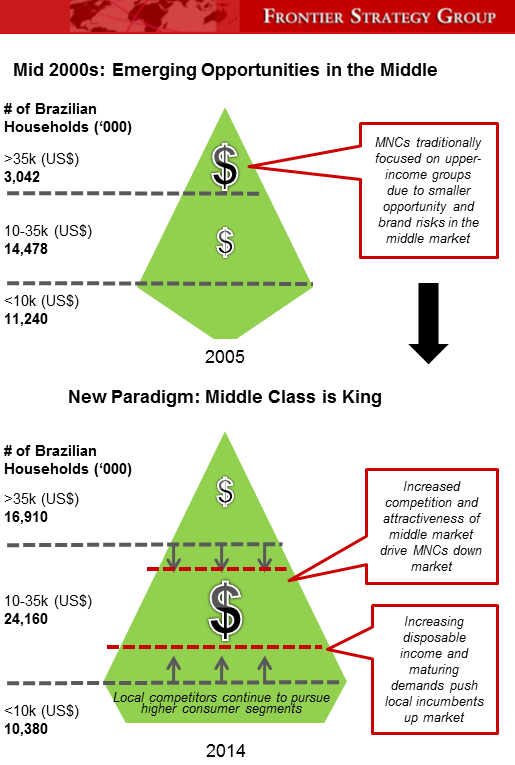
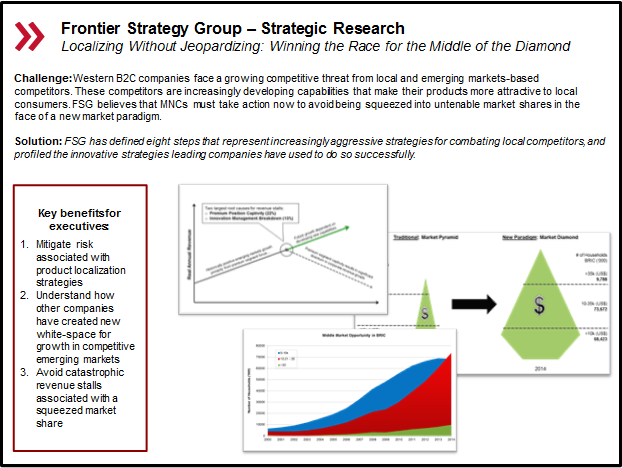
The changing dynamics of a softening and increasingly competitive premium market demand a new approach in how executives should think about emerging markets. Aggregated across the BRICs, middle tier households (as measured by annual household income) will actually surpass lower-tier households in sheer quantity by 2014. What this means is that the traditional market segmentation of the market pyramid will soon morph into what we like to refer to as the “Market Diamond”. As executives are thinking about emerging markets, the Market Diamond represents the idea that the middle market will be so compelling that both local competitors and multinational companies cannot afford to ignore such a large market opportunity.

A race to the middle

The only way to fight the inevitable market squeeze (competition and lower growth at the top-end, and increased local competition from the bottom-end) is to prioritize product localization strategies and move down the diamond into this huge opportunity. Growing into new market segments is not an easy task, and choosing the right strategies depends in part on executive tolerance for risk.

FSG has identified two key root challenges that are preventing companies and executives from implementing these eight middle market strategies: 1) corporate risk aversion, and 2) organizational misalignment. To provide a framework for overcoming these challenges, FSG has defined eight steps that represent increasingly aggressive strategies for penetrating the middle market, and profiled the strategies and tactics leading companies have used to mitigate the risks associated with each strategy:

  1. Redefine metrics of success
  2. Operational efficiency
  3. Adjusting price
  4. Distribution strategy
  5. Branding strategy
  6. Adapting products
  7. M&A
  8. Reverse innovation

The best companies are acting now

Mounting evidence suggests that emerging market based companies will continue to develop new capabilities and increase in levels of sophistication. Local competitors are increasingly following their current low-income customers into the middle market as those customers’ tastes and preferences evolve, and if multinationals fail to act now, they may find that they are arriving to the game too late. As the world economy continues to globalize, sophisticated emerging market based companies are no longer anomalies, but are more frequently becoming the norm. This trend illustrates that companies we now consider “local competitors”, might soon in the future become just “competitors”.

*Sam Osborn, Senior Analyst at Frontier Strategy Group contributed to this piece.
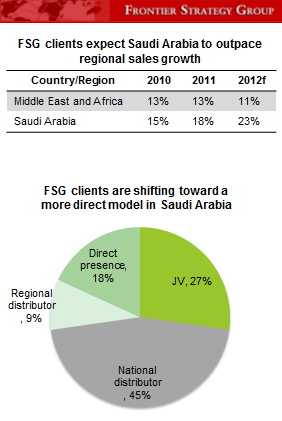
MNCs are Going Direct in Saudi Arabia According to Poll Results

Saudi Business

Companies are moving to more direct models in Saudi Arabia to capitalize on increasing public expenditure in priority sectors like education, healthcare, housing, and related infrastructure.

A local presence allows MNCs to be closer to customers and to leverage partners more effectively.

Drivers

Companies know their products better than distributors: Visiting local partners on an infrequent basis is not enough to imbue expertise in your product offering. There will always be a gap between realized and actual market potential without this knowledge.

Closer oversight of partners: Establishing a more direct presence allows companies to manage local partners closely and take advantage of special treatment due to the government’s mandate to prioritize companies with a local presence.

Business climate stability amid regional uncertainty: The Saudi market is growing in regional importance as companies de-prioritize business in less stable markets such as Egypt, Iran, Lebanon, Syria, and Tunisia.

Recognition of rising MNC competition: MNCs must get closer to customers due to the rapid expansion of foreign MNCs and regional conglomerates into the Saudi market.

Frontier Strategy Group View

Companies should no longer expect to capture the full potential of the Saudi market if they are based elsewhere in the Gulf region.

MNCs are finding it easier and more necessary than ever to go direct or form joint ventures in Saudi Arabia. The commercial infrastructure improved significantly over the past decade, exemplified by Saudi Arabia’s #12 global ranking in the World Bank’s Ease of Doing Business Index.


Brazil: High Costs Weigh on Profitability, Limiting the Impact of Growth

Brazil Revenue Growth

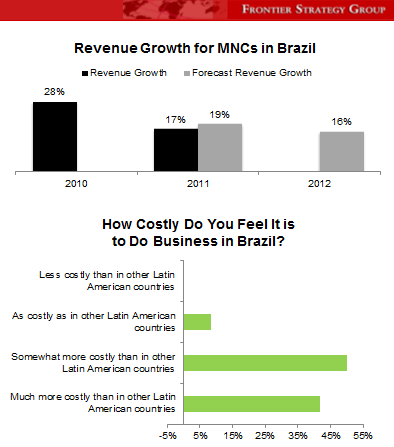
Brazil remains a growth engine for multinationals in Latin America:

Despite the economic slowdown, multinationals are counting on Brazil to deliver significant growth in 2012.

But the high cost of doing business, known as Custo Brasil, is eroding the profitability of Latin American business portfolios:

92.3% of executives believe that doing business in Brazil is at least somewhat more costly than the in other Latin American countries.

WEBINAR: Winning the Battle for the Emerging Market Consumer

Retail EM

Join Frontier Strategy Group for our upcoming webinar - “Winning the Battle for the Emerging Market Consumer.” The webinar will focus on how consumer companies can capitalize on the growth opportunity in emerging markets.

Mr. Chris Brill, one of FSG’s EMEA Practice Leaders, will lead the webinar on March 21st (9am New York/1pm London).

Instead of dwelling on softer revenue prospects in the U.S. and E.U., retail and consumer goods executives are turning their attention to the roughly 3 billion shoppers in emerging markets - who will account for 75% of global growth in consumer expenditure through 2015.

This webinar addresses the three issues that will determine whether executives will be able to convert this trend into improved company performance :

(1) Identifying the most attractive target markets

(2) Determining the ideal product mix for these target markets

(3) Gauging opportunities to establish or relocate manufacturing operations.

Please enter your details below if you would like to receive additional participation details:

Or Email: registration@frontierstrategygroup.com


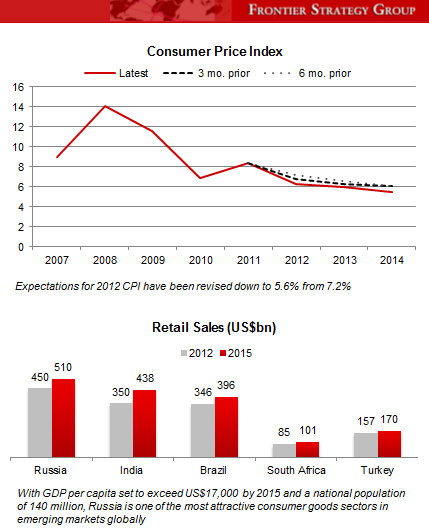
Russia’s Positive Consumer Outlook Will be Hit by Inflation Spike in H2 2012

Consumer spending will remain high through H1 2012, benefiting the consumer goods and technology sectors. However, a struggling industrial sector and a rise in inflation will reverse this trend starting in H2 2012.

Drivers

Historically low inflation, averaging 6.1% in 2011, will support household spending through H1 2012. However, utility and residential tariff hikes scheduled for June will lead to a sharp uptick in consumer prices in the second half of the year.

Unemployment, at 6.1% in December, is at a historic low and is supporting a positive consumer outlook.

High energy prices are supporting the ruble, driving up consumer demand for imported goods.

Frontier Strategy Group View

High consumer spending will buoy demand for consumer goods, pharmaceuticals, consumer electronics, and durable goods through the first half of 2012.

A decline in energy prices remains a downside risk to the broader Russian economy, including to the consumer sector.

Over the next two years, some of the social spending increases promised by Vladimir Putin during his presidential campaign will be carried out, providing support for Russian consumers.

Social spending increases will have the strongest impact on sales of fast-moving consumer goods and out-of-pocket pharmaceuticals.


Electricity Woes Plague Indonesia’s Manufacturing Sector

Indonesia Electricity

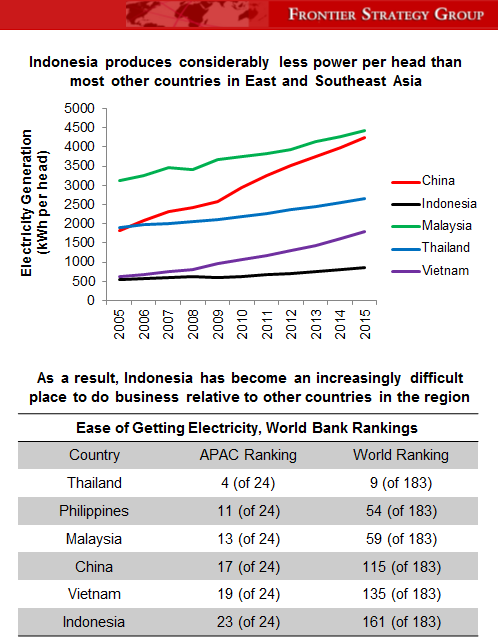
Indonesia faces significant energy production issues despite abundant domestic resources

Although Indonesia is the world’s largest coal exporter and the third-largest exporter of LNG, almost 33% of its people lack access to electricity.

Poor transport links across the archipelago and consistent underinvestment in power generation capacity have left the country well behind its peers.

Companies operating in Indonesia have been plagued by significant power shortages

In polls conducted by the Asia Foundation in 2010 and 2011, almost half of the 13,000 companies surveyed reported experiencing power outages at least three times a week.

While some companies have resorted to diesel generators, this adds significantly to their costs and requires them to procure and store their own fuel.

Indonesia’s capacity to address this issue will rely largely on three factors: reducing subsidies, fighting corruption, and implementing a new land law

Reforming Indonesia’s current fuel subsidies will free funds for the state utility to invest in new power plants.

Reducing corruption at lower levels of government will help prevent officials from holding up projects.

The successful implementation of Indonesia’s new land law will speed the development of new power projects.

MNCs and Local Companies Fight for Brazil’s Middle Class

Brazil Middle Class

Multinationals in the consumer space are looking increasingly to the middle class for growth as high-end segments mature.

Local firms are following their traditional customer base as it moves into the middle and upper middle class, putting them on a competitive collision course with multinationals moving down market.

“New middle class consumers are bringing their traditional tastes and preferences with them, helping incumbent local producers tap into the emerging consumer segments.” – FSG Executive FMCG Company

Drivers

The middle class is surpassing the lower class in quantity of households, which changes the traditional shape of the market pyramid and demands a change in strategy.

Leading multinationals are acquiring local producers to enhance their product portfolio and distribution infrastructure in order to meet emerging middle class demand.

Companies that are reluctant to adapt products or stretch their brand equity risk losing middle class customers to more nimble local competitors.

Middle- and higher-end segments are becoming more competitive.

As more multinationals enter Brazil, higher-end segments are becoming increasingly saturated, forcing multinationals to look down-market for new opportunity.

Frontier Strategy Group View

Multinationals that continue to focus primarily on the higher-end segments risk losing emerging middle class consumers to local competitors who are consistently improving and expanding their capabilities in the medium and high-tier segments in order to gain first-mover advantage.

A failure to plan accordingly will result in MNCs being restricted in their maneuverability as local companies grow in strength.


Political Risk is Here to Stay Under Putin

Original article appeared in Business Insider

MNCs should anticipate some political and economic liberalization, particularly among regional authorities, after Putin returns to the presidency. However, we expect any new reforms to have limited positive effect on the business climate in the country.

In the short term, Russia may see increased investor uneasiness paired with ruble depreciation and capital outflows, as the elections will be followed by protests. However, we expect the situation to stabilize and investor confidence to return by 2H 2012.

Putin is neither willing nor capable of delivering the reforms demanded by the Russian middle class. Over time, this will erode Putin’s legitimacy and power base. To avoid large-scale political change that may threaten their personal wealth, Russia’s political elite may decide to sacrifice Putin in a partial political liberalization that would see him replaced before his six-year term as president ends. This scenario is particularly likely if there is a major external economic shock, such as a sharp decline in energy prices.


China’s GDP Target: “Under Promising, Over Delivering”

China has revised its GDP growth target down to 7.5%, deviating from government’s insistence on 8% growth during economic crisis. However, China has a track record of “under promising and over delivering.” It has consistently delivered over 10% growth before 2008 when the official target was only 8-9%. We have strong reasons to believe that China is going to achieve an above 8% GDP growth rate in 2012.

  • China has plenty of room in both fiscal and monetary policies to stimulate growth if the economic engine stalls
  • Policy makers in China has been very responsive to changes in the macroeconomic environment, demonstrated by recent monetary loosening (though minor) measures
  • Last but not least, 2012 is the year of leadership transition. So China will do whatever it takes to ensure stability and avoid a hard landing scenario which will cause increasing social unrest


Tensions in the Middle East are a Concern for Import-Dependent Markets

Middle East & Africa

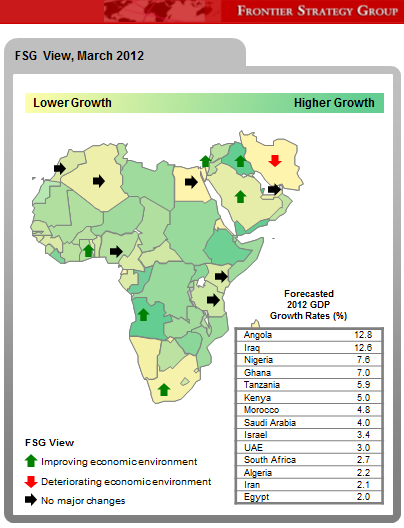
Relatively high commodity prices are supporting government spending plans for most oil and gas exporters in the Middle East and Africa. If rising tensions involving Iran and Israel turns into a conflict, then commodities prices will climb to much higher levels and stoke inflation regionally. Import-dependent economies in East Africa, North Africa, and the Middle East are particularly vulnerable to commodity price spikes that undermine consumer spending power and make it difficult for SMEs to meet their financial obligations

Algeria: The export-oriented economy is exposed to eurozone volatility due to trade with European markets

Angola: Massive oil diversification budget spending continues this year, which means more opportunities for consumer goods and healthcare MNCs

Egypt: The country’s economy remains on the brink, though investors are hopeful that an IMF deal will provide short-term relief

Ghana: The economy remains strong due to government spending and natural resource riches, though new tax policies are a concern for investors

Iran: The local environment is increasingly precarious due to a combination of economic distress and covert military activity

Iraq: The country’s short- and long-term growth outlooks are positive, supported by increased oil production capacity and elevated global prices

Israel: Apple’s commitment to the Israeli technology sector demonstrates the attractiveness of the country’s tech industry right now

Kenya: Parliament’s bid to unseat the head of the central bank head is only the latest example of domestic political discord

Morocco: Government spending keeps growth positive, but the eurozone casts a long shadow as a fall in remittances impact Moroccans

Nigeria: Strong growth will not be derailed, though inflation and security risks pose challenges to the economy

Saudi Arabia: Economic fundamentals underpin a strong outlook, though MNCs should monitor regional tensions

South Africa: The budget offers opportunities for investment and tax relief to citizens, though alcohol and tobacco tax hikes will sting some MNCs

Tanzania: Inflationary growth continues to place pressure on consumers and the economy

UAE: Tighter Iran sanctions will benefit the UAE through increased oil demand, but a critical trade relationship will suffer