What Mexico’s presidential election has in store for the healthcare industry

PRI presidential candidate Enrique Peña Nieto’s ambitions of providing universal healthcare and implementing social security reforms will significantly impact healthcare-related industries in Mexico over the next 6 years. Mr. Peña Nieto intends to consolidate public institutions and public hospitals, establishing the government as a major consumer of generic medical products. The government is likely to unveil cost-reduction initiatives that will redirect consumer preferences towards low cost generics. This increase in government spending will potentially prop up the demand of generic products at lower prices, cutting into multinational profit margins, and broadening Mexico’s generics market. FSG clients must consider modifying their strategies and expectations ahead of July’s presidential election.

FSG offers 5 possible strategies for success under the proposed reforms of the healthcare system:

  1. 1. Adjust sales strategy to the new market and prioritize sales to the Mexican government. Mr. Peña Nieto’s reforms will require a larger role for the Mexican government to step in and become a leading consumer in the healthcare market. Commercialization strategies aimed at engaging end-users and industry regulators will be a key factor.
  2. 2. Communicate changing standards and higher operational costs related to reforms as part of the finance strategy. Multinationals’ finance strategies must expect increases in regulatory standards and costs stemming from healthcare reforms.
  3. 3. Adjust marketing strategies to reflect the changing landscape and stakeholders. Social-Media and smart phones applications will be important in capturing the changing dynamic of consumer base.
  4. 4. R&D strategy must align with the government’s priority areas and localize R&D. Companies need to focus on the core areas that will be critical to the Mexican government. Medical tourism will boost demand for highly advanced and alternative treatments.
  5. 5. Public and private sector partnerships will become vital to future revenue growth strategies. Leveraging local and cross-sector partnerships will emerge as an essential component to stay ahead and generate revenue in the changing healthcare environment.

*Erick Soto contributed to this piece
 

3 Strategies for Improving Collections Efficiency in Emerging Markets

For executives in emerging markets, currency volatility stemming from the eurozone crisis and other uncertainties has added an extra layer of complexity and urgency to the management of working capital. Reducing Days Sales Outstanding (DSO) is critical for preserving margins if local currency–denominated receivables depreciate against the dollar. Furthermore, reduced access to capital continues to be a major pain point for smaller, local partners in emerging markets. Helping these local partners navigate the credit crunch by giving them the tools to more effectively manage their working capital can be critical for ensuring their survival, maintaining the continuity of supply chains and distribution networks, and fostering long-term goodwill.

Executives need to consider two dimensions when evaluating the best strategies for mitigating these challenges: Internal (their own business operations), and External (their distributors and other channel partners). Let’s focus on the Internal dimension first:

Internal Focus: Three Strategies for Improving Collections Efficiency

1. Prioritize receivables based on risk and value rather than age

Traditionally, treasury teams have aligned resources by prioritizing the oldest outstanding receivables for collection. An FSG client in the agricultural chemicals industry has given its treasury team a more strategic mandate to look beyond age to consider risk and value as the key metrics guiding collections activities. This ensures that extra steps can be taken at an early stage to collect from the accounts that are most likely to lapse beyond 30 or 60 days outstanding, which minimizes foreign exchange exposure, lowers default risk, and ultimately reduces DSO.

2. Avoid a “one size fits all” approach to collections

Many companies have invested extensively in automating receivables collections, but one FSG client in the software space has emphasized the importance of the general manager working with the treasury team to ensure that collections strategies are adapted for specific customer segments. Recognizing that a small, privately owned local company with 30 employees requires a different collections strategy than a government client will not only improve the efficiency of collections and reduce DSO but will also help to foster goodwill and increase the long-term value of the relationship.

3. Separate disputes from normal collections processes

For many companies, the inability to segregate disputed receivables from a particular invoice can seriously impact cash flows and negatively impact DSO. An FSG client in the consumer electronics industry invested in a receivables management software package that allows it to disaggregate these disputes from invoices. Now, rather than placing an invoice’s entire value in dispute due to a disagreement with the customer regarding one line item, the company can move forward with collection of the agreed-upon balance and handle the remainder through the normal dispute process. This simple shift has allowed the company to reduce past due accounts receivable by 20%.

In my next post, we will take a look at the External dimension, with three strategies focused on third-party distributors and channel partners.

India: The Stumbling Elephant

India

India’s quarterly growth hit a near-decade low during Q1 2012. Companies need to wake up to the new reality and plan for a slowing macroeconomic environment in Asia’s third largest economy.

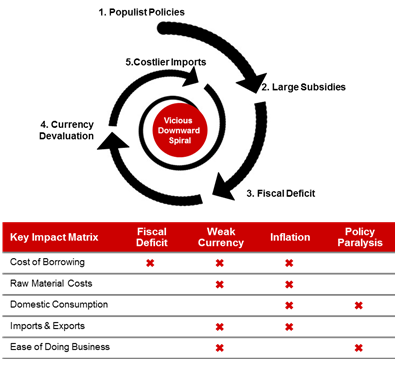
Companies need to immediately start evaluating how major aspects of their business are going to be impacted by India’s deteriorating fiscal and monetary conditions, which are caught in a vicious downward spiral.

Understanding The Downward Spiral

India is caught in a vicious cycle of domestic fiscal and monetary issues stemming from its strong populist agenda. Results so far include a weaker rupee, more expensive oil, higher inflation, and a possible decrease in the country’s international credit rating

Evaluating Impact on Your Business Value Chain

Companies should create an impact matrix to evaluate how individual macroeconomic drivers will impact their business activities. The impact matrix should scrutinize every step of the value chain from lending availability to machinery import, consumer demand, and overall ease of doing business.


Choosing the Right Distribution Model for Turkey

Turkey distribution


Going direct is not always the best strategy in Turkey

Companies looking to scale their presence in Turkey often assume that a transition to a fully direct presence in the market is the most logical next step as they seek to grow. However, this is not always the case. Instead, for many companies across industries, a hybrid presence is a more cost-effective way to cover the market.

What makes hybrid an attractive option for companies looking to grow their presence in Turkey?

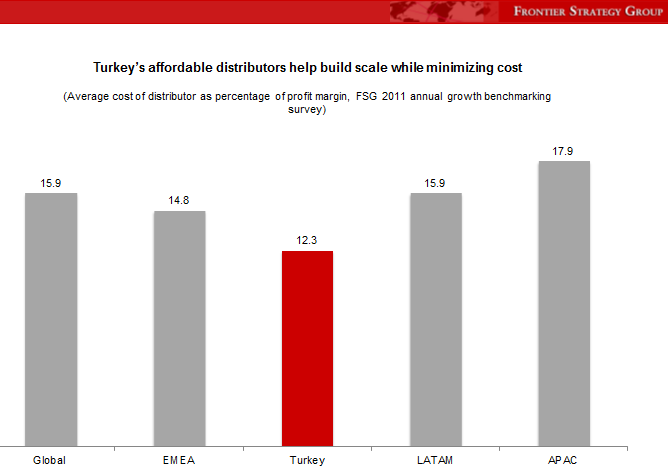
First, Turkish distributors are relatively cheap. Turkish distributor margins are 23% lower than the global average distributor margins, according to FSG’s annual growth benchmarking survey. For companies selling low-margin products to numerous, geographically dispersed customers, working through a distributor could be the most cost-effective strategy to cover those markets.

Second, Turkish distributors can offer multinational companies access to markets that are difficult and/or costly to cover via a direct sales force. This is particularly true for Turkey’s traditional market – bazaars, open-air markets, individual merchants. The traditional market is heavily driven by relationships and having a local distributor with strong connections on the ground can make or break your access to this market.

Finally, multinationals in some industries, such as consumer goods, can find distributors with enough capabilities to be strategic partners. Because of the well-developed consumer market in Turkey, there is a wide supply of distributors who have the geographic coverage, networks, and capabilities to effectively cover the market.

Despite these advantages of working with Turkish distributors, companies often still need a direct presence to ensure the high quality customer support and technical expertise that higher-end or more technologically sophisticated products require. Multinationals who work with corporate or large business clients also find that a direct presence is the best way to serve these types of clients.

As a result, a hybrid model based on segmenting the market and selecting the right channel to cover each segment is often the most cost-effective strategy of scaling your presence in Turkey.


Spain/Italy - Stress tests lack credibility & Berlusconi makes a comeback? - Analyst Insights

Interview with Matt Lasov, Head of EMEA Research for Frontier Strategy Group

Spain –Take today’s banking stress test results with a grain of salt because the hired consultants were not permitted to audit the banks directly and instead could only review Spanish central bank records. These are the same records that showed Bankia earning a profit, not a multibillion euro loss. Bizarrely, the government also hired the big four to audit the banks directly, but those results are not set to be released publicly.

Regardless of the opacity surrounding the stress test, one thing we have learned is that the capital needed after stress tests has tended to be 2x or 3x the stated amount. This was the case in the US (take Citi, or Bank of America for example) and has been the case in Europe. Be wary of the results.

Italy – There are concerns that Berlusconi will use an anti-austerity platform to reshape government and regain power. Berlusconi has been completely out of the political spotlight as his reputation recovered. He chose these comments to mark his return:

“The day we stop supporting this technical government, we will recover a lot of votes”

“If we continue on with the policies of Signora Merkel,” Mr. Berlusconi said referring to German Chancellor Angela Merkel, “We will end up in a worsening recessionary spiral. This is really the wrong policy.”

Berlusconi still has a tremendous amount of power in Italy and is the leader of the party that backs Monti’s technocratic, unelected government. Any moves in the opposite direction will roil markets, as the Italian government loses credibility.

Brazil’s Bumpy Road Ahead

Brazil

Brazil’s recovery from the previous quarter’s economic slowdown has proven more difficult than multinationals expected, and the road to growth appears to be very bumpy. FSG clients reported underperforming sales growth during the first half of the year with many considering a slowdown as a viable threat to overall sales in 2012. Regardless, FSG clients are looking to capitalize on growth opportunities in the second half of the year by introducing new products into local markets.

The weakening real is providing some aid to exporters, but recent efforts by the government to stimulate consumer credit have failed to engender sustainable growth as consumers’ appetite for credit wanes. Brazil’s complex tax system is adding even further strain to multinationals’ business operations, yet FSG clients have reported scarcely allocating resources towards strengthening tax compliance teams. FSG surveys indicate that 35% of clients foresee a significant increase in the tax burden on their profits this year. FSG believes that tax compliance efforts by clients must be ramped up in order to capture cost-saving opportunities and protect profit margins.

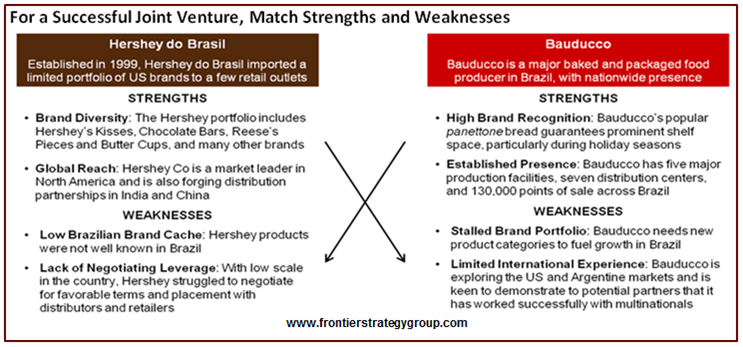
Acquisitions have been a popular strategy for multinationals seeking to capture Brazil’s rising middle-class, but recent obstacles have made joint ventures a cost-effective alternative. Intensifiedcompetition for the “middle of the diamond” along with consumer growth in far-reaching regions and adaptation to regional middle-class preferences has made acquisitions more difficult and more costly. By targeting local companies offering popular products and with established distribution networks, JVs offer a successful alternative strategy to commonly pursued acquisitions.

*Erick Soto contributed to this piece
Spain’s Woes Continue - FSG Analyst Insights

Interview with Matt Lasov, Head of EMEA Research for Frontier Strategy Group

Politically, there is zero will to allow Spain to default but markets have moved faster than politicians every step of the way. It’s very difficult to view European politicians as credible at this point, the markets certainly do not. Remember, default is always a political decision (or in this case indecision). There are policy tools available to fix this crisis, debt monetization for example. The challenge is in getting 17 eurozone governments to agree when they are beholden to domestic voters, though they share a supranational currency. As of now there is no path to solve this fundamental challenge in a timely manner.

Here’s what we know about Spain – and why we think risks are very high:

The story for Spain is bust banks and a dose of social unrest

CDS spreads show 40% chance of default, up from 30%

Youth unemployment at 50% with zero public benefits (there is no available cash for extended unemployment etc…) is a recipe for disaster

12-month yields at 5% and 10-yr at 7% is not sustainable from a funding point of view – borrowing at these rates only compounds the debt crisis.

With high borrowing costs and the 100bn euro loan, Spain’s government debt to GDP jumped to 90%, it was at 60% last year. The credit crisis was effectively transferred from Spain’s banks to its government – a government that lacks cash and the typical policy toolkit – ie printing money, devaluation.

Spain’s bond purchases are fully subscribed but there is zero foreign participation which will be necessary to bring in rates. The only buyers are Spain’s bust banks which are now reliant on government funding. This is a less-than-virtuous circle that cannot last.

Various eurozone bailout funds have the cash to string Greece along, but not Spain/Italy. A true bank recapitalization would overwhelm the size of current facilities.

Timing:

We’ll know more about the willingness of policy makers to credibly solve the problem by June 30th. At that point the European summit will have ended, the G-20 will be over, and Greece will hopefully have been extended. The pendulum will have hopefully swung from harsh austerity to the balanced deleveraging approach.

If things have not made progress by June 30th, we will need to talk about broader eurozone contingency planning. Policy makers are running out of chances and markets don’t give mulligans.

Meanwhile in Greece:

Looks like a weak coalition of pro-Europe parties will govern Greece.

Greek parties have told the Greek people that they will modify bailout terms but simultaneously told European leaders they would not ask for this.

Driven by the cycle of austerity, social pressures in Greece are too high to bear and coalition parties realize they will need to soften austerity if they are to stay in power for any period of time.

This coalition will not be long lasting. Aside from historic domestic political competition between the parties, the coalition’s legitimacy now depends completely on Europe’s willingness to modify loans. Germany has not indicated it is willing to do this in a meaningful way.

MNCs to Target Thailand’s Attractive Tax Incentives

Thailand

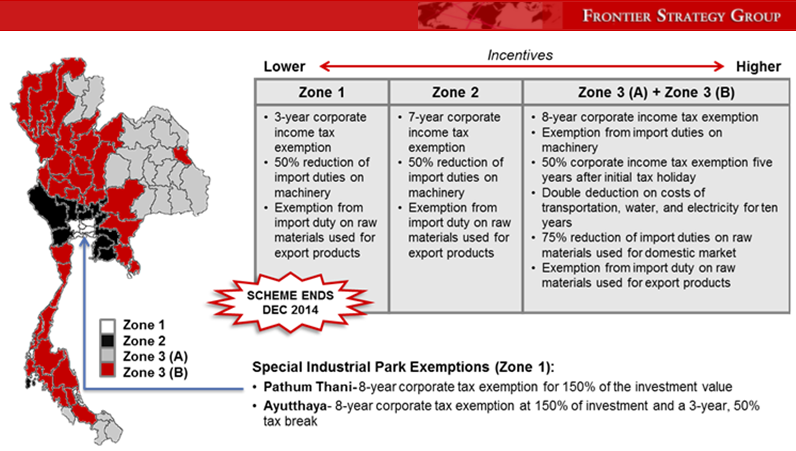
Thailand is bouncing back from the devastating floods of 2011 due to large scale fiscal spending, which is creating opportunities for multinationals in the South-East Asian nation. Companies need to evaluate investment opportunities immediately in order to take advantage of government incentives, many of which expire by the end of 2012-14

Multinationals should immediately explore investment opportunities in order to take advantage of favorable tax laws

Companies can reap significant cost savings for nearly a decade through government incentive schemes

  • Firms affected by the floods are being given 8 years of corporate income tax exemption at 150% of investment value; flood-affected industrial estates are being given the same tax break at 200% of investment
  • All firms investing in Thailand will be given incentives depending on their choice of zone


Latin America - Emerging Markets Insights - June 2012


LATAM

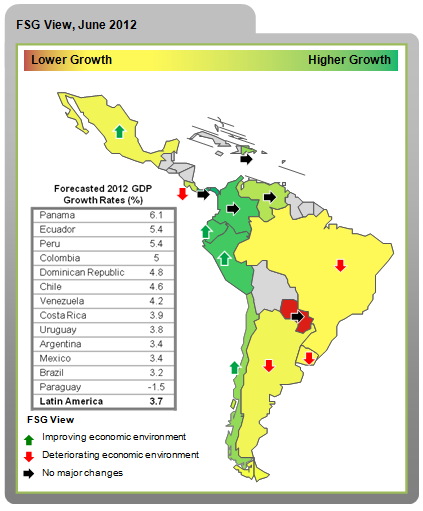
Multinationals are taking note of the strength of the Andean economies of Colombia and Peru, but the increasingly negative outlook in Argentina and Brazil is weighing down growth in the region. Stagnating industrial output and diminishing consumer demand in Brazil led economists to trim economic growth expectations to less than 3% for 2012. The race for the Mexican presidency heats up as PRI candidate Enrique Peña Nieto maintains a steady lead heading into the July election. Meanwhile, the race for Venezuela’s presidency in October is underway contributing to market uncertainty as president Chavez registers to run for a third term despite his poor health.

For a more detailed insight on key trends in Latin America, here are the analyst headlines for our key markets:

  • Argentina:A thriving black market for dollars and widespread withdrawals from local banks signal a growing belief that boom times are over
  • Brazil: Multinationals are facing increasing headwinds as the effectiveness of government stimulus falls short of expectations and credit markets soften
  • Chile: Higher-than-expected export growth is keeping Chile’s economy buoyant, but protests continue to mar President Piñera’s government
  • Colombia:Colombia’s potential is no longer a secret, but popularity brings a pricey peso that is eroding competitiveness
  • Mexico: Multinationals look to Mexico as a safe haven to weather the European storm
  • Peru: Stellar performance is only somewhat dimmed by concern over tax reform increasing the cost of doing business in Peru
  • Venezuela: Oil-fueled spending is succeeding at supporting higher growth this year, but Chavez’s poor health is creating political uncertainty

*Erick Soto contributed to this piece.

Egypt Plunged into Crisis - Part 1

This week’s dissolution of Egypt’s parliament and imposition of martial law were the first steps of a military-led coup. As a result, the ruling military council has taken over legislative powers and the committee for writing a new constitution no longer exists. The decision has plunged the political transition into crisis just one day ahead of the presidential election.

Companies should expect short-term political instability, making it more difficult to make the case for investment and delaying the reinvestment timeline for Egypt. While the Muslim Brotherhood’s initial investment policies left much room for improvement, the dissolution of parliament delays Egypt’s efforts to pass legislation that will improve the economy and attract investment.

This weekend’s presidential election will determine whether or not the military coup is successful. If former Prime Minister Ahmed Shafiq, who is backed by the ruling military authority, beats the Muslim Brotherhood candidate Mohamed Morsi, then it will be the second stage of the coup. The military is counting on Egyptians to be too disenchanted to put up a serious fight if at all. Martial law was reinstated earlier this week as a precautionary measure.