Asia CEO Insights: Investing in the Strategic Planning Process

Over the past few weeks, I have been posting some of the key takeaways from a recent Executive Breakfast on the topic of strategic planning in emerging markets. The event, hosted by Frontier Strategy Group in Singapore, was attended by a group of nine senior Asia-based executives. In this third and final post (you can find part one here, and part two here), I wanted to touch on some of the highlights on the topic of investments – both in terms of financial capital as well as human capital – in the context of strategic planning.

Incentives were discussed as a possible tactic for countering short-term thinking by local teams. Many companies have considered using “plan accuracy” as a KPI for evaluating managers’ variable compensation, but one executive from the pharmaceuticals industry felt that this led to managers being overly conservative in their planning and execution in order to ensure that targets could be consistently met, which could result in missed opportunities and lost market share. Another executive shared that he has found success in providing highly attractive long-term incentives to instill long-term thinking, as well as to fight attrition. For example, one general manager on his team received a bonus equivalent to a full year’s salary for developing and then successfully executing an aggressive four-year strategic plan.

Beyond the question of human capital, financial capital was naturally a key topic of discussion. For many executives running an emerging markets portfolio, operations often do not yet have the scale necessary to self-fund new initiatives, so the case must be made to corporate headquarters for additional investment. FSG has recently profiled The Coca-Cola Company’s approach of creating a global opportunity fund (as distinct from an emergency fund), contributed to equally by each business unit, to which requests for funding could be submitted via a rigorous and competitive application process.

Another approach, used by several companies attending our discussion, is to ask managers to submit “layered” plans, consisting of baseline plan supplemented by one, two, or more layers of “what if” scenarios. For example, local managers are asked to provide details into the specific investments that would be made, and incremental opportunities captured, if corporate were to invest $1 million above the baseline plan, $2 million above baseline, and so forth. The downside risk discussed to this approach is whether such a methodology encourages managers to submit overly optimistic plans as they make the case for additional resources. Here again, the group came to consensus on the need for a high degree of discipline to checking progress against plan milestones on a frequent and structured basis.

Although having the right capabilities in place is necessary to achieve success, capabilities alone are not sufficient. The right incentives and adherence to processes are also key to ensuring that time spent planning is time well spent.
Strategic Planning: Enfranchising Your Local Managers

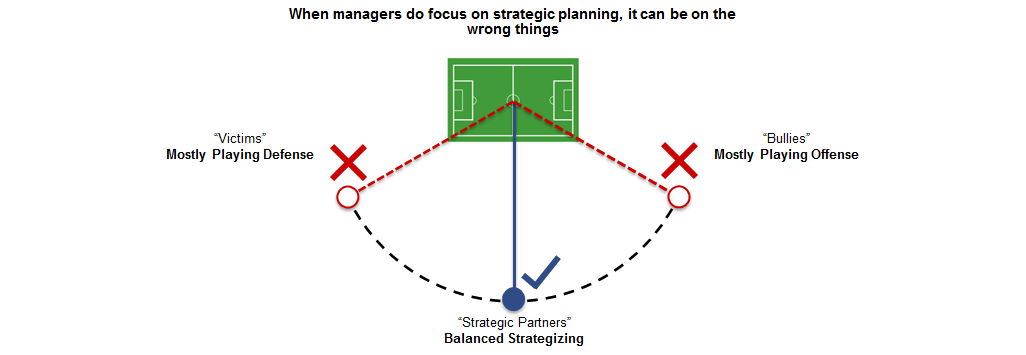
I would venture a guess that it’s not exactly common for multinational executives to make an analogy between their local managers and schoolyard recess. Clearly one group is comprised of precocious adults, while the other group, well, is not. However in the strategic planning process, Frontier Strategy Group has identified a surprising amount of similarities in behavior. Often times when local managers engage in the planning process, they are tempted to act as what we have playfully called either victims or bullies.

The “victims” play defense, focusing on keeping expectations on the low end so they can make sure to meet or exceed them. This can manifest in managers consistently providing overly pessimistic forecasts, and constantly communicating upwards regarding current and anticipated market constraints.

The “bullies,” on the other hand, tend to be concerned with expanding their own little fiefdoms, regardless of whether that is the right answer for the organization as a whole. “Bullies,” tend to show up a little less frequently than “victims,” but they may still be a concern in certain pockets of your organization. Bullies are found arguing for expanded operating budgets and are often overly optimistic regardless of whether targets are met in the short-term.

What you want, of course, is for each of your key team leaders to be in a healthy place in the middle of this pendulum. You want them to serve as trusted partners in the planning process with the freedom to speak their minds, the energy to propose some creative and courageous proposals, and the best interests of the health of your overall organization as their guiding concern while planning.

To achieve that end, Frontier Strategy Group has identified a number of strategies that are built on the foundation of:

1. Capturing the wisdom on the front lines

2. Ensuring plan morale stays high

One unique strategy for ensuring that plan morale stays high is the result of an insight that many companies overlook – employees can simultaneously be highly engaged, demonstrating high enthusiasm, and yet be poorly aligned to the strategic direction is trying to work towards. In this case, one Frontier Strategy Group client refers to these types of employees as “Loose Cannons”. Loose Cannons are people you really want to keep in your organization, but they need to be reoriented so that their energy and ability is helpful than potentially damaging or just wasted.

In my next post, we’ll discuss more about how companies are equipping their team leaders to spot and correct Loose Cannons, as well as other strategies for improving overall local team buy-in to the strategic plan.


3 Key Objectives of Chinese Government Healthcare Spending

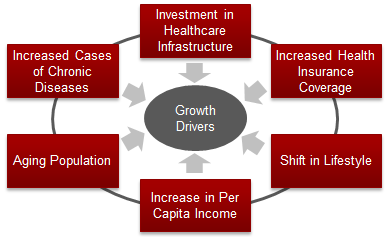
In the latest installment of China’s 5-year plan, the government laid out a series of initiatives that will make China one of the largest pharmaceutical markets in the world. China’s pharmaceutical market is expected to grow from $46 billion in 2009 to $178 billion in 2019, and this massive growth is largely being driven by the ongoing healthcare reforms.

These government initiatives are creating massive opportunities for companies with their fingers on the pulse of these programs. Here are three key government objectives and the impacts they are having on our clients:

1) Key Objective – To Provide Universal Healthcare Insurance

Under the healthcare reform, the government introduced two new basic healthcare insurance schemes, NRCMS and BMIUR, to expand coverage among the rural and the poor urban population, respectively. In addition to a much larger population with access to health insurance, reimbursement rates have also increased; which is likely the cause of higher per capita spending on medical examination and treatment in hospitals countrywide.

2) Key Objective – To Improve Healthcare Services at Grassroots Level

As of February 2012, around 2,200 county hospitals and 33,000 primary healthcare institutions have been renovated as part of the healthcare reform, with approximately 70% of township hospitals and 85% of community health centers having been upgraded. In 2010, 627 new hospitals were set up in China, and because of improved spending on healthcare facilities, about 70% of counties have at least one hospital at the secondary level-A. With all of this new construction, there has been a sharp uptick in utilization and demand for diagnostics and examinations.

3) Key Objective – Public Hospital Reform

Introduction of reforms in the public hospital system has been the toughest challenge for the Chinese government; the government’s reform plan includes separation of ownership and management and a gradual elimination of drug margins. This has led to the government announcing policies that promote private sector investment in hospitals. Specifically, the tendering process is now much more in the hands of individual hospitals and lower-tier clinical facilities, which could be a boon for healthcare companies that are able to leverage their geographic reach and local knowledge into a competitive edge during this process.

Asia CEO Insights: Incorporate Local Market Dynamics into the Strategic Plan

CEO Takeaways

“Knowledge of local markets should not reside only in local markets. Institutionalizing knowledge is critical in light of the high attrition of local talent in Asia.” –Head of Asia, Food & Beverage Company

Last week, I shared the first post in a small series on key takeaways from the recent Executive Breakfast hosted by Frontier Strategy Group in Singapore. I had the opportunity to join nine senior APAC executives for a robust discussion on managing the strategic planning process despite the volatility and distance from HQ that characterize doing business in emerging markets.

One of the most important capabilities for multinational companies to possess is an effective and efficient process for capturing the insights and wisdom of front-line managers when formulating strategic plans. In Asia, the fact that highly capable local managers are so difficult to retain for more than a few years before they leave for a big pay increase being offered by a competitive firm, or that many managers have relatively little multinational work experience, adds an extra layer of complexity to an already thorny challenge.

Furthermore, we discussed the fact that constantly churning local teams may lack a sense of ownership of plans developed by predecessors. And, that when employees expect to have short tenure with the organization, it can be hard to incentivize them to invest in developing and implementing long-term plans that may not maximize short-term personal benefits.

A leading packaged food company in attendance of our discussion has responded by attempting to institutionalize local market knowledge at the regional and corporate headquarters (where employee tenure tends to be longer and strategic capabilities tend to be more consistent) by developing a strategic planning Center of Excellence within each business unit to own the process of long-term planning, and gives local teams ownership (and accountability for) short-term planning and execution.

Another executive, from the fashion/retail space, chimed in to mention that his company has used a similar Center of Excellence strategy, with the added tactic of segmenting focus by channel as well as business unit. Some of the executives in attendance questioned the obvious drawback of not involving local teams directly in long-term planning, but acknowledged that this approach may be a realistic compromise in markets suffering from particularly high attrition.

An executive from the medical devices industry has shrunk the planning horizon for country teams to just two months; longer-term planning is done at the regional level. In his view, the key to executing in this type of bifurcated planning environment is a highly structured discipline of communication between regional and country teams, and strict accountability to meeting mutually agreed upon strategic milestones.

Another important consideration when it comes to managing the human element of planning is of course incentives. I’ll touch on some of the highlights of our discussion on that front in my next post.


Russia: Slowing Despite High Oil Prices

The most obvious risk to Russia’s performance in 2013 is that a sharp decline in oil prices will result in a rapid deterioration of the country’s macroeconomic environment. Foreign multinationals operating in the market, however, have a much more immediate issue to deal with – the Russian economy is slowing, even as Brent prices remain above US$110.

Demand from business customers, consumers, and the government will be trending down in the next several months and continue in 2013; the timelines, however, will differ depending on the customer. Demand for business products and services is already slowing significantly as a result of stalling investment by Russian businesses. Consumer demand started to decelerate in late summer and will continue to weaken over the next several months as inflation, a weak currency, slowing salary growth, and the anticipation of a deterioration of the macroeconomic environment in the country weigh on consumer confidence. Finally, the Russian government plans to cut spending in 2013, including in sectors such as healthcare, education, and infrastructure. As a result, multinationals selling to the government can expect reductions in public sector demand starting from next year, or at best a slowdown in the implementation of existing public commitments.

Together, these trends will contribute to a slowdown in the Russian economy in H2 2012 and 2013. However, Russia’s slowdown has a broader set of implications for multinationals. As growth in many multinationals’ core markets – particularly in Western Europe – slows, companies are increasingly turning their attention to emerging markets as a source of growth that would compensate for Europe’s weak performance. Russia is high on the list of markets where multinationals will increasingly seek to grow their presence. As a result, multinationals operating in Russia will be facing increasing competition in the context of slowing market growth. Capturing opportunity in this environment will increasingly require a commitment of greater resources to the market, as well as excellence in execution through superior logistics, distribution, and marketing, among others. Thus, Russia’s slowdown should be a wake-up call for multinationals that taking advantage of Russia’s opportunity will increasingly require a sophisticated strategy and best-in-class execution.

Brazil in Q3: Multinationals Shift Focus in Response to Slow Down

Brazil has been a cause of concern for multinationals as of late, with credit-fueled consumer spending and GDP growth both trending downwards in Q3. This slowdown is particularly worrisome for B2C companies, who fear for their ability to meet annual growth targets. The macroeconomic drivers of this trend paint a mixed picture: on the one hand, inflation and unemployment both remain low, and an emerging middle class continues to benefit from government cash transfers and social programs. On the other hand, even after the central bank’s most recent round of rate cuts, interest rates remain relatively high, external headwinds continue to hamper demand for exports, and consumers are increasingly hesitant to take on additional debt.

There is, however, an upside to this story which bodes well for long-term growth: consumer spending is expected to rebound over the medium-term, as government spending ramps up in preparation for the 2014 electoral cycle and World Cup. Furthermore, the Rousseff administration has begun the politically difficult process of setting Brazil on the path towards an investment-led growth model. This transition is likely to proceed in fits and starts, given that more than 50% of federal government spending goes towards pensions and government salaries at present, and Rousseff’s left-wing and labor union supporters will adamantly oppose any cuts. These challenges, while not unique to Brazil, are exacerbated by the sheer size and diversity of the country, and multinationals should expect structural reforms to proceed gradually, with limited impact over the short-to-medium term.

Many multinationals in Brazil who have long been concerned with growth have responded to the current slow-down by shifting their focus to operational efficiency and profitability. Notable best practices include: transitioning from an indirect to a direct or hybrid distribution model, streamlining and centralizing back office services, leveraging technology to improve supply chain efficiency, and pursuing growth by expanding within Brazil’s five regions and second-and third-tier cities.

The experience of Takeda Pharmaceuticals in Brazil illustrates that these strategies often work best in tandem. Takeda entered the Brazilian market in 2011. While its initial acquisition gave Takeda access to major wholesalers and chains, regional wholesalers and smaller pharmacies remained out of reach. Takeda then acquired Multilab, a locally based pharmaceutical company with an established regional distribution network. As a result of this acquisition, Takeda was able to increase its product portfolio and market share within Brazil, while gaining a valuable foothold within Brazil’s emerging regions that leaves it advantageously poised for future growth. Main take away points from Takeda’s success story include the following:

1. Multinationals should anticipate and plan for growth beyond the South and Southeast regions. The North and Northeast in particular are expected to experience economic growth, and multinationals that successfully penetrate these markets now will be poised for success down the road.

2. Multinationals hoping to increase their presence in Brazil through acquisition must carefully analyze the distribution capabilities of potential targets, and choose those with capabilities that best address existing deficiencies. This is especially crucial in lesser-penetrated regions, including the North and Northeast. Infrastructure is less developed in these regions, making scalable direct distribution quite difficult, while indirect and hybrid models require relationships with regional wholesalers and local retailers that foreign multinationals are often unable to forge endogenously.


Frontier Strategy Group Appoints Joel Whitaker as SVP Research

WASHINGTON, DC-(Marketwire - Sep 12, 2012) - Frontier Strategy Group (“FSG”), the leading information services provider for emerging markets executives, is pleased to announce the appointment of Joel Whitaker as Senior Vice President and Global Head of Research. Whitaker, who will be based in FSG’s Washington D.C. headquarters, is a veteran research leader who brings a wealth of regional and industry experience to FSG. He will be responsible for FSG’s research team globally, which spans Latin America, EMEA and Asia-Pacific.

“Joel’s background is a perfect fit for FSG. His deep understanding of the information services business, coupled with his first-hand experience working with senior executives on-the-ground in emerging markets, makes him our ideal research business leader,” said Richard Leggett, Chief Executive Officer of Frontier Strategy Group. “Joel’s addition to the team and the implementation of our shared vision for the FSG product roadmap will have a significant and almost immediate positive impact to our over 200 multinational clients.”

A 15-year veteran of the research and advisory business, Whitaker most recently served as Head of Asia-Pacific Research for the Corporate Executive Board, based in Singapore. In that role, he advised C-level executives across Asia on locally-relevant best practices to capture growth opportunities in China, India, and Southeast Asia, while managing significant challenges in talent management, compliance, and sales force effectiveness. Previously, Whitaker led CEB’s global research programs for CIOs, heads of R&D, and heads of strategy and corporate development. Outside the private sector, Whitaker launched the Center of Innovation for Science, Technology and Peacebuilding at the U.S. Institute of Peace, and serves on the advisory board of TechChange.

“I am excited about the tremendous opportunity for Frontier Strategy Group to help its clients succeed in emerging markets. I am impressed by the high caliber of the entire team — from my research analysts’ deep understanding of the regions they cover, to a senior management team dedicated to client service and product innovation. FSG has clearly earned the long-term trust and partnership of some of the world’s most important companies by combining distinctive macroeconomic insight with actionable advice for business leaders. I look forward to helping write the next chapter in FSG’s success,” said Whitaker.

About Frontier Strategy Group
Frontier Strategy Group (FSG) is a leading information services firm providing decision-critical solutions to senior executives responsible for emerging markets. FSG partners with executives at over 200 multinational corporations. The Firm is headquartered in Washington D.C. with regional offices in Singapore, London, and Miami. For more information, visit www.frontierstrategygroup.com or follow FSG on Twitter@FrontierStrtGrp.

Scaling your Business in Indonesia

Indonesia

Indonesia is becoming one of the top choices for many multinationals looking to diversify their APAC portfolio as growth in China slows and India experiences high volatility

  • Indonesia’s remarkable growth, which is drawing record numbers of global investors, is no longer limited to Jakarta and Java
  • To take full advantage of Indonesia’s rapidly growing market, companies must strike a balance between market penetration and cost effectiveness
  • Leading companies in Indonesia are accelerating their expansion outside of Jakarta and Java by focusing their efforts on:
  • Prioritizing provinces and placing strategic bets
  • Understanding the changing market landscape
  • Leveraging relationships with local companies and distributors

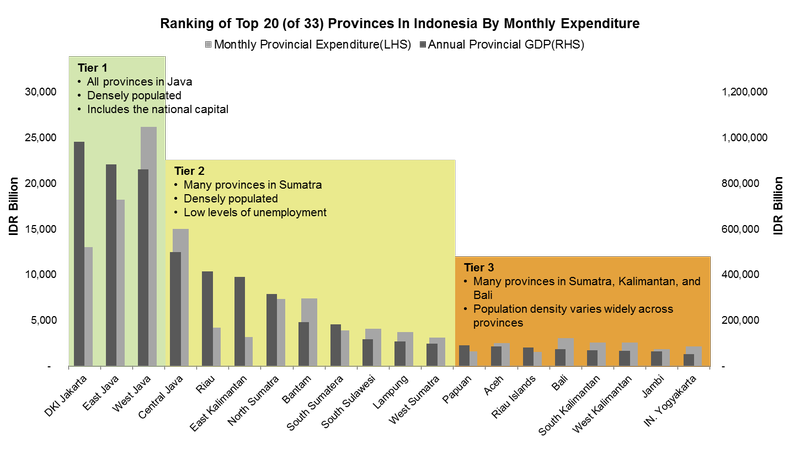
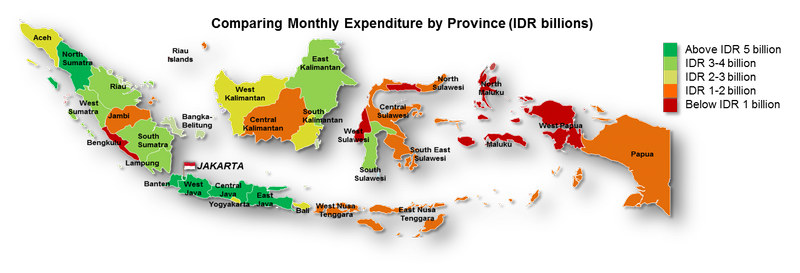
B2C Companies Should Gauge Relative Opportunity by Tiering their Markets and by Monitoring Proxy Indicators to Add Depth to This Analysis*

  • B2C companies should find a strong consumer base on the islands of Java and Sumatra, where the majority of Tier 1 and Tier 2 provinces are located
  • Companies can conduct more in-depth studies by including proxy indicators and focusing on key cities during their tiering exercises; this should help them to expand strategically without spreading themselves thin
  • Example: Monthly Expenditure, % of Households with Computers, CAGR of cellphone ownership

**Stay tuned for next post on Growth Opportunities in Indonesia B2B Market**

After Prime Minister Meles Zenawi’s Death - What’s Next for Business in Ethiopia?

After strongmen Meles Zenawi’s death, MNCs should invest time now in building relationships with influential politicians that could become the new head of state in 2015. Meles’ grip on power for the last two decades meant that business affairs were often dealt with at a personal level. He attracted FDI through personal relationships and resolved business disputes on a personal basis. Until Ethiopia transcends to a more liberal economy in the long term, personal contacts will continue to be crucial for doing business.

Meles’ economic policies combined a dominant state role with private investment by leading international and regional companies. He was responsible for the country’s rapid economic growth in recent years (8% in 2012). However, the ongoing reform agenda to liberalize the economy and privatize parastatals is likely to slow as political attention shifts to an internal power struggle as Meles’ autocratic leadership style prevented the emergence of a strong successor.

In the long term however, the implementation of economic reforms will accelerate. Ethiopia relies heavily on inbound flow of funds from donors (US$4 billion of aid annually) and investors (US$184 million in 2010). To guarantee the continued inflow of foreign direct investment, the new prime minister elected in 2015 is likely to continue many of Meles’ economic policies.


Can strategic plans survive in emerging markets?

“One of our senior corporate strategic planners just took on a general management role in India. Now he gets it!” –Head of Asia, Healthcare Company

In the late 19th century, Prussian military officer Helmuth von Multke famously remarked that, “no plan survives first contact with the enemy.” Many managers in emerging markets might agree with Multke. Strategic planning is often a frustrating and time consuming process, which is complicated in emerging markets by heightened volatility, scarcity of data, and front-line communication hindered by distance and time zones. These three challenges often converge and result in strategic plans that do not last for more than a few quarters before being scrapped or forgotten.

Multke, however, was actually a meticulous planner. He developed a planning process that considered a wide range of variables and potential outcomes in order to provide front-line officers with a framework to guide battlefield decisions, despite rapidly changing and unpredictable front-line developments. As a general manager in emerging markets, your mandate is similar: to implement a planning process that results in plans that 1) guide day-to-day decisionmaking of employees, 2) are robust enough to withstand volatility, and 3) are reflective of local market dynamics despite the scarcity of granular data and the fog of distance.

Last week, I met with a group of nine senior Asia executives from a range of industries over breakfast at the Fullerton Bay Hotel in Singapore to discuss their best practices for strategic planning in emerging markets. Much of the conversation centered on recognizing and responding to the capabilities and constraints of local teams relative to corporate teams. We spoke a bit about incentives. And, we touched on the question of how to best make the case for investment and additional “plus plan” funding.

I’d like to take a few blog posts to share some of the key takeaways of our discussion in the coming weeks. Watch this space.