3 Key Considerations For Your Government Engagement Strategy

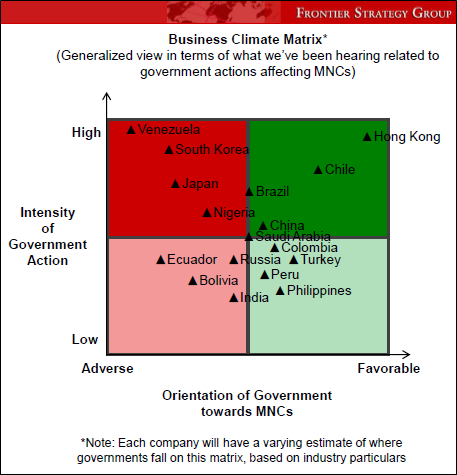
Business Climate Matrix

Country and regional heads are increasingly turning their attention to their government engagement function. Government decisions, from regulatory issues to government sales, can deeply impact the bottom line.

Companies wrestle with a variety of questions when it comes to running successful government engagement functions. These questions can be broken down into three principal challenges:

1. Ensure the company invests the right amount in government engagement.

2. Generate positive engagement when government actors are initially unreceptive.

3. Capitalize on the abilities of third parties without putting the company at risk.

In response to these challenges, most companies resort to a reactive, problem-solving approach. In order to succeed, the government engagement function should reframe traditional ROI evaluations to embrace the broader goals of government engagement, thus creating a proactive decision framework. This new ROI approach applies to each of the three major challenges companies face:

1. Justify Your Investment – First understand how to tailor your investments to the realities presented by each country’s business and political environment.

2. Earn Your Influence – Make sure you time the ―I‖ well in ROI.

3. Discipline Your Delegates – Do not take short cuts with third parties. A low ―I‖ does not guarantee high ROI if the ―R‖ turns out to be negative.
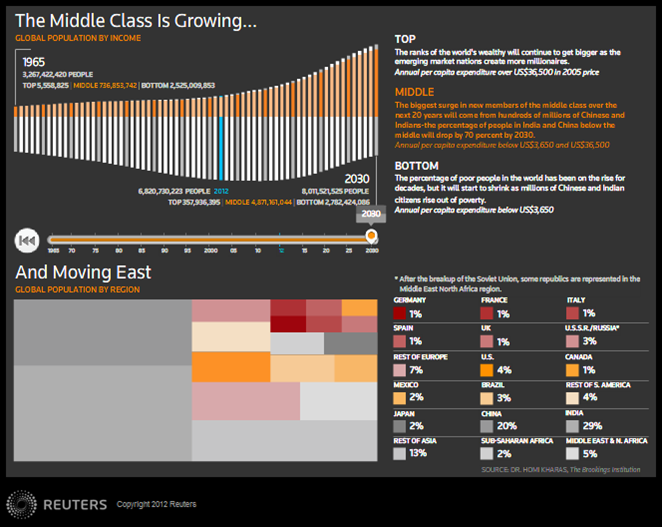

Emerging Middle-Class in Emerging Markets

Reuters recently released an interactive infographic depicting the evolution of the middle-class around the world. Emerging markets such as China, India and Indonesia are estimated to increase Asia’s share of the global middle-class to 64% and account for over 40% of global middle-class consumption by the year 2030.

Middle-Class Consumers

Russia’s WTO entrance redraws global resource map - MarketWatch

Full article on MarketWatch

Russia’s acceptance into the World Trade Organization last month didn’t just mark an end to nearly two decades of negotiations, but opened a door to free up global trade with a nation that is one of the world’s largest oil producers and home to the globe’s biggest natural gas reserves.

And if the impact on the last large economy to join the organization — China — offers any clue, the outlook for Russian trade and its economy has much improved.

On Dec. 16, the World Trade Organization approved Russia’s membership. WTO trade ministers have said Russia’s accession to the organization will bring the nation more firmly into the global economy and make it a more attractive place to do business.

“Russia took 18 years to complete its WTO negotiations, but in the end it walked away with a great deal,” said Martina Bozadzhieva, senior analyst for Central and Eastern Europe (CEE) & Russia at Frontier Strategy Group. “Over the long term, WTO accession will increase the competitiveness of the Russian economy and [foreign direct investment] inflows.”

Will Chinese Consumers Pay for Quality?

Chinese market

The following post is from Frontier Strategy Group expert advisor, Richard Brubaker’s All Roads Lead to China blog. The post is called Quality in China. Is it Valuable Enough to Pay for?

***********************************************************************************

While the typical conversation about “quality” in China will be one of manufacturing failures, I was asked by a good friend to comment about my thoughts on whether or not the “Chinese” market was ready as a consumer of quality.

A topic that I would say I brush past on a regular basis as in the last few years it is easy to see there is a market of Chinese consumers who are looking to enjoy a higher level of standard in products (middle market and luxury), but more widely there was a mass who were engaging in what I call fear based consumerism as a result of the countless consumer scandals in China.

And in answering her questions below, I really felt it was best to focus on the later group because (in my mind) these are the consumers that are going to be far more interesting, stable, and loyal in the future. And that for all the hub bub of China’s growth in luxury, it will ultimately be the middle market where firms focused on “quality” should be focusing their efforts.

Question 1: How will Chinese consumers be thinking about Quality (Durability, Safety, Longevity, etc) for products in 3-5 years

This is ultimately the question that will drive brands nuts going forward because there are going to be some very clear markets that develop, and some which pop up and then die quickly, all depending on the “consumer”.

If one views the government as a consumer who is looking to by “quality” for their projects (think cleantech, healthcare, security, etc). This is a very large market already, and is one where the “buyer” is looking for quality (even in the face of domestic innovation policies), and it is a market that is largely owned by foreign firms like CISCO, GE, and NALCO

If the market is of the average consumer, this will obviously re-frame a bit, but buying quality if becoming something important to them, particularly if one considers food, children, and healthcare markets. In these markets, there is a lot of anxiety, and foreign pharma and overseas Organic labels are selling at a premium to the local alternatives.

… and this trend will only continue consumer income increases, awareness of local product safety issues increases, and access to “quality” items increases.

Question 2: Will they pay more

Yes. They already are.

Looking at food alone, you have markets for local organic and imported organic, which both carry a premium.

In areas of education, parents are more likely to pay the 20% premium to send their kids to Disney English, than to the even the best nationally branded schools, and there are parents who are (currently) willing to spend the 20% premium to send their kids to the nationally branded English schools than to a local English school

.. and in the area of healthcare, Shanghai and Beijing hospitals have up to 50% “waidi” patients who have opted not to visit local/ provincial options. They are seeking the best in care, and are willing to pay (above and below the table) what it takes. Even if that means selling land.

Question 3: What will be top of mind for them

Depends on category, but product safety will be one of the biggest drivers for consumers to seek out, and remain loyal to, a product. However performance and durability will also be at the top of the list. There will be a point where consumers locally understand that there are some products whose short term savings will have a much higher long term cost due to their design, materials, etc, and these consumers will begin moving towards quality in that regard as well (even at a premium) so as to reduce their own time suck.

Question 4: How should companies be thinking to cater their offerings towards these needs

Companies that succeed will be the ones that understand the undercurrents the best. A lot of firms who have entered China do so without considering the big picture. They have researched a specific market, or group of people, in a vacuum environment without considering the what ifs, and a year later they are shuttering operations (or hemorrhaging cash keeping it on life support)

Entering the market doesn’t just require a good product, it also requires good technical support (for the development of future products) and after sales service (for when things go wrong), and anyone who is operating a model without either is either going to burn out quickly or have a pack of angry consumers banging on their door. Either way, they are not developing a loyal consumer base.


Frontier Strategy Group Appoints Richard Leggett Chief Executive Officer

WASHINGTON, DC-(Marketwire - Jan 18, 2012) - Frontier Strategy Group (“FSG”), a leading provider of decision-critical information to senior executives responsible for emerging markets, announced the appointment of Richard Leggett, 44, as Chief Executive Officer of the firm.

Leggett, who will be based in FSG’s Washington D.C. headquarters, is a recognized leader who brings 20 years of global information and financial services experience to FSG.

“Rich’s unique background in information services and international management make him the right leader for FSG,” said Alex Gorbansky, Co-Founder and Chairman of the firm. “His vision and extensive executive experience will help take FSG to the next level as we grow and expand globally. Most importantly, Rich is a great fit with FSG’s culture.”

Most recently, Leggett served as Chairman and Chief Executive Officer of Business Intelligence Advisors (BIA), an independent investment research, advisory and analytics firm. Prior to BIA, Mr. Leggett ran the ISS Business Unit at RiskMetrics Group following its acquisition of the Center for Financial Research and Analysis (CFRA), a leading independent research firm where he was President and Chief Executive Officer. Earlier in his career, Mr. Leggett served as a Managing Director at Goldman Sachs in New York and London in both the equity research and investment banking divisions.

“I have been incredibly impressed by the business and market position established at FSG. I am thrilled to join the company and to have the opportunity to lead an incredible team as we write the next chapter in the firm’s already successful history,” said Richard Leggett. “We are fortunate to work with some of the world’s most important companies in helping them develop and execute their strategies for the emerging markets.”

About Frontier Strategy Group

Frontier Strategy Group (FSG) is a leading provider of data and decision-support on emerging markets. Founded in 2005, FSG helps senior executives operating in emerging markets make better and faster decisions through a unique subscription offering. Over 200 leading multinationals such as The Coca-Cola Company, Johnson & Johnson, Proctor & Gamble and Microsoft leverage proprietary insight from their senior executive peers, world-renownedexpert advisors and FSG’s analyst teams. FSG is headquartered in Washington D.C. with regional offices in Singapore, London, Miami and New York. Follow FSG on Twitter at www.twitter.com/frontierstrtgrp.

What are your top emerging market priorities in 2012?

During the final weeks of 2011, Frontier Strategy Group spent a great deal of time speaking with emerging markets executives to understand their top priorities for 2012. The chief concern for nearly every executive we spoke with largely boils down to, “How can I maintain growth in the face of market deceleration?” Corporate expectations are roughly in line with the performance achieved in 2011, despite increasing external headwinds, uncertainty, and volatility.

As we began to unpackage and dig a bit deeper into these concerns, we identified four very common issue sets that we will address in our quarterly global business analysis and executive forums in 2012:

Responding to Local Competitors

  • What are the most successful Western MNCs doing to counter the threat of local and emerging markets-based rivals?
  • What are the most successful tactics for responding to price competition while preserving margins?
  • How can multinationals best leverage their strengths and mitigate their weaknesses to beat local companies in the war for talent?

Streamlining the Strategic Planning Process

  • How can I accelerate processes and ensure that time spent on strategic planning yields strong returns?
  • What are the best mechanisms for collecting local market insight from my team?
  • How can I more effectively make my case to the corporate center?

Walking the Channel Management Tightrope: Direct vs. Indirect

  • What is the right balance between direct and indirect sales?
  • How have leading companies managed the transition from indirect to direct, or vice versa?
  • When is the right time to terminate a distributor relationship, and how can I minimize disruption through the transition?

Managing the M&A Lifecycle

  • When is inorganic growth preferable to organic growth?
  • What are the best (and worst) practices for identifying and screening potential targets?
  • How can I more seamlessly integrate the new team and infuse my “corporate DNA?”

What do you think will be the most important challenge facing emerging markets executives in 2012? Give us your feedback by clicking on this link.

Cross-Strait Relations - A Second Term for Taiwan’s Ma Ying-Jeou

Ma Ying-jeou has been reelected as Taiwan’s president for a second term. Despite his victory, he faced close competition from Democratic Progressive Party candidate Tsai Ing-wen. The clip above, from The Wall Street Journal, discusses the impact of Ma Ying-jeou’s reelection on cross-strait relations between Mainland China and Taiwan.

What Strikes in Nigeria Mean for Your Business in Africa

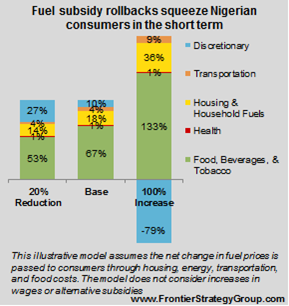
Nigeria’s government must walk a tightrope to successfully implement its reform agenda and satisfy angry citizens who are feeling the pain of fuel subsidy rollbacks. However, a resolution to the current political impasse is likely so any major changes to your strategy is a mistake

  • Fuel subsidy rollbacks caused gasoline prices to rise by more than 100% to US$0.94 per liter. As a result, Nigeria’s two largest unions called indefinite strikes that could threaten the economy if a compromise is not reached and work stoppages spread to the oil sector
  • President Goodluck Jonathan is framing the rollbacks as critical for the economy, which was burdened by the recurrent costs that total more than US$6 billion annually or roughly 25% of the budget
    • The government claims it will reallocate the cost savings to spend on education, healthcare, and the energy infrastructure. However, the public is skeptical due to past wasteful spending and a draft budget that allocated more money to security than health, education, and energy combined

Three ways you can respond to the latest developments in Nigeria

  • Diversify your production toward more high-margin products
  • Leverage Frontier Strategy Group’s making the case materials and city-level data to quantify ROI in Nigeria
  • Consider forward-buying key imported raw materials with cash-flow management tools as price pressure is likely to maintain upward momentum

Three ways fuel subsidy rollbacks impact Nigeria’s investment climate in 2012

  • More competition for the purse: B2C companies will face more cross-sector competition to capture discretionary spending from cash-strapped Nigerian consumers
    • The rollbacks will stoke food and fuel inflation, which impacts most Nigerians whom live on less than US$2 per day
    • Heightened price sensitivity may cause consumers to trade down for value in the short term
  • Difficulty in making the case: Nigeria’s medium-term growth potential remains the best among African peers, but negative headlines will raise doubt among some risk-averse corporate centers
    • The strikes coupled with a recent spike in sectarian violence will scare away some investors
  • Higher cost of doing business: All companies with local operations should brace for higher costs as instability weakens the naira and increases the likelihood of a currency devaluation
    • Strikes amid ongoing sectarian violence, mid-teens inflation growth, and depleted currency reserves raises the specter of a devaluation
    • A silver lining of a currency devaluation would be to make Nigeria a more attractive regional export hub

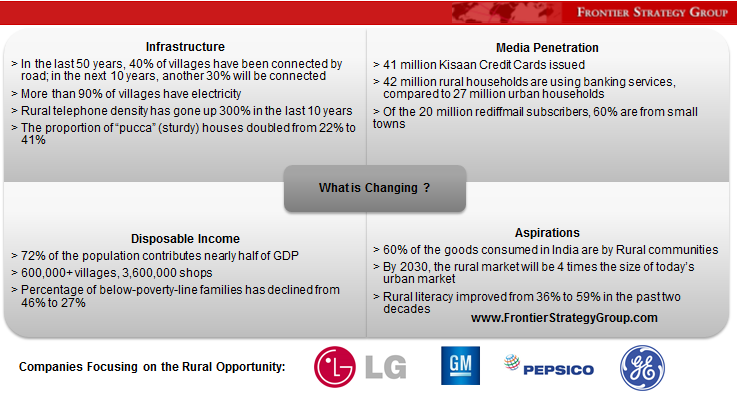
Making the Case for Rural India

Rural India

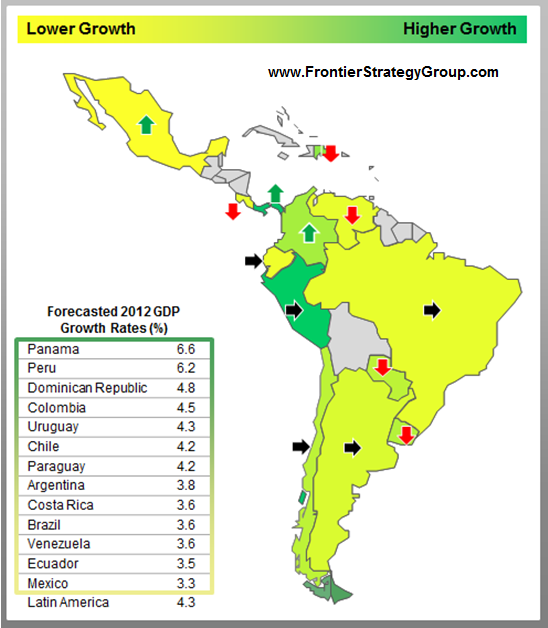
Latin America Starts 2012 with New Leaders and Laggards

LATAM January 2012

2011 year-end growth figures and new forecasts for 2012 demonstrate continued, but slower, growth, and the emergence of new risks and opportunities in LATAM. Brazil’s growth will subdued, by recent standards, and Argentina is preparing for a potentially painful economic restructuring. While larger regional economies slow, robust Chile, Peru, and Colombia increase in relative importance.

  • Argentina: High inflation and a yawning budget deficit are forcing Argentina to lower spending, but trade and capital restrictions remain in place
  • Brazil: Brazil faces a rapidly slowing economy, and government authorities are pushing for monetary easing and higher government spending
  • Chile: The Piñera administration faces political and economic headwinds going into 2012 but Chile’s fundamentals continue to shine
  • Colombia: Growing recognition of the long-term potential of the Colombian economy is quickly eclipsing investor fears of violence and instability
  • Costa Rica: Fragile public finances and a weakening economy have led the government to raise taxes, imperiling future foreign direct investment
  • Dominican Republic: Economic decline in Europe and new immigration laws will have adverse effects on the tourism, agriculture, and mining industries
  • Ecuador: Government spending and stable commodity prices will support growth in 2012, but overexposure to oil continues to present risks
  • Mexico: Mexico enters 2012 with confidence earned from economic resilience and hopes for a smooth political transition in July
  • Panama: Panama’s economy boosted by trade agreement with the US, but political uncertainty clouds the prospects for Martinelli’s reform agenda
  • Paraguay: Contrary to previous expectations, Paraguay will see lackluster growth due to weakening external demand and supply shocks at home
  • Peru: Protests are hurting President Humala’s political standing, but the economy remains strong despite growing political uncertainty
  • Uruguay: Uruguay is at the mercy of economic developments in Argentina and Brazil, with current trends pointing to a slowdown in 2012
  • Venezuela: New socialist legislation makes it harder to turn a profit and easier to run afoul of the law in Venezuela