3 Mistakes B2B Companies must Avoid for Ecommerce Success in Latin America

Ecommerce in Latin America

The consumer ecommerce channel in Latin America is experiencing rapid growth, fueled by increases in internet connectivity, the growth of the middle class, and the proliferation of smartphones that allow consumers to make purchases from anywhere. In response to growing consumer demand, companies such as MercadoLibre, eBay’s Latin American partner and one of the leading ecommerce sites in the region, have increased their reach while enjoying steady growth in sales. While the consumer oriented ecommerce segment is a field crowded with established competitors offering a variety of purchasing and payment options, B2B sales through the online channel remain relatively underdeveloped.

With no equivalent of MercadoLibre in the B2B sector, companies that act now stand to capture significant untapped market share by using ecommerce to access SMB customers that were previously deemed too difficult to reach or too expensive to serve. A recent study conducted for a client by Frontier Strategy Group’s Bespoke Research team confirmed the market opportunity for B2B sales to SMB customers in Colombia through the ecommerce channel and also identified three common mistakes avoid:

Mistake #1: Taking a One-Size-Fits-All Approach

Not all SMB customers are the same. FSG’s study focused on a variety of different types of businesses, revealing key differences in purchasing frequency and expenditure, and different priorities for each segment. While fast and reliable delivery of goods and high quality customer service were important for some respondents, other respondents were more concerned with convenience and cost savings. In order to successfully meet the needs of segments with highly differentiated priorities, B2B companies must ensure that an ecommerce site is adaptable enough to meet the needs of different segments, offering flexible payment and delivery options, with customer service that is responsive the unique needs of a diverse range of customers.

Mistake #2: Lack of Payment Options

“Usually we pay all suppliers at the end of the month by checks. We have credit for one month or 35 days. We do not pay immediately after purchase. Here, bills expire in one month and then they are cancelled. Sometimes, we do not have all the money to pay suppliers at the beginning of the month, but, at month end, we have money from everything that was sold throughout the month.”
—Interview Respondent

One of the key inhibitors of online purchasing among SMB customers is the perception that online platforms do not offer the same payment options as the local stores and distributors that these businesses typically purchase from. Many of the business respondents interviewed for FSG’s study were accustomed to making purchases on 30-day trade credit, paid at the end of each month via check, and worried that this payment option would not be available online. B2B companies seeking to reach these customers through the ecommerce channel must offer more flexible payment options, including the ability to purchase products on credit and pay at the end of each month.

Mistake #3: Failure to Minimize Customer-Perceived Risks

“The only objection I would have is around security, as the seller could be a fictitious company and there is the risk of being conned.”
— Interview Respondent

“Goods that come by boat sometimes are delayed or damaged; the service is not good.”
— Interview Respondent

For B2B customers in Latin America, payment security is paramount. FSG’s study found that concerns over security were one of the most commonly cited inhibitors of ecommerce adoption. Though many respondents reported making personal purchases online, these same respondents were concerned about the security risks involved in making business purchases through unfamiliar online portals. Ecommerce companies must take extra steps to reassure B2B customers that their personal and payment information is secure on online platforms. Because B2B customers are more trusting of recognized names with a proven track record, B2B companies that can establish themselves early on as a secure ecommerce portal will gain a significant advantage in the long run.

B2B respondents also reported concerns over the quality of products purchased online. These respondents expressed reservations about purchasing products without being able to judge product quality in person, and were also concerned that products shipped from long distances could become lost or damaged. B2B ecommerce companies can minimize this perceived risk through a comprehensive return policy that reimburses customers for products that are damaged or unsatisfactory.

Click here for more on FSG’s Bespoke Research offerings.
Are MNCs looking to expand in the Philippines?

Senior executives are increasingly answering “yes” as they seek to diversify operations in Asia beyond Greater China.

-Its small size has kept it off the radar screen of many executives, but as corporate mandates increasingly emphasize profitability, the Philippines is a market that executives need to pay attention to

-Despite its small size relative to its regional peers, the Philippines can offer fairly high and stable returns for strategically targeted investments.

  • Its fiscal prudence has already led to a credit rating upgrade this year with another upgrade expected to bring the nation to ‘investment’ status by 2013.
  • More than 60% of the population falls between the ages of 14-65 thus providing for a large and one of the fastest growing consumer bases in the region
  • President Benigno’s government has started making slow but essential progress on anti-corruption reforms and building up infrastructure

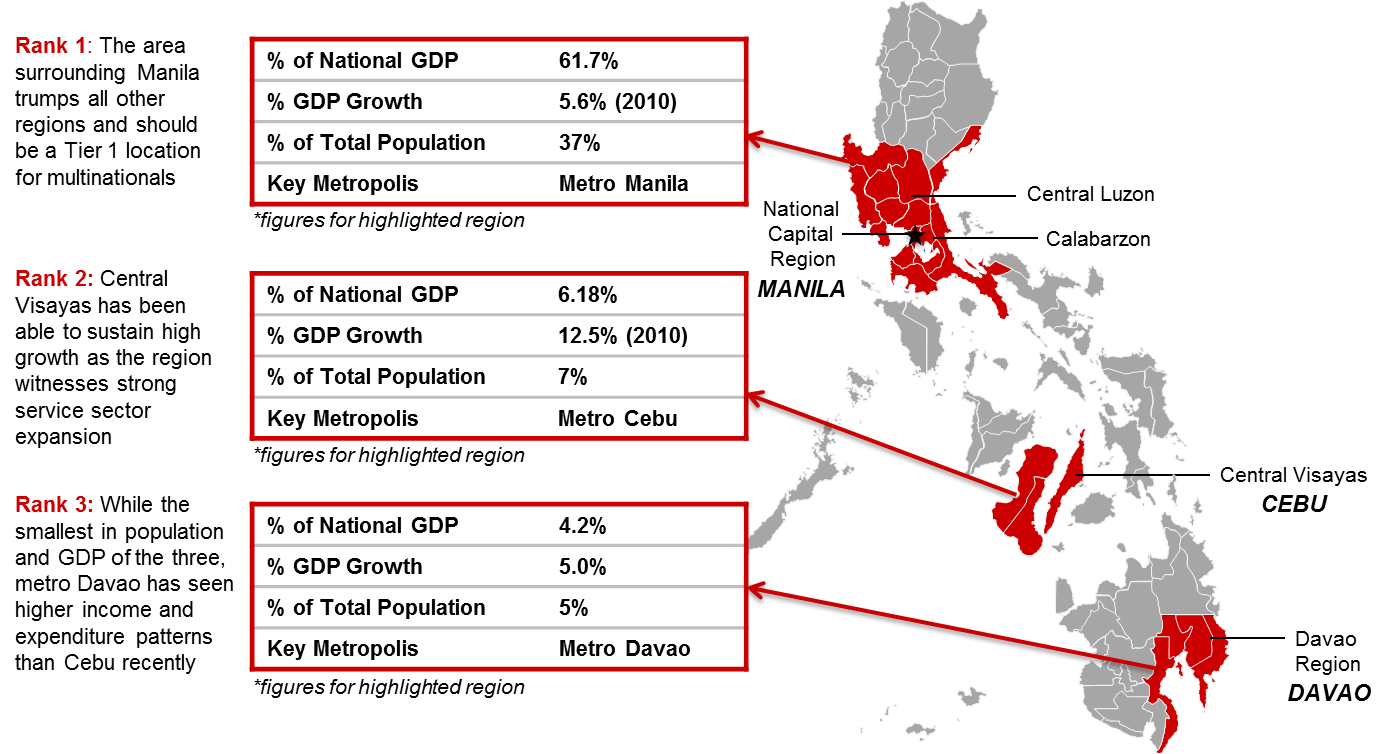
-Given the small size of opportunity, executives should focus their investment efforts into three main areas of the Philippines (see map), with the major focus on Luzon, which has the highest concentration of wealth and population. Companies looking for high-growth opportunities beyond Luzon should consider Cebu and Davao in order to keep their efforts concentrated on these more developed and business friendly metropolitan areas

Philippines

2 Issues to Tackle When Operating a Business in India

1. Fragmentation:

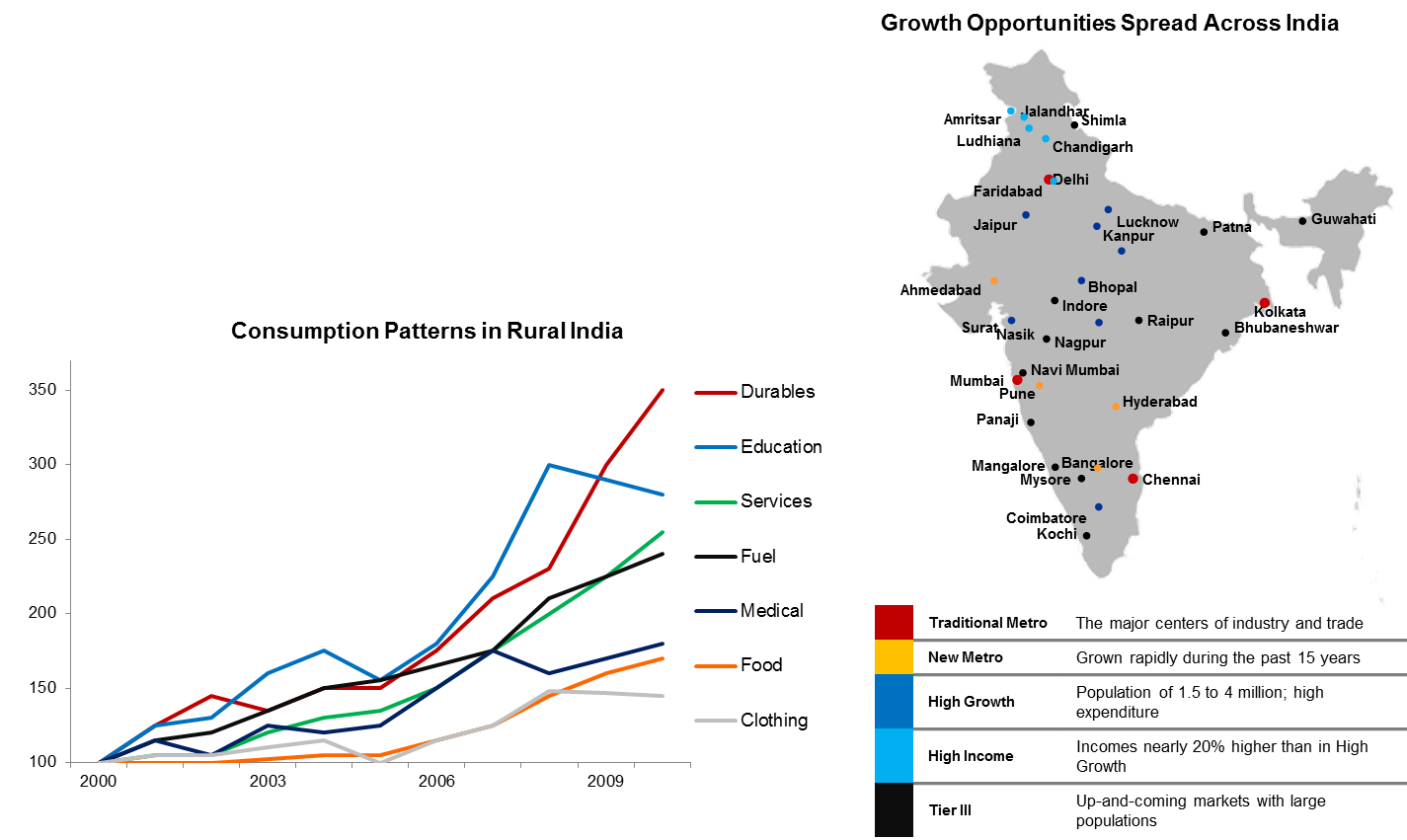
Multinationals have to move out of the traditional Tier-1 cities in order to adapt to India’s unique urbanization trend:

The rise of manufacturing in rural India has led to robust job and wealth growth, which means a lot of the rural population, is not interested in moving to large-cities but instead, we can expect small villages to turn in to small towns, then big towns and eventually into large cities. This means that as a multinational- you will have to go to your end customers, and not the other way around- waiting for them to come to the traditional metro cities

Towns simply grow into densely populated cities, as opposed to a conventional migration of people from towns to cities

Expenditure on durable goods, education, consumer services (entertainment, transport, etc.), and fuel have grown faster than the average over the last 10 years

India distribution

2. Infrastructure Issues:

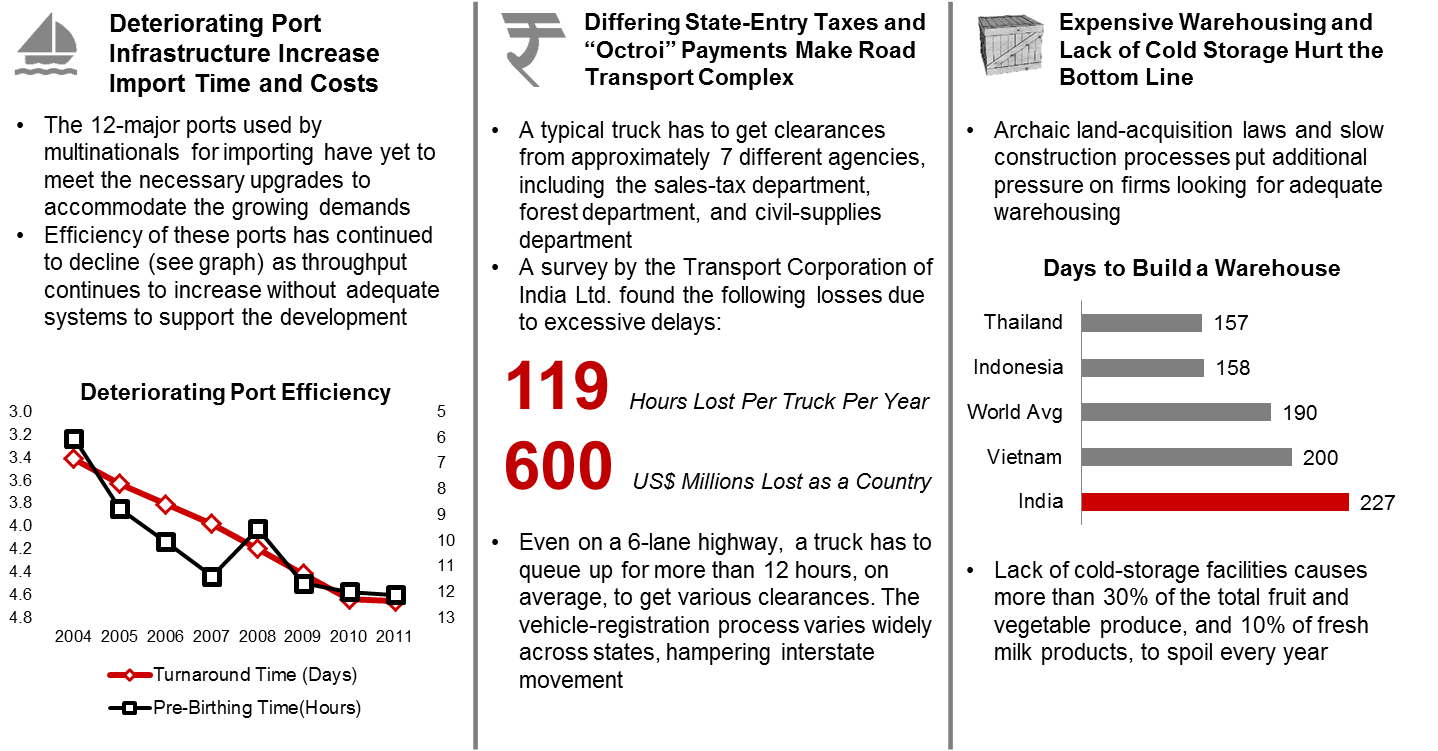
India’s consistent underinvestment in infrastructure, lack of regulatory reforms, and generally unstructured style of conducting business adds an additional layer of complexity for multinationals operating in the country:

Stay tuned for the next blog-post on distributor sophistication in India and FSG’s assessment criteria to identity gaps in your channel strategy


Austerity Measures, Weakening Growth in Central and Eastern Europe in 2012

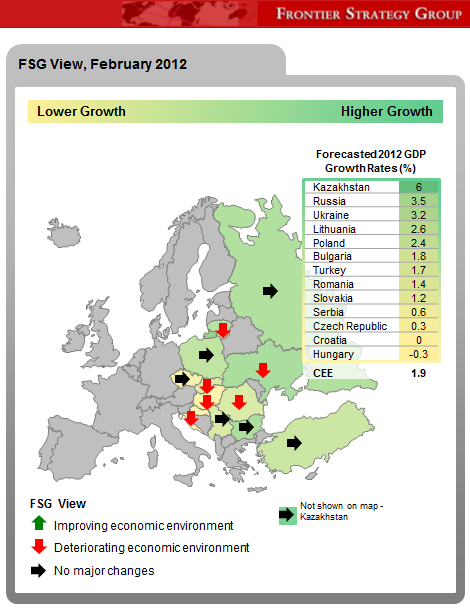
CEE View

As exports and consumer demand slow and regional governments seek to reduce spending, growth is weakening across the region and a difficult year is ahead for both B2B and B2C MNCs. GDP growth forecasts will likely be revised further down as CEE economies struggle with continuing volatility and recession in the eurozone. Kazakhstan and Russia continue to benefit from high energy prices, but remain vulnerable to an oil price decline

  • Bulgaria: The economy will slow in 2012, but a conservative budget will act as a buffer against an external macroeconomic shock
  • Croatia: Croatia is in for a challenging 2012 that will bring austerity measures, pain for local consumers, and possibly a recession
  • Czech Republic: Avoiding a deep recession in 2012 is possible if there is clear progress on the eurozone crisis and the German economy remains strong
  • Hungary: The government will struggle to regain investor confidence as its controversial policies are undermining market trust in Hungary
  • Kazakhstan: MNCs can expect continuity in government policies and populist measures in 2012
  • Lithuania: The liquidation of a major local bank threatens to offset the budget this year and may mean more austerity measures
  • Poland: MNCs pursuing investments in Poland are well-positioned to capitalize on the country’s undervalued currency
  • Romania: Romanian consumers remain deeply pessimistic about the economy’s prospects, a trend that will impact consumer goods MNCs
  • Russia: Economic performance will slow only moderately as the government will support high consumer spending ahead of the elections
  • Serbia: The key driver for Serbia’s growth this year remains the economic performance of the eurozone
  • Slovakia: The consumer outlook remains negative through 2012 as any new government would have to cut public spending
  • Turkey: Economic growth will slow gradually over the next several months
  • Ukraine: Growth will slow this year and could decline sharply if commodity prices drop as a result of the recession in the eurozone

Tie Incentives to Strategy Execution in Emerging Markets

Bridge Goals

Are multinational firms undercutting their growth potential in emerging markets because of their incentive systems? While average growth rates across global emerging markets are healthy (14% expected in 2011 from a recent Frontier Strategy Group survey), there does exist a fundamental misalignment between strategy and leadership in these markets. The misalignment is this: the average tenure of an emerging markets leader (typically a regional head of Asia, Latin America or EMEA) is about 3 years – but the average investment in these markets has a payback period much longer-term than that.

Payback periods vary, of course, by industry. But it is not uncommon to hear consumer goods companies, for example, talk about building a brand in a new developing market for several years before they build out their channel. Or for B2B companies to painstakingly build partnerships over the course of several years to set a foundation that will enable them to succeed in certain markets. Yet the vast majority of emerging markets executives (over 80%) are incentivized on short-term financial metrics. A classic case of the folly of rewarding A while hoping for B. Every executive worth his or her salt will do their damnedest to hit the financial targets laid out for them – with the inevitable consequence of compromising the long-term vision that success in emerging markets requires.

The answer clearly lies in tying incentives not just to financial outcomes but also to strategy execution. Companies must walk a fine line here. Clearly, senior executives are used to being told what to get done, not what to do. So the incentives must still be related to achieving outcomes – just not necessarily financial outcomes, which are the most lagging of all success indicators. Recent Frontier Strategy Group research on performance management has uncovered a small but growing trend of companies rewarding executives on strategy execution milestones and other non-financial metrics such as leadership behaviors.

For more detail, please write to me with questions or comments. In a future post – why the corporate budgeting process is the bane of the emerging markets executive’s existence.