Will India’s growth rate outpace China’s?

In the wake of the Mumbai bombings, concerns remain over the business environment in the commercial and entertainment capital of India. That said, India ranks among the largest and fastest-growing markets in the world, and it has weathered the economic downturn substantially better than Brazil and Russia. It also continues to attract investment due to its market size, economic diversity, and future growth potential.

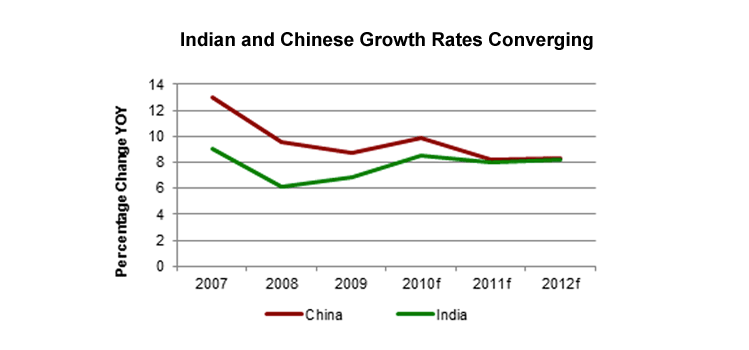
  • India’s steady growth will place it neck and neck with China in 2013

o India’s economy is expected to expand 8.0% this year and 8.4% next year. The country’s GDP growth is expected to continue rising through 2013 when it will begin to outpace China

o India’s rapid economic expansion will be reflected in the growth of its people’s spending power. Personal disposable income per capita is set to rise by 13.2% this year and 12.4% next year.

  • Favorable demographics

o India is the third-largest market in Asia, after China and Japan

o More than 65% of its 1.2 billion people are under 35 years of age

  • Improving infrastructure

o New Delhi is devoting more attention and resources to infrastructure development in an effort to eliminate bottlenecks and attract investment

o The portion of India’s budget allocated to infrastructure increased by 23% this year to US$48 billion.

o Improved infrastructure is attracting investment in automobile manufacturing, metals, chemicals, textiles, and food processing from multinationals which are increasingly looking to use India as a supplier to the rest of Asia.
Monthly Regional Insights: Central & Eastern Europe

Inflation across Central and Eastern Europe (CEE) eases on food prices, improving the outlook for increasing consumer demand in a number of countries in the region. Despite concerns about the impact of the euro zone crisis, investors’ confidence in CEE remains relatively strong, with the notable exception of Turkey where concerns about the country’s growing current account deficit weigh on investor perceptions.

  • Bulgaria: The economy is gradually recovering but inflation, low investment, and the euro zone crisis will continue to weigh on growth
  • Croatia: Despite welcome news on its EU membership, Croatia continues to struggle with serious economic problems
  • Czech Republic: The expected government spending cuts and slowdown in exports to Germany will negatively affect consumer demand
  • Hungary: As inflation eases and Hungary’s economy picks up, we expect a gradual but steady recovery in domestic demand in H2 2011
  • Kazakhstan: An increase in government spending meant to buy popular support for the government will boost consumer demand
  • Lithuania: With inflation stabilizing and the economic recovery on track, consumer demand will support growth more actively in H2 2011
  • Poland: Polish consumers are a key driver of growth and investor interest in the country’s strong domestic
  • Romania: The economy is slowly recovering and the government is seeking more aggressive reform measures
  • Russia: The question of who will run for Russia’s presidency continues to weigh on investor perceptions of the country
  • Serbia: Plagued by high unemployment and rising inflation, Serbia is seeking investors to help boost its economy
  • Slovakia: Expected increases in car production will boost Slovak exports and drive growth for the rest of 2011
  • Turkey: After winning the parliamentary elections, the AK Party will need to address rising consumer spending and inflation aggressively
  • Ukraine: The Ukrainian government is increasingly focusing on cooperation with the EU as a key economic and foreign policy goal


Optimizing Distributor Segmentation in Emerging Markets

Philip Morris International (PMI) recently reported its second-quarter results. PMI attributed declining performance in the EMEA region due to unfavorable terms with its local distributor. In my previous blog post I highlighted the top three takeaways from Frontier Strategy Group’s recent survey aimed at understanding the channel management secrets of high growth companies. In this post, I’d like to take a deeper dive into how leading companies are segmenting their distributors and assigning territories.

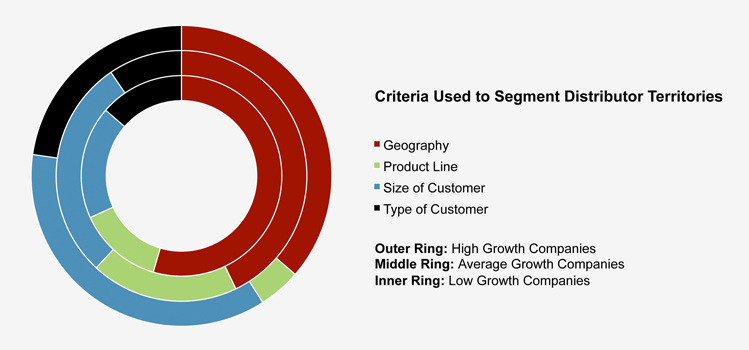
Our analysis shows that many of the most successful companies are looking beyond geography when defining distributors’ territories. In fact, nearly 60% of high growth companies are using ‘Size of Customer’ or ‘Type of Customer’ as the key criteria for defining distributor territories. Meanwhile, only 32% of low growth companies are using these advanced criteria.

Providing customers with access to a broad product portfolio through a single distributor is also correlated with higher growth. More than 95% of high growth companies’ distributors carry multiple product lines. In contrast, about 20% of average growth companies limit their distributors to a single product line.

We found these characteristics to be true across emerging market regions and industries, with one notable exception – the healthcare industry. Geography remains the dominant criteria across high, average, and low growth healthcare companies. This is not surprising given that purchases of healthcare products in emerging markets are most often driven by government bodies overseeing procurement for a particular territory.

In my next post, we will explore the incentives, and specifically non-monetary incentives that are most likely to be used by high growth companies.

How MNCs are Managing Chinese Government Relations

The following is a cross post from the All Roads Lead to China blog. The blog is written by Frontier Strategy Group Shanghai-based expert adviser Richard Brubaker.

Meeting government officials, and getting a picture with them in China, is one thing. Working with them is a whole different animal, and over the course of my time in China I have had a number of experiences for both (although I am not one for pictures).

In many ways, the interactions that I have had with officials have been some of the most interesting in my time here, and with a number of my clients and my own projects involving government agencies on some level, I thought I would share a few things about what I feel makes for successful government relationships. Or at least provides for the best chances:

1) Having a clear value proposition (product, project, or partnership) that is aligned with the objectives of the organization you are in discussions with.

This is a lesson I learned most recently with one client as we discussed a nationwide program with two agencies. Agencies one was operationally the better partner, had more experience with the type of partnership we were discussing, but the alignment was not there as the goals of the organization (and the way they were measured by their superiors) were quite different. which for the managers we were speaking with there was nothing but risk. If the partnership succeeded, they would not be rewarded, but if there was a failure.. then they would be punished.

So, make sure there is alignment.

2) Understand the scope and scale of the potential partnership

Imagine being a cleantech firm with the most attractive technology, terms, or price.. but because your manufacturing is based in the EU.. and you can only supply a fraction of the need. Why would a government who is looking for scalable solutions buy your product? This is an issue many firms face, and really fail to realize that they face it.

The fact is that there are areas where foreign partnerships are needed, and needed in a big way, but if a firm cannot support the market for that need then it is not a solution that will rank as highly as a local firm who will risk it all to scale to the government need.

3) Have the necessary internal structures ready to manage the relationship.

Working with the government requires meetings. a LOT of meetings, and if there is anything that adds to those meetings is it when the organization that they are working with is lacking the size, structure, and coordination that they are looking for. If they are working with you, then there is likely a measure of risk that they are facing, and the best way to overcome their fears of instability (or failure) is to have a tight reporting structure who is geared up, anticipating the government needs, and is walking into the room with all the answers.

Walking into a meeting any other way will result in more meetings.. and more oversight… until the partner is comfortable again

4) Learn the difference between what official say, and what they (can) do

This is honestly one of the ones that I have the hardest time with. I am someone who (typically) acts first, and then speaks, but in a number of my interactions what I have found is that a lot of brainstorming occurs in meetings .. brainstorming that are in some ways used to place pressure on the counter party.. pressure that, if appropriately identified and deflected, can deflate through a range of responses

In the meeting, they are the master of their domain, but when it comes to actually executing, it will be their teams doing the work.. so, it is important to remember that there are things that are simply easier said than done… and things that are very difficult to speak about, but easily accomplished.

5) Be Prepared to Give

I was recently in the audience where James McGregor was speaking to a group of students and by far the best line of the speech was when he recounted the words of a leader he was speaking with…. that “If western firms want to be treated like Chinese firms, they should start acting like one”

I was once naive to think that I could ask for the moon and give nothing for it.. and many firms are no different. Being accepted is something that can be very rare, and the opportunities once accepted can be very interesting, lucrative, etc… but there is a cost. Perhaps it is giving up a bit of IP, or accepting the resumes of friends, or working with organizations that (while somehow aligned) you’d rather not… it is part of the game

Beyond these, and these are perhaps my top 5 for now, keeping an open mind when meeting with officials is really the only way to proceed forward. In one of my recent partnerships, what started off as a small and well defined project resulted in a partnership that is now growing in ways never imagined. It is one of those cases where the precedent was set, the partnership proved itself, and the curtain was lifted.

So, while there are certainly times where the partnerships can be tenuous and demanding, there are times where they can be rewarding.

The original post is titled Managing Government Relationships in China


Western MNCs Shifting from Asia to Latin America

In emerging markets, multinationals are shifting from Asia to Latin America, boding well for the region’s growth. Frontier Strategy Group’s Matt Lasov explains more in this interview by MarketWatch’s Laura Mandaro.

Brazil’s Impact on Latin America Trade

httpv://youtu.be/yNdfK2zrc8M

Latin American executives are reporting lost opportunities and revenue due to increasing trade restrictions on imports into Brazil. Costs and frustrations are mounting for businesses dependent upon a smooth flow of commerce across Brazil’s borders, forcing a reconsideration of previous business models due to critical vulnerabilities to import restriction. In this interview Clinton Carter, Frontier Strategy Group’s Director of Latin America Research, discusses the impact of Brazil trade restrictions on the Latin American region.

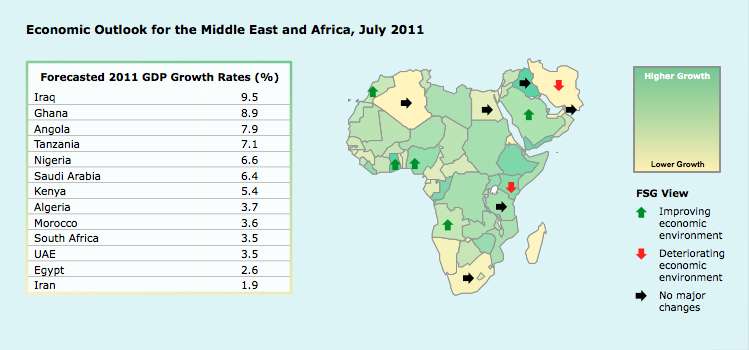
Monthly Regional Insights: Middle East & Africa

Consumers are struggling with higher food and fuel prices across the emerging markets of Middle East and Africa as external factors such as high commodity prices and regional unrest combine with internal factors including strong domestic demand. Next month, Ramadan will heighten the upward pressure on prices in countries with large Muslim populations, which may lead governments to consider interest rate hikes to bring inflation under control

Algeria: A desire for stability will trump any motivation for political change in the short term

Angola: Moody’s and Fitch signaled that Angola’s investment climate is improving, but several threats could derail recent progress

Egypt: The new budget plan fails to address how Egypt will emerge from its post-revolution struggles, but cautious optimism remains for 2012

Ghana: Politically stable Ghana has made huge strides recently in local enterprise stimulation and resource manufacturing potential

Iran: The rollback of subsidies is sustaining inflation at high levels, which is hurting Iran’s economy more than sanctions

Iraq: Investment opportunities in Iraq are growing rapidly, but the security situation remains precarious in the medium term

Kenya: Economic potential is restricted by high commodity prices, which are contributing to inflation growth and a weakening currency

Morocco: Relative stability should hold for the short term, but fallout from the constitutional referendum should be monitored closely

Nigeria: The development of the healthcare sector may be a slow process, but its untapped potential is huge

Saudi Arabia: Pace of government transactions slows, but private consumption spike will provide opportunities for consumer-oriented companies

South Africa: The investment climate received a boost with the approval of Wal-Mart’s entry, but familiar challenges still threaten the economy

Tanzania: Massive infrastructure plan hinges on willingness of private investors to take a risk on Tanzania

UAE: The government is getting ready to launch a key industrial zone just as companies revisit the UAE as a long-term export base

Each month Frontier Strategy Group releases monthly market reports to its clients. These concise, executive-friendly reports highlight key developments and market trends in a particular region.


Unlocking Africa’s Manufacturing Destiny

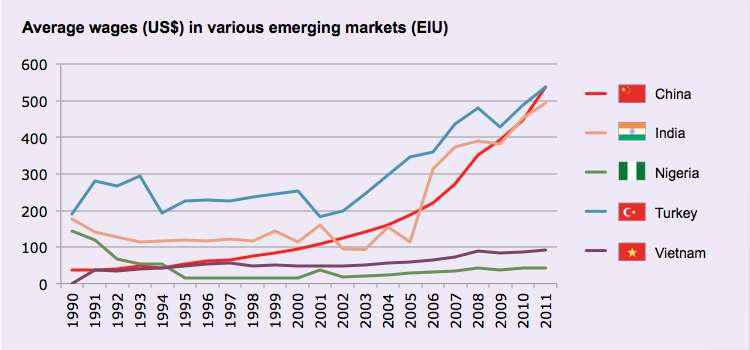
What do disgruntled Chinese bachelors and unemployed Indian call-center workers have to do with sub-Saharan Africa? At the moment, not much: A recent UN report shows that the continent at present accounts for a meager 1% of the world’s total manufacturing output. However, the same demographic and wage inflation trends that are currently raising questions about the long-term sustainability of Asian countries’ hard-won reputation for offering manufacturing firms a plentiful and cheap supply of labor do point to an opportunity for Africa — if a number of important constraints can be overcome.

Demographic trends are in Africa’s favor

The attractiveness of China as a low-cost manufacturing destination is dimming as its demographic profile changes. Due to the single child policy, the Chinese workforce will decline by around 100 million (from 72% of total population to 61%) between 2010 and 2050, with associated upward wage pressures. India is often characterized as entering a period of ‘demographic dividend,’ with a younger workforce capitalizing on a more expensive Chinese labor force.

Likewise, in Sub-Saharan Africa, the workforce will grow to 1.1 billion people by 2040. With its own demographic dividend paying off, Africa will become an increasingly attractive destination for manufacturing.

A long road with a lot of potholes

Despite the demographic and pricing trends in its favor, Africa has a long way to go if it is to become a global manufacturing destination of choice. The continent’s reputation for rampant corruption and almost permanent political instability may be a generalization — both trends are broadly improving across most of the continent — but infrastructure constraints (in particular the reliability of electricity and water) and skills shortages are both more ubiquitous, and arguably more intractable. Red tape impeding new investment, opaque tax laws, burdensome employment regulations and vexed labor relations present further obstacles in many markets.

The more enlightened African governments are aware of these impediments, and have made adding local value to the continent’s multiple natural resource exports a key priority from a foreign exchange generation and job creation perspective. Several are among the world’s most active business environment reformers; infrastructure improvement projects are proliferating around the continent. Skills enhancement and overcoming corruption are more systemic transformations that will take longer to achieve. Meanwhile, Africa is also seeking to capitalize on its competitive advantages of labor costs, availability and proximity to key markets by creating a wave of tax-efficient industrial development zones. Over 20 countries in the region offer such incentives, including Kenya, Nigeria, Ghana and Tanzania.

A sign of things to come?

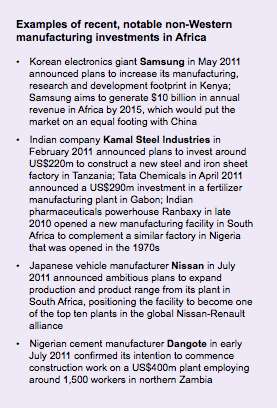
Perhaps the most telling long-term indicator of Africa’s future manufacturing potential is the growing trend of Asian and other emerging market-headquartered companies placing facilities into Africa. Emirati, Japanese, Chinese, Korean and Indian companies have all announced major manufacturing investment plans in various African countries in recent months. Western companies are currently waking up to Africa’s consumer potential, in many cases several debilitating steps behind their Eastern competitors. Frontiers Strategy Group advises them to track a parallel trend to manufacture as well as sell their goods locally.


Frontier Strategy Group launched its new AfricaVantage service, designed to give global companies the data tools, strategic insights and high-level networking opportunities they need to capitalize on the growing African opportunity. Look out for new posts on the region in the next few weeks.


Expect Costlier Penalties for Violating the FCPA

In March of this year, IBM agreed to pay US$10 million in penalties to settle charges brought by the United States Securities and Exchange Commission. In a separate case, Alcatel-Lucent is expected to settle with prosecutors and pay US$137 million in similar penalties by the end of the year. What transgressions led to these hefty penalties? Both firms were penalized for paying bribes in China and Costa Rica respectively, in violation of the Foreign Corrupt Practices Act (FCPA), a US law requiring accounting transparency and forbidding any bribing of foreign officials for US MNCs.

These high-profile cases underscore a new level of resolve in the US government to enforce FCPA compliance. For MNCs, this means that foreign operations will be subject to greater scrutiny by regulators and are at higher risk of being slapped with significant fines. For individual executives involved, this means an increased likelihood of personal prosecution.

Stricter regulation, high growth targets and the need for rapid decision-making in emerging markets put companies and executives at a much higher risk of violating the FCPA — even if violations are unintentional. Having an effective strategy for preventing, detecting and responding to breaches in compliance is increasingly important in order to avoid complications.

Among Frontier Strategy Group’s member executives in Latin America, 65% feel that remaining compliant with FCPA is more difficult now than it was just three years ago. Remaining compliant in Brazil alone requires twice as much time and resources than the regional average.

The three most common sources of FCPA compliance violations are:

  • Third-party and local partner violations
  • Locally-empowered manager violations
  • Political or campaign contributions

Protect your company from bribes with the following best practices:

  • Create and publicize clear, positive incentives for ethics compliance as well as serious sanctions for violations
  • Require regular reporting of compliance practices in each business unit


Central Banks Attack Economic Imbalances through the New Monetary Calculus

Malaysia surprised markets last week when it did not raise interest rates. Instead Malaysia’s central bank instituted increased reserve requirements in an effort to restrain the flow of credit and cool inflation in a hot economy.

This is the new monetary calculus in emerging markets. In a globalized world, most emerging market central banks do not have the firepower to maintain prices with monetary policy alone. Capital from slow-growth mature markets, mainly the US and Europe, is attracted to emerging market bonds because of strong growth prospects, increased stability and widening interest rate spreads. As emerging market central banks raise rates to cool their economies, more foreign capital pours in and exacerbates the currency and inflationary imbalances that the central banks are looking to control.

Malaysia’s move will not go far enough to normalize its economic imbalances, but it is an important and creative start. Companies can expect similar moves by central banks in other emerging markets. If the new calculus can turn into consistent policy, currency appreciation will slow to mirror the pace of rising standards of living rather than the more rapid and unpredictable pace of foreign capital flows. This will impact hedging strategies as corporate treasuries can more accurately anticipate currency volatility across their growing emerging markets portfolio. Inflation may also cool as bank lending becomes more stringent, increasing consumer wallet-share for discretionary goods while also relieving some pressure from rising labor costs.

Brazil employed similarly creative strategies around taxing portfolio inflows to slow currency appreciation, while also using more traditional rate hikes in a combined effort to curb inflation and currency appreciation.

The new monetary calculus is a key step for financial stability and continued economic growth in emerging markets. Markets employing these strategies are likely to outperform in an unbalanced economic environment characterized by slow growth in mature markets and rapid growth in emerging markets.