Scenario Planning for Emerging Markets

In my previous post on the topic of strategic planning, we took a closer look at the personal and professional risks that executives face through the strategic planning process. In this post, we will focus on another thorny question: Is my strategic planning process putting the business at risk of being blindsided by unforeseen external events and volatility?

The 2008 economic crisis demonstrated that today’s seemingly safe bets can take a sudden turn for the worse tomorrow. Today, the headlines are again dominated by dark clouds. Monetary crises, commodity bubbles, political instability, labor unrest, and even armed conflict dominate today’s headlines. Furthermore, many executives have learned the hard way that crises hundreds or thousands of miles away can have a very real impact in their markets.

Until crystal ball technology improves, you have no choice but to plan for the worst and hope for the best in the markets that you oversee. Executives at many companies are blindsided by macro shocks when they become overly focused on internal data and industry/competitor analysis. Your strategic plan needs to lay out the foreseeable scenarios, key signposts, and leading indicators to monitor, and develop contingency plans accordingly.

One of FSG’s clients in the beverage industry has tried to shake its management of myopia by requesting rigorous analysis of the external variables that could impact the company’s market. The findings of the resulting analytical exercise are used to develop a white paper that is presented to the business unit presidents every March, before the strategic plans for the following year are developed.

Such an exercise requires an investment of time and resources, but the benefits are twofold. First, the strategic plan will more accurately reflect the reality of the markets. Second, even if the scenarios developed in the white paper never unfold or if unforeseen events override contingency planning, the exercise forces managers to think more strategically, to get involved in the planning process, and thereby become personally and financially invested in the final plan.

In my next post, we’ll look at one more critical question every senior executive needs to be asking as they undertake strategic planning for 2012: Are mid- and lower-level managers placing enough priority on strategic planning, and am I doing enough to improve their planning capabilities?
Transferring Production Across Emerging Markets

(Source: Foxconn Website)

Foxconn is one of the most well-known emerging-markets based manufacturers. With labor prices increasing along with a string of suicides in it’s Chinese factories - the Taiwanese firm is looking to Latin America for new production capacity. The following is a cross-post from the China and Latin America blog which details Foxconn’s recent push into Brazil.

On August 6th, the Financial Times featured an article on Taiwan electronics firm, Foxconn (富士康科技集團), and its founder, Terry Gou. Foxconn controls close to half of the world’s outsourced technology products, including a number of Apple favorites (iPads, iPhones, etc).

According to the article, Mr. Gou recently announced a plan to place one million robots on Foxconn’s production lines. Automated production, he believes, will generate growth – the company made $80 billion in revenue last year, but is finding it hard to expand its market share.

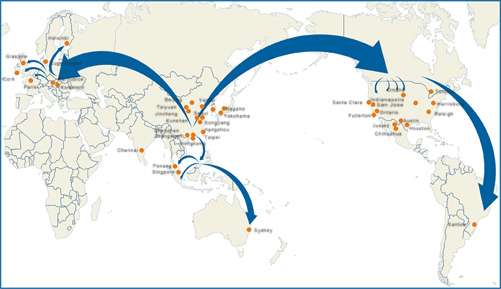
Before Terry Gou ever announced his fondness for robo-employees, Foxconn was already seeking greater efficiency and market access through global expansion. In addition to production facilities in “greater China” (where it employs nearly one million people), Foxconn also operates in Europe, Australia, the United States, and Latin America. The company’s relatively new Latin American ventures (currently limited to Brazil and Mexico) provide greater access to local markets and close proximity to North American consumers.

Foxconn is now contemplating an additional investment of $12 billion in Brazil, which was first announced by President Dilma Rousseff during her visit to mainland China in April of this year. The company already operates at a limited capacity in the South American country, but the proposed investment would significantly expand production capabilities. New investments would offer Foxconn direct access to Brazil’s market and a means of avoiding the country’s notoriously high tariffs.

If the deal goes through, it would be Foxconn’s largest global investment. But the company’s leadership has hesitated in recent months. Mr. Gou expressed concern about a culture in which “there’s all that dancing” and “as soon as they hear ‘soccer,’ they stop working.” Foxconn has asked the Brazilian government for certain labor and infrastructure guarantees and may eventually reduce the amount it is willing to invest.

Foxconn’s Mexico production is based near Ciudad Juarez. Its massive facility employs approximately 8,000 workers from nearby towns. The company’s presence was warmly welcomed by politicians in both Chihuahua and New Mexico, but faced controversy after a disgruntled worker set fire to the facility’s activities center.

Further expansion into Latin America – though certainly welcome – isn’t guaranteed. Foxconn’s founder seems to prefer Chinese manufacturing, even despite rising labor costs and the recent Shenzhen tragedy. Chinese laborers are thought to be very skilled, to tolerate more, and to work longer hours than many of their foreign counterparts. Mr. Gou believes that rising labor costs can be offset by a move to China’s cheaper inland provinces.

China’s remarkable distribution network is yet another advantage – shipments from China to the US are generally cheaper even than shipments from Brazil.

But as Foxconn and other firms look to expand market share, Latin America’s emerging markets are bound to receive more attention. Although fresh foreign investment in the country’s stock market has slowed (especially in the investor exodus this week), foreign direct investment in Brazil has increased steadily over the past year. As one of the fastest growing BRICS countries, its consumer market is attractive to investors. The country’s Mercosur affiliation also allows for tax-free export of certain goods to other member countries.

Mexico, for its part, boasts proximity to the US and a skilled labor force. Its manufacturing sector grew thirty percent in the first three months of this year and its share of US imports is also on the rise.

As for Mr. Gou’s cultural bias: if he ultimately decides to replace many of Foxconn’s workers with robots, futebol (fútbol) fanaticism and a proclivity for dancing should no longer be of tremendous concern.

The original post is titled: “Mr. Gou Goes to Latin America” and can be found here

Growth in Emerging Markets Takes Efficient Distribution Management

Luxury jewelry retailer Tiffany & Co. recently released its second quarterly results, notching a better than expected 33% boost in profits, driven by demand in international markets. In terms of growth, Tiffany cited a 46% increase in sales to distributors in emerging markets.

FSG has found that one of the keys to success for high growth companies in emerging markets is taking a “tough love” approach with their distributors.

In terms of “love,” our benchmarking research has found that high growth companies are selling more than 50% of both revenues and volumes through distributors, compared to less than 38% and 36% respectively at average growth companies. High growth companies are also investing significantly more resources in managing their distribution relationships. Measured in terms of full-time equivalents (FTEs), high growth companies are dedicating about five times more resource than low growth companies. We have also found that senior executives at high growth companies are investing substantially more time personally working with distributors than their peers at low growth companies.

In terms of “tough,” high growth companies are much more likely to terminate relationships with distributors. We found that the average tenure for distributors for high growth companies is about 7 years, compared to over 10 years at average growth companies. When we asked companies what percentage of their relationships they have terminated in just the past 2 years, high growth companies told us that on average they had ended 17% of their partnerships, compared with 7% at average growth companies.

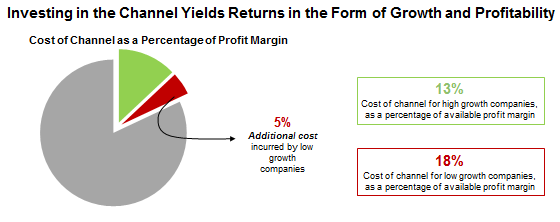
Although it may seem counterintuitive, it turns out that despite the significant extra investments that high growth companies are making as part of this tough love approach, their channels are much more profitable than those of low growth companies. Simply put, growing the size of the profit pie means that the distributors’ appetite can be satisfied with a smaller piece.


MENA Insulated from Global Economic Shocks for Now

httpv://youtu.be/xtHIP7y3HXsv=tp3I0c-uZ-M

Because of close trade ties, US foreign aid to the region, and American thirst for oil, S&P’s downgrade to the US credit rating a few weeks ago is surely a harbinger of doom for economies in the Middle East and North Africa, right? Not exactly.

After the S&P downgrade, stock markets fell across the MENA. Investors are understandably concerned about increased risk. However, FSG does not expect this to shift the regional risk profile significantly. The region should be less susceptible to economic shocks in the short term as many economies have already taken a beating due to revolutions, transitions, and ongoing political uncertainty associated with the Arab Awakening. One potential impact would be an uptick in inflation growth in the Gulf. This is because five of six GCC currencies are pegged to the US Dollar. If the US Federal Reserve decides to begin a third round of quantitative easing, then it would place upward pressure on the price of importing goods in the region.

What unfolds in Europe and Asia for the rest of the year is likely to have a more profound impact on the investment outlook for the Middle East and North Africa going into 2012. A deepening Euro zone crisis threatens countries with close trade ties to the EU. Morocco and potentially Egypt could see their currencies weakened, while Turkey could be squeezed by a slowdown in exports and foreign investment.

Hydrocarbon economies like Kuwait, Qatar, Saudi Arabia, and the UAE are fairly insulated because their respective budgets factor in oil prices averaging a range from $55 (Qatar) to $85 (Saudi Arabia) per barrel on the year. Oil has already averaged well over $100 per barrel and we are approaching the last quarter of 2011. Gulf oil exporters can draw on excess crude revenue to sustain aggressive public spending and economic diversification programs in 2012. Still, a European recession combined with a trade slowdown in Asia would represent a serious blow to oil demand and impact prices as a result. This could lead to a delay in public sector projects and place an increasing burden on the private sector to create more jobs locally.

Overall, FSG does not expect global instability to impact the Middle East and North Africa in the short term. However, a deepening euro zone crisis combined with a slowdown to Asian demand could prove to be a toxic cocktail for the region in the medium term. The silver lining in this type of double-whammy scenario would be reduced global demand for commodities and lower food and fuel prices in the region. This would be particularly important for countries impacted by the Arab Awakening as they look to rebuild their economies.

Surfing the African technology wave

(Evidence of growing technology adoption, such as this mobile telephone sales booth in Swaziland, are increasingly ubiquitous in Africa)

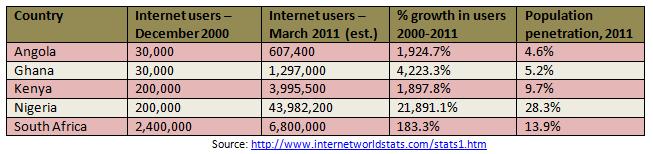
The adoption of new forms of communication in Africa over the past decade – both mobile telephone and internet – has been nothing short of revolutionary. The continent is estimated to have produced over 316 million new mobile phone users since 2000, passing 500 million total subscriptions late in 2010, and its total internet user population is now estimated at almost 120 million. Previously, communicating over long distances was fraught with difficulty and expense; that outlook has been transformed. The significance of these trends for African economic development, transparency and democratization is profound; the opportunity for technology companies and indeed for businesses across many other sectors capable of leveraging such channels for advertising and delivery is no less significant.

An unmitigated success story

The growth and profitability of mobile telephone networks in Africa is by now a widely related success story. In addition to the staggering uptake figures recorded (and company results posted), what is equally exciting is the innovation and knock-on benefits this trend has generated throughout the continent. These include access to innovative financial services products for mobile users (trailblazed by the much-studied M-Pesa scheme in Kenya), better agricultural product pricing information for farmers, and Celtel/Zain’s unprecedented low-cost international roaming capabilities within sixteen countries that are the envy of both travelling Europeans and companies importing goods physically across borders in Africa alike. New high-speed underwater fiber-optic cables encircling the continent’s coastline are meanwhile dramatically improving access speeds. Mobile broadband internet subscriptions in African countries are expected to reach a cumulative 265m by 2015.

The attraction of capturing the African digital market and exploiting its potential for new service offerings is bringing bigger and bigger names to the table. Earlier this month, Google announced it would be training 1,000 Kenyans to act as ambassadors for its products. Its move follows those of Asian companies LG Electronics and Huawei, both of which have already established local academies to train product experts and source locally-relevant innovations and adaptations to their product portfolio in the region. Korean electronics giant Samsung has announced a particularly ambitious growth strategy for the continent, aiming to generate $10 billion in annual revenue in Africa by 2015 (a fivefold increase on current sales which would put the market on an equal footing with China). Samsung reported 31% growth in revenue to US$1.23bn for its Africa operations in 2010.

New trends, new opportunities

Recent results announced by Chinese handset manufacturer Huawei on tremendous sales of its affordable IDEOS U8150 Android smart-phone in Kenya highlight the appetite and with it the opportunity for selling technology products in Africa despite comparatively low income levels. Figures revealed in June by mobile internet browser development firm Opera meanwhile showed Nigeria as the world’s fourth most active user market, followed by South Africa in seventh place. Belying its terribly outdated labeling as the ‘dark continent’, the hunger for connectivity, and openness to new technologies and service models, are clearly as strong - if not stronger - in Africa than anywhere else in the world.

Reflecting this rapid adoption of technology, e-commerce is an increasingly influential segment of African customer retail, enabling exponential increase in product access and equally dramatic reductions in the continent’s often forbidding costs of sale at through more traditional retail outlets. Recent media coverage highlights its rapid growth in South Africa, often a weathervane for the rest of the continent: the country’s population spent more than R2bn (US$275m) online in 2010 excluding air travel and accommodation outlays. This entailed a 40% increase on 2009’s figure, with 2011 expected to see a further 30% increase. The traditional perception that African consumers abide by the “I buy what I see” principle appears to be shifting, and forward-thinking businesses will seek to move ahead of that curve in their local online offerings.

In a similar vein e-learning and e-health solutions could also offer significant acceleration capacity to combating some of the continent’s serious social service provision deficiencies. Cloud computing, virtualization and hosted services are all constitute growth segments for further expansion. As the past decade has shown, in this respect the African sky really is the only limit.

Interested in learning how your company can leverage new technology channels to sell to and grow in Africa? Contact africa@frontierstrategygroup.com to learn how we can help


Latin America Insulated from Global Shocks

httpv://youtu.be/Bh9eCg8RUfov=tp3I0c-uZ-M

Interview: Arezki Daoud on challenges faced by a post-Gaddafi Libya

To gain a better understanding of the impact of recent events in Libya, I spoke with Arezki Daoud who is editor of The North Africa Journal.

In a post-Gaddafi Libya, what issues will the government need to focus on through next year for a successful transition?

This weekend’s events were predicted. We forecasted a protracted conflict, one that would end with the slow extinguishing of the regime in the manner that we have been witnessing. In essence, despite the bloody outcome, the terrible loss of life and wholesale destruction of the country, what’s coming could potentially be a more difficult period for the Libyans. Their fight against Gaddafi was a unifying factor. Now that that factor is gone, differences are likely to emerge on a host of issues, starting with drafting a constitution, establishing institutions, empowering political leaders to take proper action within a new framework of a proper rule of law, etc. But more importantly, the challenge for the Libyans would be to avoid falling into the trap of tribalism. In this conflict, many won, a few have lost and those who have lost could pay dearly if the spirit of revenge takes over.

In addition, we are assuming in the short term that rogue elements will operate under the radar to undermine any progress on the political front. They will work hard to pit tribes against other tribes. The use of shadowy agents is common practice in the Arab world. We have seen it in Tunisia, Egypt, Syria, etc and we believe Muammar Gaddafi has developed some of the strongest underground destabilization networks in the Arab world.

So in terms of what to do, it is critical that security be under the control of a single authority and that a process starts quickly to establish a constitution.

Do you expect the transition timeframe to last longer than in Egypt or Tunisia due to Libya’s lack of government institutions?

The likely scenario is one that looks at a much longer transition period for all the reasons mentioned above. But in a virgin territory where there has been no supreme law, there is also a slim likelihood of a faster political transition. We should assume that political stabilization could take more than one year.

What does this mean for regional stability? Do you think this will lead to a significant decrease in global oil prices?

The market may respond positively purely on the news of the end of Gaddafi, but the impact of Libyan oil in the world’s supply system will be limited given the economic crises affecting consuming markets. Even without Libya, oil prices have been dropping with the weakening global economy, therefore we expect the end of this crisis will have limited impact on the oil sector.

What types of challenges do you see for foreign businesses in a post-Gaddafi Libya?

Corporate executives hate uncertainty and so the lack of clarity around the existence of central authority could be a major inhibitor to foreign investments at this stage. Executives we talk to often say they will take a wait-and-see approach and will move into the country as soon as a strong authority is in place, which would create the right conditions for operating in the country. Libya has many experts that could help shape up future business legislation, but this is too premature to speak of such business environment as the political environment remains volatile.

What types of opportunities do you see for foreign businesses in a post-Gaddafi Libya?

Business opportunities are likely to arise within 6 months after the official end of the hostilities. Given the Western support to the insurgents, Western companies are likely to be the first to take advantage of the reconstruction, modernization that the country will undergo. This would positively impact the obvious sectors, namely infrastructure, oil and gas but also services as tens of thousands of foreign workers left the country and now a foreign workforce will be required to bring services back. Other industries, from consumer goods to pharmaceuticals will have to wait yet the country will likely resort to import, providing opportunities as well.

Transition in Libya - What MNCs Need to Know

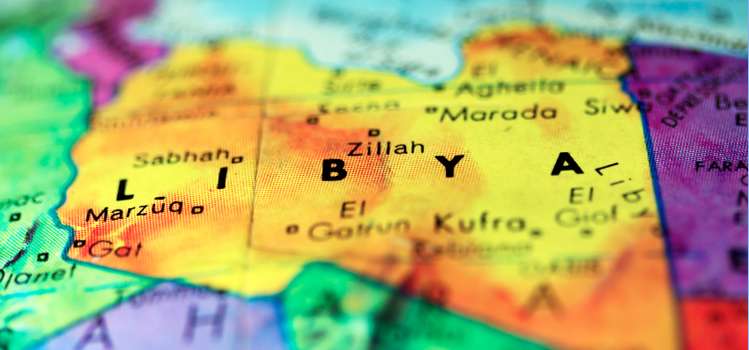
Muammar Gaddafi’s 42-year grip on power is slipping away as rebel forces fight to gain control of Libya’s capital Tripoli. This bloody conflict has taken a heavy toll on Libya’s economy and its people, but more challenges lie ahead as the country will soon focus on rebuilding and a political transition.

While it is too early for most foreign companies to return to Libya, firms should start to assess major players in the National Transitional Council (NTC) for a future government relations strategy. A transitional leadership already exists and new political players will emerge as prospective candidates start to jockey for position ahead of elections that will take place within the next year.

The NTC is speaking in a conciliatory tone regarding how former regime associates will be treated during the transition. This is not surprising considering the number of officials that have defected in recent months. However, foreign MNCs should still evaluate local partner ties to the past regime, especially if there are tribal connections to Gaddafi. As we are seeing in Egypt, Tunisia, and around the region, companies can experience a significant slowdown in business if the government targets their local partners for corruption investigations. There are serious reputational issues to consider as well.

Because many government institutions will need to be built from scratch, companies should keep a close eye on efforts to write a new constitution. This will likely mean significant changes to a post-Gaddafi business environment, which could lead to much greater transparency in the long term.

The hydrocarbon sector is still critical to Libya’s development, but there is already talk that it will take 18 to 24 months to return oil production to pre-February 2011 levels. Libya will continue plans to diversify its economy away from hydrocarbons and there will be a need to (re)build infrastructure- both physical and institutional- which will provide long-term opportunities to B2B companies in the construction, IT, cement, and transportation sectors.

GDP per capita is among the highest in Africa due to Libya’s oil and gas resources and a small population though little of this money has flowed to the majority of the population in the past. If the government implements new policies to address this critical flaw, then it could lead to a plethora of new opportunities for B2C companies.

Debt Crisis in Europe Could Lead to 50% Chance of Recession

httpv://youtu.be/5BAN_h26GFEv=tp3I0c-uZ-M</a>

Industry Reform in China

The following is a cross post from the Silicon Hutong blog. The blog is written by Frontier Strategy Group Beijing-based expert adviser David Wolf.

In a characteristically articulate editorial last week, Caixin called for an extensive overhaul of China’s Ministry of Railways (MoR) in the wake of the high-speed train crash in Wenzhou on July 23rd. The publication called for an open investigation into the accident conducted by experts from outside the control or influence of the MoR, for the functions of railway development, construction, operation, and regulation to be divided among independent entities, and for the folding of the resulting regulator into a larger ministry with a purview over the wider transport sector.

These changes are not without precedent in China. Aviation went through a similar change in the early 1990s, the telecommunications sector was similarly reformed five years later, and the energy sector has gone through a series of reforms that have separated the regulatory function from the business of generating and distributing energy. There are so many examples of where this has happened, in fact, that not only is the MoR something of a relic of China’s pre-reforming-and-opening past, it is also a matter of suggestive speculation as to why the MoR was left alone for so long.

So this sort of reform is overdue, and it looks like the higher organs of the Chinese government will try to unravel the hairball of conflicts-of-interest and mismanagement that serve as China’s railway industry.

Quis Custodiet Ipsos Custodes?

Unfortunately, even the measures suggested in Ciaxin’s excellent piece will not be enough. The world is replete with examples of industry-specific regulators who have become intertwined with – and co-opted by – the very industries they were created to regulate. One need look no further than the U.S. financial industry and its relationship with the Federal Reserve, the Department of the Treasury, and the Securities and Exchange commission to find proof, and there are ample additional examples.

The lesson of history is that regulators are most effective when they themselves are watched from the outside. While Caixin’s editors would be too modest (or timid) to say so, it is Caixin and all of the others who are watching the regulators from the outside who provide the best guarantee of a better and safer railway system for China.