Despite Strong Growth, Significant Risk Threatens Asia

Most Asian countries have maintained strong economic growth in recent months despite the turmoil in global markets; however, significant downside risks threaten the region’s continued performance. In Thailand, floods threaten to undermine the country’s growth and disrupt regional supply chains. In China, a spate of defaults in the informal banking market is casting a shadow over the country’s prospects

  • Bangladesh: Bangladesh’s deal with India will likely lead to long-term growth of bilateral trade and improvement of domestic infrastructure
  • Cambodia: As Cambodia becomes increasingly integrated into the regional and global economies, it will start drawing significant attention from investors
  • China: Multinationals should watch for news of further SME defaults as they could put a drag on Chinese growth
  • India: India’s Right to Information Act is beginning to create serious problems for corrupt politicians and businessmen
  • Indonesia: Indonesia’s policymakers have shifted their attention from inflation to growth, confident that they have price pressures under control
  • Japan: The economy’s slow path to recovery will further decelerate due to the global economic slowdown, rising Yen, and continuing energy issues
  • Malaysia: Malaysia has drawn significant FDI so far this year, suggesting that the country remains an attractive destination for manufacturing
  • Pakistan: Recent interest rate cuts, which were aimed at promoting growth, are likely to spur already high inflation
  • Philippines: A recently announced fiscal stimulus package may create opportunities for multinationals operating in the Philippines
  • South Korea: New anti-graft reform measures should help to improve South Korea’s corruption landscape over the medium term
  • Taiwan: Taiwan’s business environment will continue to improve as the island’s leaders work proactively to attract investment
  • Thailand: The recent floods will impact global supply chains for agricultural goods, automobiles, and consumer electronics until at least Q1 2012
  • Vietnam: Pledged foreign direct investment is dropping as growing domestic risks give companies reason to pause

To Differentiate Your Corporate Culture, First You Must Define It

Bristol-Myers Squibb (NYSE: BMY) recently announced changes to its top management team, including key changes to its emerging markets leadership. The company was able to promote from within because, as CEO Lamberto Andreotti remarked, “a focus on developing talent at all levels is a key element of our Bristol-Myers Squibb culture.”

Many executives, when pressed to explain what differentiates their corporate culture from that of their competitors will say something along the lines of, “our company is like a family” or, “employees are attracted to our values.” At established offices in developed markets, where hundreds of long-time employees live and breathe the corporate culture, this ambiguous but definition may be sufficient.

In emerging markets, however, companies do not have this luxury. Very few employees in a local office will ever make the trip to headquarters to absorb and live that culture first-hand. Furthermore, as companies rapidly expand their local headcount, the ratio of “indoctrinated” employees to “un-indoctrinated” employees will become even more skewed. Some locations may get lucky, organically developing their own unique corporate culture in the local office that successfully engages talent and differentiates the work environment, but relying on luck is never a best practice.

The companies that have been most successful in attracting and retaining top talent have put in place formal processes for defining, differentiating, and instilling their corporate culture in their furthest-flung emerging market locations. One case study that Frontier Strategy Group recently developed highlights the three-part strategy implemented by a prominent beverages company. To briefly summarize, the company:

  1. Conducted an internal assessment using an employee survey, focus groups, and one-on-one interviews to understand more specifically the key levers of employee engagement: Individual (how employees find personal meaning in their work), Team (understanding the optimal degree of non-work related interactions necessary to ensure open and honest communication), and Community (how to engage employees in issues that truly matter to them, their families, and their communities)
  2. Evaluated and re-defined their incentive structure through three unique lenses: monetary, professional growth, and personal engagement
  3. Provided front-line managers with tools, training, and incentives to align the day-to-day work environment to the defined vision

The process used to instill the corporate culture should reflect the company’s ethos and mission. The example above heavily reflects the profiled company’s roots as a marketing and consumer-oriented company; the strategy is designed to make current and former employees brand ambassadors. Another company FSG recently featured in a case study, a technology services provider, took a much more quantitative approach to defining and measuring a differentiated corporate culture. This approach was designed to reflect its very scientific and technical corporate mission, but the goal of defining and reinforcing a more concrete corporate culture to attract and retain talent remains the same.

The next post in this series will focus on the role of senior management in reducing attrition of top talent in emerging markets.

Outlook for North Africa Post Gaddafi

The death of former Libyan ruler Muammar Gaddafi marks the symbolic beginning of a new era in North Africa and transitioning states are keen to attract foreign investment. Companies should avoid being paralyzed by uncertainty, and must begin planning to re-engage and expand in the region to capture medium to long-term opportunities.

Investment opportunities exist across sectors though key considerations differ by country

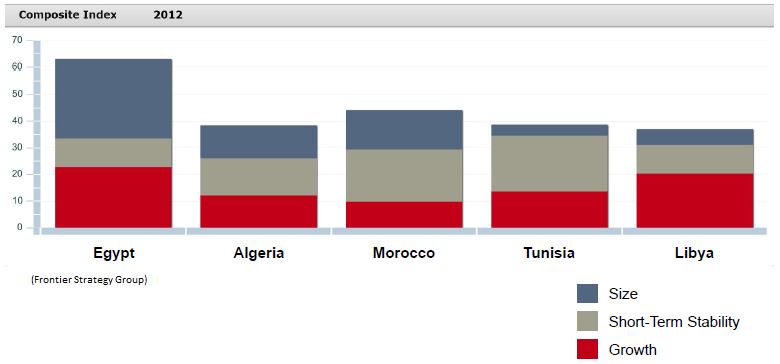
  • Consumer Goods: Egypt’s market size and strong sector growth, especially in cities, make it an attractive investment, while relative stability in Morocco and Tunisia will support a healthier outlook (see MarketView screenshot above)
  • Industrials: Ongoing public and private investment in oil and gas will support Algeria’s desirability as an investment destination in related sectors. Rebuilding opportunities and an effort to bring oil production back online will mean strong growth in Libya
  • Technology/Telecommunications: Size and growth underpin the outlook in Egypt, where plans could be revisited to become an outsourcing hub, while ICT services make Algeria’s B2B market an attractive investment target
  • Healthcare: Tunisia’s market does not offer robust size or growth, but it is a safe bet due to previous investment in the healthcare sector. Conversely, Libya’s healthcare infrastructure suffers from years of neglect, but the country is a wildcard for future growth due to high GDP per capita among a small population

Venezuela: A Tale of Potential and Peril

Venezuela presents a major challenge for MNCs who recognize the country’s market potential and high profit margins, but are troubled by the risks associated with any significant presence in the country. The upcoming elections in 2012 and recent concerns over Chavez’s health has renewed speculation over medium-term political and economic scenarios for Venezuela.

Advantages of Venezuela

Attractive demographics offer long-term prospects

  • 90% of Venezuelans live in cities and half of Venezuela’s 30 million people are under 25
  • GDP per capita is fifth highest in the region

Oil profits allow government to encourage domestic demand

  • Government maintains lending rate below inflation to encourage consumption

Business tax system is competitive with the region

  • Corporate and ordinary income tax rats are 34%
  • Attractive incentives such as non-taxable dividends for distribution of earnings and profit

Major Challenges

The operating environment is opaque and unpredictable

  • Little separation between executive, legislative, and judicial branches
  • Currency devaluation and expropriation are constant risks

Consumers behave differently than those in free market economies

  • Consumer spending is volatile as it is dictated by government spending policies
  • Price controls, inflation, and shortages alter consumer purchasing habits

Major structural challenges hinder growth prospects

  • Drought has led to shortages and rationing of electricity
  • Crime remains rampant, and a source of disillusionment with the Chavez regime
  • Oil production is rapidly declining

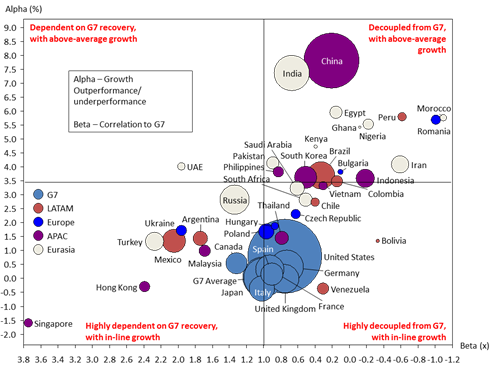
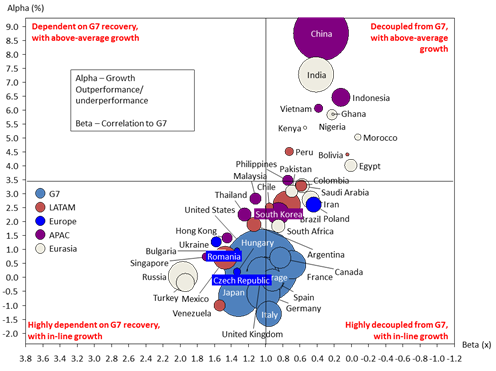
Emerging markets – decoupled from the crisis?

Frontier Strategy Group built a proprietary model in 2008 to test the assumption that “emerging markets are decoupled from western economies (G7)”. We found that certain markets such as Nigeria and Peru were not only decoupled but provided multinationals with consistently high growth opportunities. Conversely, growth in markets such as Turkey, were highly dependent on a recovery in western economies.

Surprisingly, in 2011, our model shifted to indicate that emerging markets are no longer thought to be as decoupled as before. Very few markets such as Morocco and Indonesia provide above average growth opportunities with less dependence on the status of western markets.

In 2008 we built a model to understand the global impact of a recession:

2011 data shows markets are more coupled than before

5 Risks to India’s Growth in Q4 2011

While the impact of Western volatility on Asian markets is cause for concern, this is just one force buffeting the Indian economy. Other risks to watch in Q4 and first half of 2012 are currency volatility, inflation, policy paralysis and farm output:

1) Western Recession

  • While India’s exports have withstood the global gloom so far, prolonged insecurity in Western markets could have a large impact on exports

2) Currency Volatility

  • The weak rupee may provide a short-term boost to exporters, but uncertainty around currency volatility will negate the benefits

3) Inflation

  • Inflation remains a consistent threat to business input costs, wage levels, and household consumption, as FSG observed in Q3

4) Policy Paralysis

  • This summer’s scandals halted business as usual in Parliament, and may continue to stall crucial policymaking on social and business issues

5) Poor Farm Output

  • Agriculture accounts for 17% of GDP and employs over 50% of the populace. A weak monsoon will hurt rural markets and heighten inflation

Scenario Planning: Preparing Your Nigeria Operation for a Downturn

With 155 million people and projections of 7.4% GDP growth in 2011, Nigeria is already a “can’t miss” consumer market opportunity. That said, in the next several years there will be multiple bumps on the road as Nigeria transitions from a corrupt, ethnically divided, oil driven economy, to a modern, diversified powerhouse.

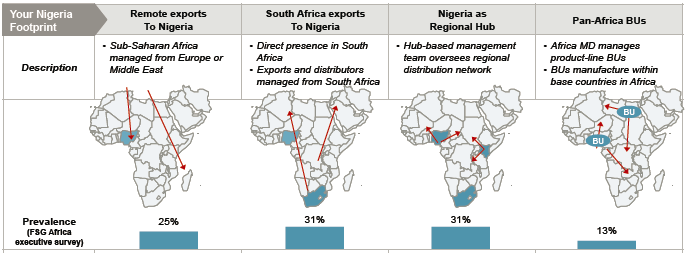
In 2012 in particular FSG believes there is a 50% likelihood of a double dip recession. The following outlines what the potential impact of a recession could have based on your current Nigeria footprint:

Remote Exports to Nigeria

  • Volumes could decline as currency weakens
  • Distributors may be crunched for credit
  • Lower logistics, fuel costs as oil prices moderate
  • Greater flexibiliy to increase/reduce export volumes
  • Indicators to watch: Exchange rates, Oil prices, Credit growth

South Africa Exports to Nigeria

  • Volumes could decline as currency weakens agains rand
  • Distributors may be crunched or credit as oil prices moderate
  • Greater flexibility to increase/reduce export volumes
  • Indicators to watch: Exchange rates, Oil prices, Credit growth

Nigeria as a Regional Hub

  • Distributors may be crunched for credit
  • Lower logistics, fule costs as oil prices moderate
  • More protection from volatile exchange rates when assessing domestic market
  • Greater responsiveness to market dmeand
  • Indicators to watch: Domestic food prices, Oil prices, Exchange rates

Pan-Africa Business Units

  • Distributors may be crunched for credit
  • Lower logistics, fuel costs as oil prices moderate
  • More protection from volatile exchange rates when manufacturing in domestic market
  • Greater responsiveness to market demand
  • Indicators to watch: Pan-Africa GDP, Exchange rates, Oil prices

Starbucks, Don’t Rely On Partners To Do Business In India

Starbucks announced last Monday that it will bring its low-fat soy lattes to one of the world’s most dynamic, fast-growing markets: India. While its focus might be on the rapid growth of the middle class, or the competitive threat from local players Barista and Café Coffee Day, Starbucks should be worried most about their partnership with Tata Coffee. They don’t want to join the long line of failed joint ventures that came before them:

Virgin and Tata Teleservices. Danone and the Wadia Group. Walt Disney and the Modi Group. General Electric and Godrej. Renault and Mahindra & Mahindra.

To succeed in India, Western executives must build their own capabilities to prioritize opportunities and localize their strategy – instead of relying solely on joint venture partners. But prioritizing and localizing is particularly difficult in India, where much of the business potential lies in diverse, hard-to-penetrate markets beyond the metros. Few executives have the information or experience to meet these challenges.

Frontier Strategy Group is pleased to introduce our India Growth Package - two new tools designed to support executives in prioritizing opportunities and localizing their strategy:

  • India MarketView: An online, executive tool that provides an in-depth view of India’s 35 states and union territories, and an independent, 3rd party assessment of growth opportunities
  • India Growth Forums: Ongoing expert teleconference series to support execution in the marketplace

Click here to inquire about FSG’s India Growth Package

Can you read Chinese? Read FSG in Fortune China

If you are a Chinese reader focused on growth in emerging markets, Frontier Strategy Group‘s column “Overseas Strategy” in Fortune China is an excellent source for the latest best practices companies are implementing to fuel their growth. Overseas Strategy is a bi-weekly column in Fortune China and can be found by clicking on this link.

Evaluating your partners in Russia

The criteria MNCs use to evaluate their distributors are designed to maximize the speed and breadth of initial market penetration, but over the long term incentive distributors to seek short-term gain rather than support their foreign partner in establishing a strong market presence.

Implications for MNCs:

  • As a result of this evaluation process, most MNCs have developed distributor relationships that are optimal in the early stages of market entry, but over time become less useful
  • However, many companies fail to upgrade and restructure these relationship to position themselves for long-term growth.